Outside my window, across the street, next to the fence of Prospect Park, is a ginko tree. It shades the bench where Melody and I sometimes sit.
Last Wednesday, it still had all its leaves, though most of them had turned. We went to Connecticut for Thanksgiving. When we got back on Friday all its leaves were down. Suddenly, like that.
And there was a beautiful carpet of yellow gold, with touches of green, around our bench. The sidewalk was covered, and the carpet was clean and fresh. In a day or two its lustre would be gone.
The ailanthus is on our side of the street, right against our building. It seems to have dropped its leaves just as suddenly. But they were scattered, and on the street. And it dropped its stems as well, the long leaf stems on which its leaflets grow, and they now litter the corner like straw.
I do not love thee, ailanthus, as I love the ginko. You have come here from China too, but you are lower class, and you have no lovely bark, and your branches break, and people call you messy.
How they can call you "Tree of Heaven" I don't know, unless it is the love of God in Heaven that loves you, and loves you no less than the ginko. But I am not God. My heart is so much smaller with less room for love.
Yet I have accepted you, finally, next to my window. At first I was consumed with wishing you were a maple or an oak, but you are what you are, and I submit to God's love of you.
But ginko, thank you for the carpet that showed us what Eden was like in its first autumn.
Wednesday, November 28, 2007


Tuesday, November 27, 2007
Sermon for November 25: Christendom and Theocracy
Christ King 2007, Jeremiah 23:1-6, Benedictus, Colossians 1:11-20, Luke 23-33-43
The Feast of Christ the King is a very late addition to the church’s calendar. In 1925, Pope Pius XI invented the Feast and required Roman Catholics to observe it. That’s how it got into the ecumenical calendar. It’s only for ecumenical reasons that we Reformed Christians observe it now.
We would say, "Why not Christ the Prophet, and why not Christ the Priest?" We prefer the title, "Christ the Lord." We would say we already have a celebration of his kingship on Ascension Day, when he took his seat on the right hand of his Father, and also, for that matter, on Good Friday, when he was enthroned upon the cross and his title was posted above his head for all to see.
The reason the pope invented this feast day was to defend the Kingship of Christ against the secularism of politicians and intellectuals. Not to mention that the Roman Catholic Church was losing power, prestige, and privilege.
Just ten years later, in 1935, Josef Stalin made his famous remark about the pope. The French Foreign Minister had suggested to Stalin that if he would encourage more Roman Catholics in Russia, then the pope would be on better terms with him. Stalin replied, "The Pope? How many divisions has he got?"
All the Christian churches use to have a lot more power in the world, including politics and economics. Now that we have so much less, does that imply that Jesus has less power too?
When I became a citizen of Canada, I had to swear allegiance to Queen Elizabeth the Second. Ironically, it’s only because she is a powerless figure-head that modern Canadians are willing to swear that. The Queen of the Netherlands actually has more influence behind the scenes, but only as long as she behaves. Is this what we have done with Jesus Christ, that we have preserved his lovely royalty but emptied it of real authority and sovereignty? Pope Benedict seems to think so.
In 1925 Pope Pius was trying to preserve the old order of Europe—historic Christendom. There are many Christians in America today who are trying to preserve America as a Christian nation. The best of their reasons is their belief that the kingship of Christ demands it.
There is no doubt that the separation of church and state has gone along with the privatization of religion and the narrowing of the kingdom of God to merely personal issues. Since religion can have no place in the public arena, you have to keep it as your own private choice. But that’s like keeping a tiger in your back yard.
Theocracy means that all of worldly power and authority derives from God. Political sovereignty derives from God, not from the people. Judaism, Christianity, and Islam are theocratic religions at their base. These three religions speak to all of life. The Laws of Moses structure a whole society. So does the Koran. The theocracy of Judaism is restricted to the land of Israel. But the theocracy of Islam is meant for all the world. Even a modern Muslim nation is expected to enforce it, whether it does that softly or strictly.
We cannot get around the theocratic element in Christianity. But how are to understand it? Should we be concerned for Christendom? Are we required to protect our Christian civilization? Is America a Christian country? Should we try to bring our Christian values into public policies and politics? Isn’t to leave it a private and individual matter to surrender the kingdom of God?
But the theocratic element in Christianity has been altered by Jesus Christ himself. The gospel version of theocracy we might better call Christocracy. There is a movement in the Bible. The Kingdom of God has been transferred into the Kingdom of Christ, the sovereignty of God is now focused in the sovereignty of Christ. And because he is the Christ who is crucified, his sovereignty is unlike any other in the world.
You can see it best revealed upon the cross. His cross is a judgement on the whole idea of kingship, but also the expression of how he does it.
Yes, his crucifixion is a travesty of justice, and in his accepting it he’s making a comment about the way that human beings do sovereignty in general. At the same time, because the cross is his throne, he’s showing us the radical difference of his kingdom. His glory is his humility. His policy is grace and reconciliation, his army is his very enemies, his weapons are the wounds of love upon his hands and feet. He does not defend his kingdom, so neither should we. He does not ask us to fight for his kingdom but simply to receive it by accepting his reconciliation.
I confess to you that I have sometimes been attracted by the arguments of those thinkers like Pope Benedict who believe it’s important for us to preserve the benefits of Christendom. I confess to you that sometimes I think I preach a slovenly form of Christianity, accommodating, easy-going, giving in too much, without standards and insufficiently rigorous. I don’t know, do you wonder this yourself? Are we selling short the sovereignty of Christ?
But then I remind myself of his sovereignty upon the cross in all its humility and lavish generosity. If you keep on bringing your enemies into your kingdom, then your kingdom needs no defense.
* * * *
Historically, kings were always judges, the supreme judges of the land. That is true of Christ, it is through judgement that Jesus exercises his kingship, not through conquest or through controlling things behind the scenes, but through judgement. And his verdicts are all set out ahead of time, his judgement is very public, it is easily available in the gospel, in what he said and what he did.
He judges all the powers and pretensions of the world. He judged the rulers of Jerusalem, both Jewish and Roman, especially by his death. He exposed the cruelty of Rome and the venality of Roman law. He exposed the corruption of the leaders of Judea and how shallow was their piety. Just by standing there before them hee exposed the fear that motivated all of them.
His judgements still continue in the world. By this very gospel he judges every nation of the world. He judges our exercise of power and our use of violence. His cross is the standard against which is measured all of our empires and achievements, and they all fall short.
But his judgement is to justify. He exposes us to reconcile us. He unmasks our pretensions in order to clothe us in his love. He condemns us with himself in order to take us with him walking in his royal garden, his paradise.
The Roman inscription posted on the cross above his head said, This is the King of the Judeans. It was a cruel joke, not to mention being anti-Semitic. The thief hanging next him did not get the joke. Unaccountably he believed it, that this loser of a Messiah would someday have a kingdom. "Jesus, remember me when you come into your kingdom."
Jesus answered that his kingdom was already there. Not completely, not yet fully, but truly there. Wherever there is reconciliation in the name of Jesus, there is the kingdom of God. We do not have to fight for it, we have only to receive it. The forgiveness of sins and of debts and of trespasses is much more important for the world and its politics than anyone seems to recognize. And that forgiveness and reconciliation is our version of Christendom and of theocracy.
A last word. The Dutch queen is not crowned, but installed, and she takes an oath of loyalty to the constitution. Dutch citizens do not swear allegiance to the Queen, but to the constitution. From 1890 till 1948 the Queen of the Netherlands was Wilhelmina, a remarkable woman of courage and intelligence who puts the modern monarchies to shame.
My grandfather loved her. Even after he immigrated in 1914. Even though he was a socialist. He might have been the only Calvinistic Socialist in New Jersey. Even after he became an America citizen he still regarded Wilhelmina as his Queen.
I believe that even as the world is changing with the positive benefits of secularization, there remains within the human heart a place for just that kind of loyalty and love, and we want to extend it to a Lord of whom the earthly kings and queens are but pale images.
So our concern is not defending the kingdom of Christ but loving its king, not its boundaries but its center, and being loyal to the power of his love, even to loving his enemies. This loyalty trumps all other loyalties, and this love generates so much other love. I want to say, "My Lord."
Copyright © 2007 by Daniel Meeter, all rights reserved.
The Feast of Christ the King is a very late addition to the church’s calendar. In 1925, Pope Pius XI invented the Feast and required Roman Catholics to observe it. That’s how it got into the ecumenical calendar. It’s only for ecumenical reasons that we Reformed Christians observe it now.
We would say, "Why not Christ the Prophet, and why not Christ the Priest?" We prefer the title, "Christ the Lord." We would say we already have a celebration of his kingship on Ascension Day, when he took his seat on the right hand of his Father, and also, for that matter, on Good Friday, when he was enthroned upon the cross and his title was posted above his head for all to see.
The reason the pope invented this feast day was to defend the Kingship of Christ against the secularism of politicians and intellectuals. Not to mention that the Roman Catholic Church was losing power, prestige, and privilege.
Just ten years later, in 1935, Josef Stalin made his famous remark about the pope. The French Foreign Minister had suggested to Stalin that if he would encourage more Roman Catholics in Russia, then the pope would be on better terms with him. Stalin replied, "The Pope? How many divisions has he got?"
All the Christian churches use to have a lot more power in the world, including politics and economics. Now that we have so much less, does that imply that Jesus has less power too?
When I became a citizen of Canada, I had to swear allegiance to Queen Elizabeth the Second. Ironically, it’s only because she is a powerless figure-head that modern Canadians are willing to swear that. The Queen of the Netherlands actually has more influence behind the scenes, but only as long as she behaves. Is this what we have done with Jesus Christ, that we have preserved his lovely royalty but emptied it of real authority and sovereignty? Pope Benedict seems to think so.
In 1925 Pope Pius was trying to preserve the old order of Europe—historic Christendom. There are many Christians in America today who are trying to preserve America as a Christian nation. The best of their reasons is their belief that the kingship of Christ demands it.
There is no doubt that the separation of church and state has gone along with the privatization of religion and the narrowing of the kingdom of God to merely personal issues. Since religion can have no place in the public arena, you have to keep it as your own private choice. But that’s like keeping a tiger in your back yard.
Theocracy means that all of worldly power and authority derives from God. Political sovereignty derives from God, not from the people. Judaism, Christianity, and Islam are theocratic religions at their base. These three religions speak to all of life. The Laws of Moses structure a whole society. So does the Koran. The theocracy of Judaism is restricted to the land of Israel. But the theocracy of Islam is meant for all the world. Even a modern Muslim nation is expected to enforce it, whether it does that softly or strictly.
We cannot get around the theocratic element in Christianity. But how are to understand it? Should we be concerned for Christendom? Are we required to protect our Christian civilization? Is America a Christian country? Should we try to bring our Christian values into public policies and politics? Isn’t to leave it a private and individual matter to surrender the kingdom of God?
But the theocratic element in Christianity has been altered by Jesus Christ himself. The gospel version of theocracy we might better call Christocracy. There is a movement in the Bible. The Kingdom of God has been transferred into the Kingdom of Christ, the sovereignty of God is now focused in the sovereignty of Christ. And because he is the Christ who is crucified, his sovereignty is unlike any other in the world.
You can see it best revealed upon the cross. His cross is a judgement on the whole idea of kingship, but also the expression of how he does it.
Yes, his crucifixion is a travesty of justice, and in his accepting it he’s making a comment about the way that human beings do sovereignty in general. At the same time, because the cross is his throne, he’s showing us the radical difference of his kingdom. His glory is his humility. His policy is grace and reconciliation, his army is his very enemies, his weapons are the wounds of love upon his hands and feet. He does not defend his kingdom, so neither should we. He does not ask us to fight for his kingdom but simply to receive it by accepting his reconciliation.
I confess to you that I have sometimes been attracted by the arguments of those thinkers like Pope Benedict who believe it’s important for us to preserve the benefits of Christendom. I confess to you that sometimes I think I preach a slovenly form of Christianity, accommodating, easy-going, giving in too much, without standards and insufficiently rigorous. I don’t know, do you wonder this yourself? Are we selling short the sovereignty of Christ?
But then I remind myself of his sovereignty upon the cross in all its humility and lavish generosity. If you keep on bringing your enemies into your kingdom, then your kingdom needs no defense.
* * * *
Historically, kings were always judges, the supreme judges of the land. That is true of Christ, it is through judgement that Jesus exercises his kingship, not through conquest or through controlling things behind the scenes, but through judgement. And his verdicts are all set out ahead of time, his judgement is very public, it is easily available in the gospel, in what he said and what he did.
He judges all the powers and pretensions of the world. He judged the rulers of Jerusalem, both Jewish and Roman, especially by his death. He exposed the cruelty of Rome and the venality of Roman law. He exposed the corruption of the leaders of Judea and how shallow was their piety. Just by standing there before them hee exposed the fear that motivated all of them.
His judgements still continue in the world. By this very gospel he judges every nation of the world. He judges our exercise of power and our use of violence. His cross is the standard against which is measured all of our empires and achievements, and they all fall short.
But his judgement is to justify. He exposes us to reconcile us. He unmasks our pretensions in order to clothe us in his love. He condemns us with himself in order to take us with him walking in his royal garden, his paradise.
The Roman inscription posted on the cross above his head said, This is the King of the Judeans. It was a cruel joke, not to mention being anti-Semitic. The thief hanging next him did not get the joke. Unaccountably he believed it, that this loser of a Messiah would someday have a kingdom. "Jesus, remember me when you come into your kingdom."
Jesus answered that his kingdom was already there. Not completely, not yet fully, but truly there. Wherever there is reconciliation in the name of Jesus, there is the kingdom of God. We do not have to fight for it, we have only to receive it. The forgiveness of sins and of debts and of trespasses is much more important for the world and its politics than anyone seems to recognize. And that forgiveness and reconciliation is our version of Christendom and of theocracy.
A last word. The Dutch queen is not crowned, but installed, and she takes an oath of loyalty to the constitution. Dutch citizens do not swear allegiance to the Queen, but to the constitution. From 1890 till 1948 the Queen of the Netherlands was Wilhelmina, a remarkable woman of courage and intelligence who puts the modern monarchies to shame.
My grandfather loved her. Even after he immigrated in 1914. Even though he was a socialist. He might have been the only Calvinistic Socialist in New Jersey. Even after he became an America citizen he still regarded Wilhelmina as his Queen.
I believe that even as the world is changing with the positive benefits of secularization, there remains within the human heart a place for just that kind of loyalty and love, and we want to extend it to a Lord of whom the earthly kings and queens are but pale images.
So our concern is not defending the kingdom of Christ but loving its king, not its boundaries but its center, and being loyal to the power of his love, even to loving his enemies. This loyalty trumps all other loyalties, and this love generates so much other love. I want to say, "My Lord."
Copyright © 2007 by Daniel Meeter, all rights reserved.
Wednesday, November 21, 2007
Park Slope Coalition for the Homeless
Good news. We had our first meeting last night in the study of Rabbi Bachman at Beth Elohim. Please read his account of it. "A Visit from DHS," at http://www.brooklynjews.org/weblog/
Thank you, George and Jodi of the DHS of the City of New York. Thank you, Common Ground. Thank you, Park Slope Civic Council. Thank you, Beth Elohim. Thank you, Deacons of Old First.
More to come.
Thank you, George and Jodi of the DHS of the City of New York. Thank you, Common Ground. Thank you, Park Slope Civic Council. Thank you, Beth Elohim. Thank you, Deacons of Old First.
More to come.
Wednesday, November 14, 2007

Monday, November 12, 2007
Weimaraner
As I was walking through the Park this morning on the way to work, I was thinking again about William Wegman's famous Weimaraner photos, and wondering why they trouble me. They feel vaguely exploitive, and disrepectful to the very dogs they celebrate. Sort of like what we did to natives and aborigines, when the European explorers brought them back to Europe, and dressed them up in formal clothes and showed them off, remarking how much manners they could be taught.
As I approached the bridge a dogwalker came out of the trees, accompanied by a Weimaraner! What coincidence. And an ally, I thought, who doubtless would confirm my opinions on the matter.
I said, point blank, "What do you think of Wegman's photos?"
She said, "I like them."
Drat. Oh dear.
I walked on, a little chastened in my self-righteousness.
But what is it that troubles me? There's nothing wrong with children dressing up their pets. We did it too. At the other end of the continuum is The Island of Doctor Moreau. It's a very broad continuum, and I don't dispute that Wegman is way over toward Dick, Jane, and Sally.
One of the most remarkable things about dogs is how "plastic" they are as a species. Much more than cats, for example. For some strange genetic reason, we can breed them into such distinct varieties (fr0m Chihuahuas to St. Bernards) that a visiting Martian, at first glance, would have to assume they're different species.
If we humans have done this to them generally, then what's wrong with what Wegman does?
And I know firsthand he treats them royally. I have a friend who is an assistant in that studio, and whose hands I have recognized sticking forward out of sleeves. Those dogs are loved. And they seem to enjoy their work.
I can't quite put my finger on it. And I'm not going to say it's immoral, or even wrong. But isn't there anyone else who finds it disrespectful to the very dogs that are being celebrated?
As I approached the bridge a dogwalker came out of the trees, accompanied by a Weimaraner! What coincidence. And an ally, I thought, who doubtless would confirm my opinions on the matter.
I said, point blank, "What do you think of Wegman's photos?"
She said, "I like them."
Drat. Oh dear.
I walked on, a little chastened in my self-righteousness.
But what is it that troubles me? There's nothing wrong with children dressing up their pets. We did it too. At the other end of the continuum is The Island of Doctor Moreau. It's a very broad continuum, and I don't dispute that Wegman is way over toward Dick, Jane, and Sally.
One of the most remarkable things about dogs is how "plastic" they are as a species. Much more than cats, for example. For some strange genetic reason, we can breed them into such distinct varieties (fr0m Chihuahuas to St. Bernards) that a visiting Martian, at first glance, would have to assume they're different species.
If we humans have done this to them generally, then what's wrong with what Wegman does?
And I know firsthand he treats them royally. I have a friend who is an assistant in that studio, and whose hands I have recognized sticking forward out of sleeves. Those dogs are loved. And they seem to enjoy their work.
I can't quite put my finger on it. And I'm not going to say it's immoral, or even wrong. But isn't there anyone else who finds it disrespectful to the very dogs that are being celebrated?
Tuesday, November 06, 2007
More on the Pastor and the Homeless

I should be flattered, and I am.
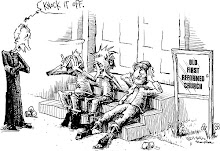
This was the editorial cartoon in the November 4, 2007, edition of The Brooklyn Paper.
(Do I have automatic permission to post it just because I'm in it? Does my caricature belong to me?)
If you haven't been following the story, the three men who see, speak, and hear no evil, are more or less Robert, Will, and Frank, I guess.
Read the story in the web edition of the Brooklyn Paper. The headline is, well, unflattering, but then I have to remember Luke 6:26. And the story itself is accurate enough. Only we're not "Reformed Presbyterian"!
Monday, November 05, 2007
The Parrots of Brooklyn
I knew about the colony of feral parrots in the gothic gateway of Green-Wood Cemetery. I knew about the feral parrots at Brooklyn College; you can see their nests on the light standards. Last spring I saw the parrots at the south end of City Island.
But now I've seen the parrots in my own neighborhood, in Windsor Terrace. Twice.
Saturday, as I walked to the Kensington Post Office on McDonald Avenue, I saw three of them in the oak trees next to the Greenwood Ave pedestrian bridge over the Prospect Expressway.
Of course, first I heard them. I wan't out bird-watching, my thoughts were on something else. But their noise is unmistakable. When you hear them, you look for them.
This morning, as I waited for the B67 bus at the corner of McDonald and Terrace, a whole flock of them flew over me, flying south out of the cemetery into our neighborhood.
On Saturday I had thought we might have our own little colony in our neighborhood, but from what I saw this morning I'm guessing that the Gatehouse parrots are wide-ranging.
I love them, I think they are so cool. Sure, I know they are not native, they're invaders, but so are my people, we invaded from the Netherlands, so how can I judge them?
If you want to read about them, go to http://www.brooklynparrots.com/
But now I've seen the parrots in my own neighborhood, in Windsor Terrace. Twice.
Saturday, as I walked to the Kensington Post Office on McDonald Avenue, I saw three of them in the oak trees next to the Greenwood Ave pedestrian bridge over the Prospect Expressway.
Of course, first I heard them. I wan't out bird-watching, my thoughts were on something else. But their noise is unmistakable. When you hear them, you look for them.
This morning, as I waited for the B67 bus at the corner of McDonald and Terrace, a whole flock of them flew over me, flying south out of the cemetery into our neighborhood.
On Saturday I had thought we might have our own little colony in our neighborhood, but from what I saw this morning I'm guessing that the Gatehouse parrots are wide-ranging.
I love them, I think they are so cool. Sure, I know they are not native, they're invaders, but so are my people, we invaded from the Netherlands, so how can I judge them?
If you want to read about them, go to http://www.brooklynparrots.com/
Thursday, October 25, 2007
The Bobs Lake Gang
This Sunday through Tuesday I will be attending the 31st session of the Bobs Lake Gang. Our name doesn't say much for our imaginations, but hey, we're guys, and we're pastors, so who expects imagination?
In October 1992, a Canadian pastor friend of mine, Rev. Dr. Orville James, had the idea of starting a small pastors' group to meet on retreat at his cottage on Bobs Lake in Ontario. We were joined by Bob Ripley, whose star was just rising. We talked, prayed, smoked cigars, read scripture, played air guitar, repeated Monty Python scripts, did dishes, prayed some more, and failed to shower and shave.
On Monday night, we lay on the floor in the dark and listened to the Blue Jays play their first World Series. It was a tiny old AM radio, and the woodstove was on to keep us warm.
We met again in the spring, and three more pastors joined us, Drew and Andrew and Orville's brother John. Or did Andrew come the next time? Or was John there the first time? We've been going long enough to need an historian.
Since then we've added new members, three of them, and we've had vacancies and visitors along the way, but there's no question that we have forged ourselves into something; just what that something is I am not sure I want to know.
We are all Canadian pastors, mainline denominations, United and Anglican, except for me, a Dutch Calvinist from the States (though I am a dual citizen, and a subject of Elizabetha Regina and her heirs-by-law). I used to say that they wanted me in so that I could buy the single-malt Scotch at the Duty Free at the border. Then my wife and I bought the cottage next door to Orville's, and if they kicked me out I could just go up any and blast my radio like at General Noriega. And now some of the other guys are bringing the Scotch.
Fifteen years, now, or 31 sessions, without a break. We're the only group we know to have endured so long. Orville is the leader, and the rest of us have different roles to play. Andrew makes breakfast, Ripley cooks a formal dinner on Monday night (despite our lack of shaving and showering). John and I fight over the control of the coffee. We've been fighting over the coffee for years. It's what we do.
Sunday night we kick back and let loose. We report the news, and we tell the stories that pastors never dare tell anyone else but pastors. I always try to have a long joke ready. Early on I told the one about the Lutheran pastor who wakes up in hell. It remains the unbeatable standard, like Johnny Vander Meer's back-to-back no-hitters.
Monday, after breakfast, we spend all morning in scripture and prayer. We use the Anglican service for morning prayer, and whatever lessons that come up in the lectionary. We try to do that sitting outside on the deck above the lake, if it's not too cold. It's never too cold for me; I love to wrap myself in blankets like a sachem and talk about the Eternal, and then talk to the Eternal.
Soup and sandwiches for lunch, then we split up for exercise and naps and conversations, and golf or hiking or canoing on the bright, cold lake. Monday dinner is nice with napkins and wine. Monday night, the talk is quieter and calmer.
Tuesday morning, prayers and scripture again, but less intense. A quick lunch and then off home.
We have prayed each other through many difficulties. We have prayed each other through broken marriages and tough times in the ministry. Wandering children and troublesome staffs. Clergy stuff. We challenge and support each other. We probably should use more soap.
In October 1992, a Canadian pastor friend of mine, Rev. Dr. Orville James, had the idea of starting a small pastors' group to meet on retreat at his cottage on Bobs Lake in Ontario. We were joined by Bob Ripley, whose star was just rising. We talked, prayed, smoked cigars, read scripture, played air guitar, repeated Monty Python scripts, did dishes, prayed some more, and failed to shower and shave.
On Monday night, we lay on the floor in the dark and listened to the Blue Jays play their first World Series. It was a tiny old AM radio, and the woodstove was on to keep us warm.
We met again in the spring, and three more pastors joined us, Drew and Andrew and Orville's brother John. Or did Andrew come the next time? Or was John there the first time? We've been going long enough to need an historian.
Since then we've added new members, three of them, and we've had vacancies and visitors along the way, but there's no question that we have forged ourselves into something; just what that something is I am not sure I want to know.
We are all Canadian pastors, mainline denominations, United and Anglican, except for me, a Dutch Calvinist from the States (though I am a dual citizen, and a subject of Elizabetha Regina and her heirs-by-law). I used to say that they wanted me in so that I could buy the single-malt Scotch at the Duty Free at the border. Then my wife and I bought the cottage next door to Orville's, and if they kicked me out I could just go up any and blast my radio like at General Noriega. And now some of the other guys are bringing the Scotch.
Fifteen years, now, or 31 sessions, without a break. We're the only group we know to have endured so long. Orville is the leader, and the rest of us have different roles to play. Andrew makes breakfast, Ripley cooks a formal dinner on Monday night (despite our lack of shaving and showering). John and I fight over the control of the coffee. We've been fighting over the coffee for years. It's what we do.
Sunday night we kick back and let loose. We report the news, and we tell the stories that pastors never dare tell anyone else but pastors. I always try to have a long joke ready. Early on I told the one about the Lutheran pastor who wakes up in hell. It remains the unbeatable standard, like Johnny Vander Meer's back-to-back no-hitters.
Monday, after breakfast, we spend all morning in scripture and prayer. We use the Anglican service for morning prayer, and whatever lessons that come up in the lectionary. We try to do that sitting outside on the deck above the lake, if it's not too cold. It's never too cold for me; I love to wrap myself in blankets like a sachem and talk about the Eternal, and then talk to the Eternal.
Soup and sandwiches for lunch, then we split up for exercise and naps and conversations, and golf or hiking or canoing on the bright, cold lake. Monday dinner is nice with napkins and wine. Monday night, the talk is quieter and calmer.
Tuesday morning, prayers and scripture again, but less intense. A quick lunch and then off home.
We have prayed each other through many difficulties. We have prayed each other through broken marriages and tough times in the ministry. Wandering children and troublesome staffs. Clergy stuff. We challenge and support each other. We probably should use more soap.
Wednesday, October 24, 2007
Update on the Homeless Men
In the words of the Leonard Cohen song, "It's come to this, oh yes, it's come to this."
First, I thank you all for your participation in this conversation. I thank you for your comments and your interest. In particular I thank the Park Slope Civic Council for their desire to be part of a solution, and I thank Rabbi Andy Bachman and Congregation Beth Elohim for their offering to support us and assist us. ("Love bears all things, believes all things, endures all things.")
Second, now that this conversation has started, it needs to keep developing. If Park Slope was just voted the best neighborhood in NYC, then why shouldn't homeless people want to live here too? A truly diverse community needs to embrace its FULL diversity. Old First wants to be part of the continuing conversation, especially with Beth Elohim and the Civic Council.
Third, because this is a developing story, let me update you on the weekend. There are some new facts on the ground. On Sunday afternoon, the cops were called in twice by neighbors. I have to say the cops were great.
As left the church on Sunday evening, I found a steel bar the guys were keeping as a weapon. On Monday morning I learned that the men had been urinating in front of nursery school children and into their play-yard. On Monday evening a deacon confirmed to me that the men had exposed themselves in front of children while urinating.
Yesterday Frank showed me his face, very badly bruised. He told me had fallen, but I don't believe him. His face tells a different story. This morning I removed a blanket with blood stains on it.
"It's come to this, oh yes, it's come to this." (I guess I always expected it would come to this.)
I have been denying them permission to sleep on our grounds since last July, but I found it impossible to enforce. As of this morning, the Commander of Precinct 78 agreed with me that the police would enforce it.
The story isn't over. What's going to happen next, I don't know. But now that the community seems to have woken up I want it to stay involved. The men were sleeping and hanging out at Old First because Old First is public space for the community, and because, like anyone, they want a short commute, and they work on Seventh Avenue.
So please don't give them money. Give them food. Address them by name. Robert, Will, and Frank.
It's not over for us with them either at Old First. We have three deacons who will work on this with me. We'll get back to you.
Meanwhile, you might check the Brooklyn Paper for a story this weekend.
First, I thank you all for your participation in this conversation. I thank you for your comments and your interest. In particular I thank the Park Slope Civic Council for their desire to be part of a solution, and I thank Rabbi Andy Bachman and Congregation Beth Elohim for their offering to support us and assist us. ("Love bears all things, believes all things, endures all things.")
Second, now that this conversation has started, it needs to keep developing. If Park Slope was just voted the best neighborhood in NYC, then why shouldn't homeless people want to live here too? A truly diverse community needs to embrace its FULL diversity. Old First wants to be part of the continuing conversation, especially with Beth Elohim and the Civic Council.
Third, because this is a developing story, let me update you on the weekend. There are some new facts on the ground. On Sunday afternoon, the cops were called in twice by neighbors. I have to say the cops were great.
As left the church on Sunday evening, I found a steel bar the guys were keeping as a weapon. On Monday morning I learned that the men had been urinating in front of nursery school children and into their play-yard. On Monday evening a deacon confirmed to me that the men had exposed themselves in front of children while urinating.
Yesterday Frank showed me his face, very badly bruised. He told me had fallen, but I don't believe him. His face tells a different story. This morning I removed a blanket with blood stains on it.
"It's come to this, oh yes, it's come to this." (I guess I always expected it would come to this.)
I have been denying them permission to sleep on our grounds since last July, but I found it impossible to enforce. As of this morning, the Commander of Precinct 78 agreed with me that the police would enforce it.
The story isn't over. What's going to happen next, I don't know. But now that the community seems to have woken up I want it to stay involved. The men were sleeping and hanging out at Old First because Old First is public space for the community, and because, like anyone, they want a short commute, and they work on Seventh Avenue.
So please don't give them money. Give them food. Address them by name. Robert, Will, and Frank.
It's not over for us with them either at Old First. We have three deacons who will work on this with me. We'll get back to you.
Meanwhile, you might check the Brooklyn Paper for a story this weekend.
Monday, October 22, 2007
With Apologies to Frost
Nature’s last green is brown,
Her tints are going down
To blend in with the earth
From which we rise in birth.
Prospect Park is finally changing color now, though the temperature is still too warm. Most of the trees just go to brown, while a few are beginning to show off their yellows, golds, and reds.
Not the white pines on Lookout Hill, above the Nethermead, the white pines that I love. Their needles are even greener than a month ago. They have groomed themselves for winter. It is not so that they do not loose their leaves like other trees. They do.
In September we went to our cabin in Ontario, and my wife Melody said, "Look, the white pines are turning brown." And they were. Their branches were all dead brown needles. She worried for our trees, but she needn’t have. Those brown quintuplet clusters hid the tiny new growth needles behind them.
When I went back in October, the ground was thick with needles, and the white pines were bright and fresh and green. For white pines, Easter should happen in October. Oaks and maples celebrate Passover as the New Year, but conifers keep true to Rosh Hashanah.
White pines like the winter sun. And so in wintertime, when I walk from my apartment to the church, I take the long way, up and over Lookout Hill, so that I can say hello to the white pines, especially when there is snow on the ground.
I haven’t started that yet. And Sunday I was running late, so I took the Center Drive. And as I walked past the Friends Cemetery I saw what I had seen before, that most of the gravestones were in shadow from the trees, but some of the stones were brightly lit in the low rays of the autumn sun.
What’s better for gravestones — sunlight or shadow? I mean, what hastens their decay, the algae that grow in shade, or the heating and cooling of solar energy? Those stones that are brightly lit, do they mark the graves of specially righteous Quakers, whose spirits leave an energy behind to greet the sun, or of specially sinful Quakers, unhappy ones, whose souls are not at rest, and cannot abide the sweet decay of shadow and shade? Is there anyone who can come back from the dead to tell me?
Time is linear for Quakers, and for the rest of us Christians. What has been has been, there is no return, and we are praying for the future, which is a fulfillment of the past, but also therefore essentially different from the past. That's a fundamental belief of Jews and Christians and Muslims.
But trees are Taoists or Buddhists, I think. Trees believe that time is circular, and that everything will come around again. I have no desire to convert the trees to Christianity. Certainly not the white pines. They have no need of redemption.
Her tints are going down
To blend in with the earth
From which we rise in birth.
Prospect Park is finally changing color now, though the temperature is still too warm. Most of the trees just go to brown, while a few are beginning to show off their yellows, golds, and reds.
Not the white pines on Lookout Hill, above the Nethermead, the white pines that I love. Their needles are even greener than a month ago. They have groomed themselves for winter. It is not so that they do not loose their leaves like other trees. They do.
In September we went to our cabin in Ontario, and my wife Melody said, "Look, the white pines are turning brown." And they were. Their branches were all dead brown needles. She worried for our trees, but she needn’t have. Those brown quintuplet clusters hid the tiny new growth needles behind them.
When I went back in October, the ground was thick with needles, and the white pines were bright and fresh and green. For white pines, Easter should happen in October. Oaks and maples celebrate Passover as the New Year, but conifers keep true to Rosh Hashanah.
White pines like the winter sun. And so in wintertime, when I walk from my apartment to the church, I take the long way, up and over Lookout Hill, so that I can say hello to the white pines, especially when there is snow on the ground.
I haven’t started that yet. And Sunday I was running late, so I took the Center Drive. And as I walked past the Friends Cemetery I saw what I had seen before, that most of the gravestones were in shadow from the trees, but some of the stones were brightly lit in the low rays of the autumn sun.
What’s better for gravestones — sunlight or shadow? I mean, what hastens their decay, the algae that grow in shade, or the heating and cooling of solar energy? Those stones that are brightly lit, do they mark the graves of specially righteous Quakers, whose spirits leave an energy behind to greet the sun, or of specially sinful Quakers, unhappy ones, whose souls are not at rest, and cannot abide the sweet decay of shadow and shade? Is there anyone who can come back from the dead to tell me?
Time is linear for Quakers, and for the rest of us Christians. What has been has been, there is no return, and we are praying for the future, which is a fulfillment of the past, but also therefore essentially different from the past. That's a fundamental belief of Jews and Christians and Muslims.
But trees are Taoists or Buddhists, I think. Trees believe that time is circular, and that everything will come around again. I have no desire to convert the trees to Christianity. Certainly not the white pines. They have no need of redemption.
Thursday, October 18, 2007
The Homeless Men at Old First
Their names are Robert Royster, Will Franklin, and Frank. They cause me a great deal of trouble, and lots of anger from our neighbors, and I do wish they would go away, but, whatever else, they remain human beings, images of God, and they need to be treated with respect.
People keep asking why don't we get rid of them. We can't. We've tried. Believe me, we have tried. They have abused our hospitality, they piss on our building, they leave food around, they leave garbage all over, they play their radio at great volumes (God forgive me, I have had to resort to theft against them to deal with that one). They are a pain in the neck. But we will not treat them as less than human beings.
We have tried to get rid of them. We've discovered the hard way that we can't do it, we can't beat them. Whenever I chase them away, they just wait an hour, two hours, and they come back. I go home at night, and they come back. No matter what we do or say, they come back.
I will confess a strong desire inside myself to just let them be. It's Jesus' church, not mine, not ours, and the New Testament is very clear about our hospitality to the poor. "The poor you will always have with you." The parable of Lazarus. Etc. You get the point. And there is no asterix pointing to a codicil that says, "the nice poor."
But at the same time I recognize we belong to a community, and the church has the responsiblity to be a good neighbor, and if the guys scare the kids, and make lewd comments at women and passersby, and if they leave food scraps around for vermin to get at, etc. etc., then, well, I know that the church has to be a good neighbor. So we decided this last July that they absolutely had to go. We tried to get rid of them. As I said, we couldn't.
We chased them away every morning. They came back every night. We threw out their stuff. They found new stuff. Only now they started getting even more hostile, to us and to other passersby. We finally found that we couldn't beat them, and the only thing was to try to control it. Yes, they beat us.
The cops can't do anything either, apparently. If you call them, you have to wait there, on the spot for about half an hour till the cops come, and all they can say is "Scram," and they give you dirty looks for taking up their time, and half an hour later the guys are back.
The cops have to catch them in the act of public urination or public consumption of liquor, which are misdemeanors, and mean nothing to anyone, or catch them inside the building, which is trespassing, and might mean a trip to Rikers Island, but Rikers is already over-crowded and they don't want to put vagrants there.
Why are they there at Old First? Easy. The money is good on Seventh Avenue. The money dries up, the guys go. Where I grew up in Bedford-Stuyvesant there are no panhandlers. Up at Ethical Culture the front porch is deeper and drier, but people don't give out money on PPW.
Old First is the only church on Seventh Avenue without a fence. That's important to us, we love it that people sit on our steps and that kids run on the top of our little wall. And that's also why they are at Old First.
Today, again, I cleaned up their garbage. Waddayagonnado. But I will not remove their sleeping bags. Some of our neighbors think I should do that. But that's a moral line I will not cross. The Torah is very clear, that you should not take from a poor man what keeps him warm at night. Leaving their filthy sleeping bags there is my little attempt to be moral in this whole thing, and honor the basic dignity the Torah assigns them.
I used to talk to them and pray with them. I used to be able to reason with them. That's no longer possible. They're drinking 24/7 lately. They are nasty to me too. How long this will go on I do not know. In the short term, it's people giving them money that keeps it going. In the long term, they are killing themselves. If they manage to get arrested, they will get cleaned up at Rikers, and we'll have them back in February!
Before Robert had descended to his current condition, and when he had sober moments, he used to pray very moving prayers for certain people in the area. for poor children, for illiterates (such as himself), for soldiers, for forgiveness of his sins. I hate what has become of him. I always knew it would be coming.
It's a grief, and we're at our wits end. We have been unable to find any solution. In a strange way, the three of them are in control. Robert, Will, and Franklin.
They have names. They have souls. They belong to our community. They tell us something about ourselves.
People keep asking why don't we get rid of them. We can't. We've tried. Believe me, we have tried. They have abused our hospitality, they piss on our building, they leave food around, they leave garbage all over, they play their radio at great volumes (God forgive me, I have had to resort to theft against them to deal with that one). They are a pain in the neck. But we will not treat them as less than human beings.
We have tried to get rid of them. We've discovered the hard way that we can't do it, we can't beat them. Whenever I chase them away, they just wait an hour, two hours, and they come back. I go home at night, and they come back. No matter what we do or say, they come back.
I will confess a strong desire inside myself to just let them be. It's Jesus' church, not mine, not ours, and the New Testament is very clear about our hospitality to the poor. "The poor you will always have with you." The parable of Lazarus. Etc. You get the point. And there is no asterix pointing to a codicil that says, "the nice poor."
But at the same time I recognize we belong to a community, and the church has the responsiblity to be a good neighbor, and if the guys scare the kids, and make lewd comments at women and passersby, and if they leave food scraps around for vermin to get at, etc. etc., then, well, I know that the church has to be a good neighbor. So we decided this last July that they absolutely had to go. We tried to get rid of them. As I said, we couldn't.
We chased them away every morning. They came back every night. We threw out their stuff. They found new stuff. Only now they started getting even more hostile, to us and to other passersby. We finally found that we couldn't beat them, and the only thing was to try to control it. Yes, they beat us.
The cops can't do anything either, apparently. If you call them, you have to wait there, on the spot for about half an hour till the cops come, and all they can say is "Scram," and they give you dirty looks for taking up their time, and half an hour later the guys are back.
The cops have to catch them in the act of public urination or public consumption of liquor, which are misdemeanors, and mean nothing to anyone, or catch them inside the building, which is trespassing, and might mean a trip to Rikers Island, but Rikers is already over-crowded and they don't want to put vagrants there.
Why are they there at Old First? Easy. The money is good on Seventh Avenue. The money dries up, the guys go. Where I grew up in Bedford-Stuyvesant there are no panhandlers. Up at Ethical Culture the front porch is deeper and drier, but people don't give out money on PPW.
Old First is the only church on Seventh Avenue without a fence. That's important to us, we love it that people sit on our steps and that kids run on the top of our little wall. And that's also why they are at Old First.
Today, again, I cleaned up their garbage. Waddayagonnado. But I will not remove their sleeping bags. Some of our neighbors think I should do that. But that's a moral line I will not cross. The Torah is very clear, that you should not take from a poor man what keeps him warm at night. Leaving their filthy sleeping bags there is my little attempt to be moral in this whole thing, and honor the basic dignity the Torah assigns them.
I used to talk to them and pray with them. I used to be able to reason with them. That's no longer possible. They're drinking 24/7 lately. They are nasty to me too. How long this will go on I do not know. In the short term, it's people giving them money that keeps it going. In the long term, they are killing themselves. If they manage to get arrested, they will get cleaned up at Rikers, and we'll have them back in February!
Before Robert had descended to his current condition, and when he had sober moments, he used to pray very moving prayers for certain people in the area. for poor children, for illiterates (such as himself), for soldiers, for forgiveness of his sins. I hate what has become of him. I always knew it would be coming.
It's a grief, and we're at our wits end. We have been unable to find any solution. In a strange way, the three of them are in control. Robert, Will, and Franklin.
They have names. They have souls. They belong to our community. They tell us something about ourselves.
Wednesday, October 10, 2007
On Widows and Apologetics
I just had a little piece published in a theology magazine, under the title above. It's about how God seems to have set things up in such a way as to make God's self more credible to orphans, widows, and the poor than to intellectuals.
And I say a word of two about our desire for intellectual respect, which can be a kind of covetousness.
To get to the full journal, called Perspectives, go here: http://www.perspectivesjournal.org/index.html
There are some other worthwhile articles as well.
To get to my little essay, go here: http://www.perspectivesjournal.org/2007/10/seeit-widows.html
And I say a word of two about our desire for intellectual respect, which can be a kind of covetousness.
To get to the full journal, called Perspectives, go here: http://www.perspectivesjournal.org/index.html
There are some other worthwhile articles as well.
To get to my little essay, go here: http://www.perspectivesjournal.org/2007/10/seeit-widows.html
Babycoat
I love Julia Durgee's cartoon style, which is why I am happy to host her on this blog.
And this last one is my favorite. Because it's so real about the self-conscious, the zelf-bewustzijn in Dutch, the self-awarness that is often sharpest in the memory of dreams. I love her take on wimsy and how she touches what is just under the surface.
And I love how her drawing is essential to her little stories, and not a mere excuse for dialogue.
I don't want to say too much about this cartoon, because I should let it speak for itself, but it expresses for me the complexity of love. There is desire in it, humility, courage, grandiosity, childlikeness, great gift and great need. This is a Romantic cartoon in the classic Don Quixotic sense of High Romance.
And this last one is my favorite. Because it's so real about the self-conscious, the zelf-bewustzijn in Dutch, the self-awarness that is often sharpest in the memory of dreams. I love her take on wimsy and how she touches what is just under the surface.
And I love how her drawing is essential to her little stories, and not a mere excuse for dialogue.
I don't want to say too much about this cartoon, because I should let it speak for itself, but it expresses for me the complexity of love. There is desire in it, humility, courage, grandiosity, childlikeness, great gift and great need. This is a Romantic cartoon in the classic Don Quixotic sense of High Romance.
Monday, October 08, 2007

Wednesday, September 12, 2007
Thoughts on Being Honest Even if it Hurts: or, Yes, I Stole a Backpack
Note: this is a guest entry from one of my parishioners, Julia Hurn. Enjoy.
Recently my husband and I gave a Game Boy to my son Aidan. To say that he really loves it is an understatement. When he first got it, he had no self-control. He could not turn the thing off, despite pleadings, bargainnings and even threats from us. We have had to wrench it out of his hands often. Things are getting better, but while we were on vacation, he was in the throes of Game Boy mania and decided to bring it with him to the beach one day.
On our way home from the beach as we were unloading the car, he decided to take a bucket full of seawater and sea creatures out of the backseat with the same hand that was holding his Game Boy. You can guess the rest.
I don’t know who was more upset, Aidan or my husband who knew by heart every word of the replacement agreement he paid for when he bought the thing…”water damage not covered” was what was echoing through his head. While it did not cost near what a new one cost, it was about the priciest toy we’ve bought him, weighing in at about $60, not including the game cartridges.
Well, Aidan was so dejected. He had this shocked, devastated look on his face. Shawn was hopping mad, and I was watching all this thinking; we never should have done it in the first place. Once the shock wore off and we got safely back to Brooklyn, Shawn had the idea of taking it anyway back to the store and seeing if they would fix it or exchange it, even though water damage was clearly not covered.
I wasn’t happy that he was getting Aidan’s hopes up, but Shawn did a good job of explaining to him that he might not get a new one and he should be prepared for the disappointment. (Big sigh) “yes, dad,” says Aidan.
Not more than an hour later, I hear the happy sounds of chatting and the electronic ping ping ping of a…you guessed it, new Game Boy floating up our stairs. In walks Aidan, happy as a clam. “What happened?” I ask Shawn, incredulous.
Apparently they approached the clerk, and Shawn urged Aidan to speak directly to her about what happened. Shawn did not say he had to volunteer that he dropped it in water. But, Aidan, with sheepish shame, head bowed, muttered “I sort of accidently kind of dropped it in some water.” The clerk took one look at him (the fact that he has sandy blond hair, freckles and huge, gorgeous blue eyes didn’t hurt) and said “the truth will set you free, my friend. Here’s a new one.”
When I heard this story, I have to admit to some feelings of ambiguity. I’m happy he got another one, of course, but a bit saddened that Aidan did not learn about the consequence of his actions.
How does an accidental dropping of a game in water constitute an action, you ask? We had warned him that the likelihood that it would get damaged was very great when he took it in the car to the beach. We told him not to do it, but he went ahead anyway. Because he chose to keep his precious possession in proximity to potential disaster, he has to take some responsibility for what happened.
But I am relieved that, in telling the truth, he was met with mercy and compassion. For a little guy who is six, I think this is very appropriate. See, because now that I’m a parent, I can’t hide from my own parental/moral uprightness. I’m ashamed of something I did recently, and as a way of avoiding being hypocritical (do as I say, not as I do), I’ve just plain avoided the situation.
About a year ago this summer, I was loaned a backpack by the good people at Prospect Park Audobon Center, filled with materials to do an educational experiment. I am ashamed and embarrassed to say that I did not do the experiment, and that the materials (including some clip boards, some plastic containers and mostly papers and bird guides) are sitting in my closet.
My regular backpack started to fall apart recently; and out of desperation, I appropriated the one in my closet containing all the stuff in it, toke the stuff out of it, and voila...new backpack for me. Pretty reprehensible, huh? I have always had some excuse for not returning it all…I don’t have time right now to do the experiment; we will get to it soon; blah blah (it involved observing ducks on the pond in the park).
My husband just recently pointed out to me that in reality, I have stolen that stuff as it was given to me in good faith to be used then returned and I have not returned it, and he doesn’t think I’m ever going to. He said this because it’s been sitting for a year in our closet.
And you know, in my paralysis of guilt, he’s right. I stopped recently thinking I would ever return it. In my mind there was a “statute of limitations” on returning it, and that if I did now return it, I would be really chastised…with questions, like: what took you so long? How could you be such a bad person as to keep this very important and valuable stuff from being used by some other well-deserving person/people?
The anticipation of the scolding and shaming I would receive really was the thing that kept me from doing the right thing. Rather than facing up to the possible bad reception by the staff there and just doing the right thing, I’d best just avoid it all together by keeping it, though every passing week and month I keep it, I feel worse.
Isn’t it the same with our children? The anticipation of the punishment for doing something bad prevents us and them from doing right thing and owning up. Being bad (or the Christian term Sinning) is something we all do because we are human. We screw up; we fail to give back what’s not ours; we try not to take responsibility for something bad we caused so we can get out of fixing it.
I love my husband for being my moral compass in these areas; my morality can get pretty loosey-goosey sometimes (one reason why I think I make a lousy Christian), and he often gently and not so gently reminds me to do the right thing. What does Jesus have to do with this? I think Jesus would laugh at me for keeping the backpack for so long. He would stand over my shoulder and say, “hey, you’ll feel so much better when you give it back,” with a smile and a wink, and then just walk away.
My plan is to go tomorrow to the Audobon Center in a car service to drop it ever so stealthily by the front door of the education dept. Anonymously, of course. If anyone asks me, I’ll just say: “I’m returning something I found to it’s rightful owners,” and leave it at that.
Recently my husband and I gave a Game Boy to my son Aidan. To say that he really loves it is an understatement. When he first got it, he had no self-control. He could not turn the thing off, despite pleadings, bargainnings and even threats from us. We have had to wrench it out of his hands often. Things are getting better, but while we were on vacation, he was in the throes of Game Boy mania and decided to bring it with him to the beach one day.
On our way home from the beach as we were unloading the car, he decided to take a bucket full of seawater and sea creatures out of the backseat with the same hand that was holding his Game Boy. You can guess the rest.
I don’t know who was more upset, Aidan or my husband who knew by heart every word of the replacement agreement he paid for when he bought the thing…”water damage not covered” was what was echoing through his head. While it did not cost near what a new one cost, it was about the priciest toy we’ve bought him, weighing in at about $60, not including the game cartridges.
Well, Aidan was so dejected. He had this shocked, devastated look on his face. Shawn was hopping mad, and I was watching all this thinking; we never should have done it in the first place. Once the shock wore off and we got safely back to Brooklyn, Shawn had the idea of taking it anyway back to the store and seeing if they would fix it or exchange it, even though water damage was clearly not covered.
I wasn’t happy that he was getting Aidan’s hopes up, but Shawn did a good job of explaining to him that he might not get a new one and he should be prepared for the disappointment. (Big sigh) “yes, dad,” says Aidan.
Not more than an hour later, I hear the happy sounds of chatting and the electronic ping ping ping of a…you guessed it, new Game Boy floating up our stairs. In walks Aidan, happy as a clam. “What happened?” I ask Shawn, incredulous.
Apparently they approached the clerk, and Shawn urged Aidan to speak directly to her about what happened. Shawn did not say he had to volunteer that he dropped it in water. But, Aidan, with sheepish shame, head bowed, muttered “I sort of accidently kind of dropped it in some water.” The clerk took one look at him (the fact that he has sandy blond hair, freckles and huge, gorgeous blue eyes didn’t hurt) and said “the truth will set you free, my friend. Here’s a new one.”
When I heard this story, I have to admit to some feelings of ambiguity. I’m happy he got another one, of course, but a bit saddened that Aidan did not learn about the consequence of his actions.
How does an accidental dropping of a game in water constitute an action, you ask? We had warned him that the likelihood that it would get damaged was very great when he took it in the car to the beach. We told him not to do it, but he went ahead anyway. Because he chose to keep his precious possession in proximity to potential disaster, he has to take some responsibility for what happened.
But I am relieved that, in telling the truth, he was met with mercy and compassion. For a little guy who is six, I think this is very appropriate. See, because now that I’m a parent, I can’t hide from my own parental/moral uprightness. I’m ashamed of something I did recently, and as a way of avoiding being hypocritical (do as I say, not as I do), I’ve just plain avoided the situation.
About a year ago this summer, I was loaned a backpack by the good people at Prospect Park Audobon Center, filled with materials to do an educational experiment. I am ashamed and embarrassed to say that I did not do the experiment, and that the materials (including some clip boards, some plastic containers and mostly papers and bird guides) are sitting in my closet.
My regular backpack started to fall apart recently; and out of desperation, I appropriated the one in my closet containing all the stuff in it, toke the stuff out of it, and voila...new backpack for me. Pretty reprehensible, huh? I have always had some excuse for not returning it all…I don’t have time right now to do the experiment; we will get to it soon; blah blah (it involved observing ducks on the pond in the park).
My husband just recently pointed out to me that in reality, I have stolen that stuff as it was given to me in good faith to be used then returned and I have not returned it, and he doesn’t think I’m ever going to. He said this because it’s been sitting for a year in our closet.
And you know, in my paralysis of guilt, he’s right. I stopped recently thinking I would ever return it. In my mind there was a “statute of limitations” on returning it, and that if I did now return it, I would be really chastised…with questions, like: what took you so long? How could you be such a bad person as to keep this very important and valuable stuff from being used by some other well-deserving person/people?
The anticipation of the scolding and shaming I would receive really was the thing that kept me from doing the right thing. Rather than facing up to the possible bad reception by the staff there and just doing the right thing, I’d best just avoid it all together by keeping it, though every passing week and month I keep it, I feel worse.
Isn’t it the same with our children? The anticipation of the punishment for doing something bad prevents us and them from doing right thing and owning up. Being bad (or the Christian term Sinning) is something we all do because we are human. We screw up; we fail to give back what’s not ours; we try not to take responsibility for something bad we caused so we can get out of fixing it.
I love my husband for being my moral compass in these areas; my morality can get pretty loosey-goosey sometimes (one reason why I think I make a lousy Christian), and he often gently and not so gently reminds me to do the right thing. What does Jesus have to do with this? I think Jesus would laugh at me for keeping the backpack for so long. He would stand over my shoulder and say, “hey, you’ll feel so much better when you give it back,” with a smile and a wink, and then just walk away.
My plan is to go tomorrow to the Audobon Center in a car service to drop it ever so stealthily by the front door of the education dept. Anonymously, of course. If anyone asks me, I’ll just say: “I’m returning something I found to it’s rightful owners,” and leave it at that.
Tuesday, September 11, 2007
Everyone Has A 9/11 Story
It was in the evil tragedy of 9/11 that I was called here, to Old First.
In the summer of 2001, the pulpit of Old First church was, as we say, "vacant." Pastor Otte had moved on to Tarrytown, and an interim pastor, Dr. Washington, was filling-in part-time, while the Search Committee looked for a new pastor to fill the pulpit.
I was the senior pastor at Central Reformed Church in Grand Rapids, Michigan. I had applied to Old First, and had been interviewed. My wife Melody did not want to come to Brooklyn: she had a good job in Grand Rapids, we owned a home (for the first time), and we were near her parents.
The other candidate preached her trial sermon at the "neutral site" of the Flatbush Church on Sunday, 9/9, where the Search Committee had gone to hear her. I was scheduled to preach there on 9/16. It was all very confidential in Grand Rapids; I had used the excuse that our Grand Rapids church was considering a partnership with the Flatbush Church, which was not untrue. Only my church officers and my associate pastors knew the whole story.
On the morning of 9/11 I was visiting a neighboring African-American pastor with whom I was trying to do some joint programming (Grand Rapids is very divided racially). His secretary ran in to the study and told us to come look at the television. We watched, transfixed, unbelieving, and listened to Bryant Gumble, who seemed just as shocked as we were.
I raced back to my own church. Immediately I began working with other city clergy to prepare a city-wide prayer service at the cathedral. And then I got a phone call, from Rick, the vice chair of the Old First search committee. He was at the Grand Rapids airport and could I maybe pick him up, and could he stay with us (the hotels were full) and could we send some clergy to the airport to minister to the people there?
It seems Rick had been flying to San Francisco for business, and his plane got put down in Grand Rapids. Coincidence? Providence? I went to the airport and picked him up. As we drove we agreed that I might have to postpone my trial sermon, as I really had to be with my own people at this time, and Rick understood, but the problem was that the next available date would be in October or November, and they already had a good candidate. I was very disappointed of course.
That afternoon, Melody got home from work, and there was Rick on our front porch. She looked up to heaven, and said, "Did you have to drop him right on the porch?" Then I told her that my trial sermon was now up in the air, so to speak.
That night I led some of the prayers at the cathedral downtown. My congregation's own service was scheduled for Thursday. On Wednesday I met with my leadership. They encouraged me to go to Brooklyn anyway. They said, "Of all the times to preach in New York, it's now. Especially since you're from there. You'll be with us tomorrow. We can cover the rest." Okay. It's on.
So Friday we drove to Brooklyn. No planes were flying, of course, and rental cars were scarce. Rick and Melody drove, and I sat in the back seat and rewrote my sermon.
Crossing the Tappan Zee we could see the fires and smoke at ground zero. Coming in over the Triboro was where it hit me emotionally. It was a familiar route from my childhood, how we drove back home to Bedford-Stuyvesant after visiting my relatives in Jersey. As you know, the whole city felt stunned and shocked and wounded. No airliners over the Grand Central Parkway, but fighter jets circling, a powerful symbol. That's where I "lost it."
We got into Park Slope Friday night. We walked around. The doors of Old First were open, people were there, candles were burning in and out, sheets of newsprint were hanging in the narthex and people were writing their prayers. The laymembers of Old First, without any help from any clergy, had decided to make this grand old building a sanctuary for everyone. I was impressed. This was the kind of church I'd like to serve. And every other church in the neighborhood was closed up and their gates locked.
On Sunday I preached the 9/11 sermon at the Flatbush Church, and the text from Jeremiah was perfect. As I came down the aisle, I was greeted by Mr. Woodson, an elder from the church of my childhood. He calls me Danny and he welcomed me home.
I have never felt so "called" as I felt then. And Melody began to believe that maybe this could be okay.
A week later the Search Committee offered me the pulpit. They made a great offer to Melody as well. Over the next two months we went through the normal approvals of the consistory, the congregation, and the Classis of Brooklyn, and in December, 2001, we moved to Garfield Place.
I am always uncomfortable in pointing to this or that in my life and saying, This was God. That feels presumptuous to me. I certainly do not believe that the destruction of the World Trade Center was an act of God, or was endorsed by God, or desired by God. And I do not want to trivialize 9/11, or make it overly personal for myself, when it was far more personal for many other people.
But it is very strange and mysterious to me how such an evil thing should have been, in my own life, for good. But in the midst of that awful event, I was called here, and I came.
In the summer of 2001, the pulpit of Old First church was, as we say, "vacant." Pastor Otte had moved on to Tarrytown, and an interim pastor, Dr. Washington, was filling-in part-time, while the Search Committee looked for a new pastor to fill the pulpit.
I was the senior pastor at Central Reformed Church in Grand Rapids, Michigan. I had applied to Old First, and had been interviewed. My wife Melody did not want to come to Brooklyn: she had a good job in Grand Rapids, we owned a home (for the first time), and we were near her parents.
The other candidate preached her trial sermon at the "neutral site" of the Flatbush Church on Sunday, 9/9, where the Search Committee had gone to hear her. I was scheduled to preach there on 9/16. It was all very confidential in Grand Rapids; I had used the excuse that our Grand Rapids church was considering a partnership with the Flatbush Church, which was not untrue. Only my church officers and my associate pastors knew the whole story.
On the morning of 9/11 I was visiting a neighboring African-American pastor with whom I was trying to do some joint programming (Grand Rapids is very divided racially). His secretary ran in to the study and told us to come look at the television. We watched, transfixed, unbelieving, and listened to Bryant Gumble, who seemed just as shocked as we were.
I raced back to my own church. Immediately I began working with other city clergy to prepare a city-wide prayer service at the cathedral. And then I got a phone call, from Rick, the vice chair of the Old First search committee. He was at the Grand Rapids airport and could I maybe pick him up, and could he stay with us (the hotels were full) and could we send some clergy to the airport to minister to the people there?
It seems Rick had been flying to San Francisco for business, and his plane got put down in Grand Rapids. Coincidence? Providence? I went to the airport and picked him up. As we drove we agreed that I might have to postpone my trial sermon, as I really had to be with my own people at this time, and Rick understood, but the problem was that the next available date would be in October or November, and they already had a good candidate. I was very disappointed of course.
That afternoon, Melody got home from work, and there was Rick on our front porch. She looked up to heaven, and said, "Did you have to drop him right on the porch?" Then I told her that my trial sermon was now up in the air, so to speak.
That night I led some of the prayers at the cathedral downtown. My congregation's own service was scheduled for Thursday. On Wednesday I met with my leadership. They encouraged me to go to Brooklyn anyway. They said, "Of all the times to preach in New York, it's now. Especially since you're from there. You'll be with us tomorrow. We can cover the rest." Okay. It's on.
So Friday we drove to Brooklyn. No planes were flying, of course, and rental cars were scarce. Rick and Melody drove, and I sat in the back seat and rewrote my sermon.
Crossing the Tappan Zee we could see the fires and smoke at ground zero. Coming in over the Triboro was where it hit me emotionally. It was a familiar route from my childhood, how we drove back home to Bedford-Stuyvesant after visiting my relatives in Jersey. As you know, the whole city felt stunned and shocked and wounded. No airliners over the Grand Central Parkway, but fighter jets circling, a powerful symbol. That's where I "lost it."
We got into Park Slope Friday night. We walked around. The doors of Old First were open, people were there, candles were burning in and out, sheets of newsprint were hanging in the narthex and people were writing their prayers. The laymembers of Old First, without any help from any clergy, had decided to make this grand old building a sanctuary for everyone. I was impressed. This was the kind of church I'd like to serve. And every other church in the neighborhood was closed up and their gates locked.
On Sunday I preached the 9/11 sermon at the Flatbush Church, and the text from Jeremiah was perfect. As I came down the aisle, I was greeted by Mr. Woodson, an elder from the church of my childhood. He calls me Danny and he welcomed me home.
I have never felt so "called" as I felt then. And Melody began to believe that maybe this could be okay.
A week later the Search Committee offered me the pulpit. They made a great offer to Melody as well. Over the next two months we went through the normal approvals of the consistory, the congregation, and the Classis of Brooklyn, and in December, 2001, we moved to Garfield Place.
I am always uncomfortable in pointing to this or that in my life and saying, This was God. That feels presumptuous to me. I certainly do not believe that the destruction of the World Trade Center was an act of God, or was endorsed by God, or desired by God. And I do not want to trivialize 9/11, or make it overly personal for myself, when it was far more personal for many other people.
But it is very strange and mysterious to me how such an evil thing should have been, in my own life, for good. But in the midst of that awful event, I was called here, and I came.
Monday, September 10, 2007
Sermon for September 9, 2007
Note: This was a special interfaith prayer service. The first part of what follows here is the Welcome at the opening. The second part is my homily on Jeremiah 18:1-11, which is the Old Testament lesson for the Fifteenth Sunday after Pentecost. I am sorry that I do not have here the other sermon we heard, which was by Dr. Gazi Erdem.
Opening Welcome
Today we commemorate 9-11. That day made all the difference. We need to interpret that day in terms of God and to pray to God about the repercussions of that day. That day made all the difference to Muslims in America, and so it’s fitting that we do this together with Muslims. We Jews and Christians and Muslims pray to the same God. We tell different stories about God, and our stories don’t all match up, but God is One, and our God is the truest unity we have, so it’s in praying together that our best unity is found.
It was in 2002 that Rabbi Jerry Weider challenged me to use 9-11 to make contact with the Muslims of Brooklyn. Since then we have welcomed here Imam Abdallah Allam of the Dawood Mosque, and then Wa’el Mousfar of the Arab Muslim American Federation, and then Faruq Wadud of the Bangladeshi Baitul Jannah Mosque, and then Debbie Almontaser of Women of Islam.
Today we are pleased to welcome the Universal Foundation, which represents the Turkish community of Brooklyn. But their hospitality was first. They welcomed us to their Ramadan Iftars. It was at the Mosque of the Crimean Turks that I was first invited to join the prayers. That was profound for me. While they prayed in Arabic I knelt beside the wall and I prayed as a Christian, and there, in prayer, I discovered that it was the same God we were praying to. It was in prayer that I found our deepest unity, because the Spirit of God was present there.
Today I am most pleased to welcome Dr. Gazi Erdem, from the Consulate General of Turkey, who is the Mufti or chief Iman of all the Turkish Imams in North America. Sort of like a Muslim archbishop. It’s an impressive office but Dr. Erdem carries it with gentleness and a great sense of humor. I love his laughter and his joy. I have heard Dr. Erdem address a thousand people at the Waldorf-Astoria, but I’m really looking forward to what he has to say within a house of prayer.
Today we are praying side-by-side. Our Christian prayers will be Christian and our Muslim prayers will be Muslim. Our unity is not some unnatural amalgamation. Or unity is in the One God that we worship, and in the loving hospitality that we practice with each other.
Homily
On the basis of Jeremiah, you might get the impression that God was behind 9-11, that God sent the evil against America. That was the claim of some fundamentalist Christians, and ironically, that put them very close to Al-qaeda, as if 9-11 was what God wanted.
On the one hand, we do believe that God has the freedom and authority and sovereignty and power to do whatever God wills to do, and we believe that God is the great judge of the world, and that God judges the nations, but on the other hand, we also believe that ever since Jesus, at least, the way God judges us is not through violence or disaster or weapons or by making use of criminal actions but simply and directly by means of God’s Word.
God’s public Word. God’s open and straightforward Word. In the prophets. In the Book. We are people of the Book, we are people who honor the prophets, because through the Book and the prophets God speaks to us and judges us, and the reason that God judges us is in order for us to hear and learn and turn and live.
The judgement of God is a privilege and a gift. People make judgements all the time, pundits and politicians, police chiefs and generals, CEOs and CFOs, regulators and mortgage lenders, we make judgements all the time, and our judgements affect our freedom and our lives, and amidst the clamor and tumult of all these voice, to get the judgement of God is a privilege and a gift.
And the judgement of God is simultaneously good and bad for us. It is good for us if we honor and accept it and it is bad for us if we refuse it and ignore it. It justifies us if we affirm it and it condemns us if we deny it. It’s up to us whether it’s for evil or for good. God gives us such freedom and responsibility.
This prophecy from Jeremiah combines what many people find paradoxical, the freedom and responsibility of humanity with the total sovereignty of God. But the truth of this, in different ways, is a common conviction of both the Reformed Church and Islam. And so, to push the metaphor, we say to God, "Thou are the potter, I am the clay, mold me and make me after thy will, while I am waiting, yielded and still." That’s a Christian song, but it perfectly describes the physical attitude of "islam," which is to wait on God, yielded and still.
The enduring significance of 9-11, for us, at least, is not how many died, though that is hugely important. The enduring significance of 9-11 is not why Al-qaeda did it, though we need to be clear about that for our foreign policy. The enduring significance of 9-11 is that we learn from it, that we learn from it rightly and not wrongly, that we interpret it rightly, not on our own, but with God’s wisdom, and that in response to it we examine our own selves, that we search ourselves, and the way that we search ourselves is by means of the judgements of God, and the judgements of God are given to us faithfully and lovingly in the Word of God.
In a moment we will do just that. We will pray selections from Psalm 139, in which we open ourselves to the searching of God. I wish that our lectionary editors had not taken out the last few verses, which are both the most severe and most liberating, but we do with what we have. Psalm 139 is one of the great prayers in the Bible, it’s a profound expression of the religious consciousness, and remarkably modern despite its antiquity, and, as far as I can tell, it’s a prayer that can be said equally by Jews and Christians and Muslims.
We will take a few moments of silence in order for you all to look it over, and then I will invite you to rise together and pray it with me. Our custom here is to do it responsively; I read the first part, and you read together the part in bold print. After the Psalm will come the traditional Gloria Patri, and would the Muslims and Jews be so kind as to indulge the Christians as we sing it with the hospitality of your listening? I thank you in advance.
Opening Welcome
Today we commemorate 9-11. That day made all the difference. We need to interpret that day in terms of God and to pray to God about the repercussions of that day. That day made all the difference to Muslims in America, and so it’s fitting that we do this together with Muslims. We Jews and Christians and Muslims pray to the same God. We tell different stories about God, and our stories don’t all match up, but God is One, and our God is the truest unity we have, so it’s in praying together that our best unity is found.
It was in 2002 that Rabbi Jerry Weider challenged me to use 9-11 to make contact with the Muslims of Brooklyn. Since then we have welcomed here Imam Abdallah Allam of the Dawood Mosque, and then Wa’el Mousfar of the Arab Muslim American Federation, and then Faruq Wadud of the Bangladeshi Baitul Jannah Mosque, and then Debbie Almontaser of Women of Islam.
Today we are pleased to welcome the Universal Foundation, which represents the Turkish community of Brooklyn. But their hospitality was first. They welcomed us to their Ramadan Iftars. It was at the Mosque of the Crimean Turks that I was first invited to join the prayers. That was profound for me. While they prayed in Arabic I knelt beside the wall and I prayed as a Christian, and there, in prayer, I discovered that it was the same God we were praying to. It was in prayer that I found our deepest unity, because the Spirit of God was present there.
Today I am most pleased to welcome Dr. Gazi Erdem, from the Consulate General of Turkey, who is the Mufti or chief Iman of all the Turkish Imams in North America. Sort of like a Muslim archbishop. It’s an impressive office but Dr. Erdem carries it with gentleness and a great sense of humor. I love his laughter and his joy. I have heard Dr. Erdem address a thousand people at the Waldorf-Astoria, but I’m really looking forward to what he has to say within a house of prayer.
Today we are praying side-by-side. Our Christian prayers will be Christian and our Muslim prayers will be Muslim. Our unity is not some unnatural amalgamation. Or unity is in the One God that we worship, and in the loving hospitality that we practice with each other.
Homily
On the basis of Jeremiah, you might get the impression that God was behind 9-11, that God sent the evil against America. That was the claim of some fundamentalist Christians, and ironically, that put them very close to Al-qaeda, as if 9-11 was what God wanted.
On the one hand, we do believe that God has the freedom and authority and sovereignty and power to do whatever God wills to do, and we believe that God is the great judge of the world, and that God judges the nations, but on the other hand, we also believe that ever since Jesus, at least, the way God judges us is not through violence or disaster or weapons or by making use of criminal actions but simply and directly by means of God’s Word.
God’s public Word. God’s open and straightforward Word. In the prophets. In the Book. We are people of the Book, we are people who honor the prophets, because through the Book and the prophets God speaks to us and judges us, and the reason that God judges us is in order for us to hear and learn and turn and live.
The judgement of God is a privilege and a gift. People make judgements all the time, pundits and politicians, police chiefs and generals, CEOs and CFOs, regulators and mortgage lenders, we make judgements all the time, and our judgements affect our freedom and our lives, and amidst the clamor and tumult of all these voice, to get the judgement of God is a privilege and a gift.
And the judgement of God is simultaneously good and bad for us. It is good for us if we honor and accept it and it is bad for us if we refuse it and ignore it. It justifies us if we affirm it and it condemns us if we deny it. It’s up to us whether it’s for evil or for good. God gives us such freedom and responsibility.
This prophecy from Jeremiah combines what many people find paradoxical, the freedom and responsibility of humanity with the total sovereignty of God. But the truth of this, in different ways, is a common conviction of both the Reformed Church and Islam. And so, to push the metaphor, we say to God, "Thou are the potter, I am the clay, mold me and make me after thy will, while I am waiting, yielded and still." That’s a Christian song, but it perfectly describes the physical attitude of "islam," which is to wait on God, yielded and still.
The enduring significance of 9-11, for us, at least, is not how many died, though that is hugely important. The enduring significance of 9-11 is not why Al-qaeda did it, though we need to be clear about that for our foreign policy. The enduring significance of 9-11 is that we learn from it, that we learn from it rightly and not wrongly, that we interpret it rightly, not on our own, but with God’s wisdom, and that in response to it we examine our own selves, that we search ourselves, and the way that we search ourselves is by means of the judgements of God, and the judgements of God are given to us faithfully and lovingly in the Word of God.
In a moment we will do just that. We will pray selections from Psalm 139, in which we open ourselves to the searching of God. I wish that our lectionary editors had not taken out the last few verses, which are both the most severe and most liberating, but we do with what we have. Psalm 139 is one of the great prayers in the Bible, it’s a profound expression of the religious consciousness, and remarkably modern despite its antiquity, and, as far as I can tell, it’s a prayer that can be said equally by Jews and Christians and Muslims.
We will take a few moments of silence in order for you all to look it over, and then I will invite you to rise together and pray it with me. Our custom here is to do it responsively; I read the first part, and you read together the part in bold print. After the Psalm will come the traditional Gloria Patri, and would the Muslims and Jews be so kind as to indulge the Christians as we sing it with the hospitality of your listening? I thank you in advance.
Watching the Episcopalians
I remember during the heady days of ecumenism that one of the top Lutheran bishops was happy for the prospect of full communion with the Episcopalians because it took them one step closer to Rome. Well, the next step will have to be like Neil Armstrong’s, because right now the Episcopalians are even in trouble with Canterbury.
As I write this, Bishop Gene New Hampshire (that would be Rt. Rev. Gene Robinson) has been uninvited to the next Lambeth Conference, which is a big deal for Anglicans. Is the Archbishop of Canterbury not in full communion with the Bishop of New Hampshire? Shall the rest of the Episcopal Church accept this half of an excommunication of one of their own?
Did Rowan Williams expect this when he became Archbishop? I wonder if he looks back with longing on his quiet days in the see of St. David and the primacy of Wales. All this Anglican Communion politics, when what he’s best at is encouraging the church in a secular England and winsomely representing the gospel there. Canterbury is the head of the Communion, but he’s only the first among equals, and he has little clout compared to Rome and even Constantinople.
We grieve for the Anglican Communion right now. I don’t see how they can work this out, considering the parties and positions. The Nigerians versus the Americans. The Americans are the Nigerians of the Western hemisphere and the Nigerians are the Americans of Africa. Or some would say, the Germans, but Germans are not Anglicans.
From a Reformed perspective, you have to ask, why is Bishop Robinson such an issue when Bishop Spong never threatened the Anglican Communion? I have met Bishop Robinson and heard him speak. He loves the Lord Jesus. He worships the Trinity. He confesses the faith once delivered and he testifies to the gospel. He believes in the Resurrection and the Atonement and the Exodus from Egypt, for Heaven’s sake.
Bishop Spong is still called a Christian only because he calls himself that. He’s an impressive man, especially to himself. Bishop Robinson exhibits repentance, humor, and self-deprecation.
But the Anglicans don’t think from a Reformed perspective. When you finally come down to it, apparently the cliche is true, that for Anglicans it doesn’t matter what you believe. Well, it does, of course, but not enough to pose a threat.
What matters is your ritual. What you celebrate and how you celebrate. This has its virtues. If you attend any Anglican church, the sermon might be thin, but the liturgy will give you a Creed, the Trinity, the death and resurrection of the Lord Jesus and his coming again, some repentance from sins, some real prayers, some real blessings, and some real miracles — the sacraments. During the sermon you can read the Thirty-Nine Articles in the back of the Prayerbook and thank God for the Belgic Confession.
Anglicans found it problematic when some Canadians and Americans began celebrating gay weddings, or holy unions, or whatever, but even this was tolerable. It used to be the case that all Anglicans, worldwide, were united by the Book of Common Prayer. But since the ’60’s the various provinces have developed their own Prayerbooks, and the New Zealand book is now very different from the British ASB. Liturgical disunity may distress Anglicans, but they’ve been living with divergence for some decades now, and it hasn’t threatened their Communion’s unity.
But a gay bishop! Anglicans are fundamentalists about one thing, and one thing only, and that is the hierarchical episcopacy. In the Seventeenth Century their motivation was political — "No bishop, no king." What their motivation is nowadays is open to question. But as we saw in the process of full communion with the Lutherans, everything is negotiable, except episcopacy.
And when an out gay man is elevated to the episcopacy, then Anglicans are threatened.
What matters is not what he believes but what he is, because a bishop is. The symbol of an hierarchical bishop is not his pulpit but his chair. When he’s just sitting there, holding his staff, he’s at the center of his job. Celebrating Eucharist and baptizing and preaching can be done by mere priests. Only bishops can confirm, but since a Prayer Book Study in the ’60’s it’s agreed that this is not essential but political. It gives the bishop something special to do when he or she visits a parish. Otherwise a bishop has nothing distinctive to do.
A bishop just is. The chief role of a bishop is to represent the church, and, with such Incarnational theology, to represent Christ himself. Well!
The Anglican Communion is at heart a communion of bishops. This communion is objective and linear, like a family tree. They may or may not take the Bible literally, but they are literal about their hierarchical network.
Your ordinary American and Canadian laity are not really in communion with each other. They are in communion with their respective bishops, who are in communion with each other, provided their communion is guaranteed by being in communion with the Archbishop of Canterbury. The crisis shows us what Anglicans are fundamentalist and literalist about!
This past July I attended three different Anglican churches in Canada. The first week I went to the tiny parish near our cottage, where we have prayed for eighteen years. Our lay reader preached on the gospel, and he was good; he preached the text. The next Sunday I had to be in Kingston so I attended the cathedral. An archdeacon preached on the gospel, and he was excellent; he preached the text. The third week our little parish had a union service with the parish in the next town, so with four other locals I went there. I heard another archdeacon preach on the gospel, and he was very good; he preached the text.
Not once did I hear a peep about the troubles of the Anglican Communion. I heard about the Lord Jesus, and his death, resurrection, and coming again, and we confessed our sins, and we praised the Trinity, and we repeated the Creed, and we gave thanks and ate his precious body and blood. I was quite satisfied each time.
As I write this, Bishop Gene New Hampshire (that would be Rt. Rev. Gene Robinson) has been uninvited to the next Lambeth Conference, which is a big deal for Anglicans. Is the Archbishop of Canterbury not in full communion with the Bishop of New Hampshire? Shall the rest of the Episcopal Church accept this half of an excommunication of one of their own?
Did Rowan Williams expect this when he became Archbishop? I wonder if he looks back with longing on his quiet days in the see of St. David and the primacy of Wales. All this Anglican Communion politics, when what he’s best at is encouraging the church in a secular England and winsomely representing the gospel there. Canterbury is the head of the Communion, but he’s only the first among equals, and he has little clout compared to Rome and even Constantinople.
We grieve for the Anglican Communion right now. I don’t see how they can work this out, considering the parties and positions. The Nigerians versus the Americans. The Americans are the Nigerians of the Western hemisphere and the Nigerians are the Americans of Africa. Or some would say, the Germans, but Germans are not Anglicans.
From a Reformed perspective, you have to ask, why is Bishop Robinson such an issue when Bishop Spong never threatened the Anglican Communion? I have met Bishop Robinson and heard him speak. He loves the Lord Jesus. He worships the Trinity. He confesses the faith once delivered and he testifies to the gospel. He believes in the Resurrection and the Atonement and the Exodus from Egypt, for Heaven’s sake.
Bishop Spong is still called a Christian only because he calls himself that. He’s an impressive man, especially to himself. Bishop Robinson exhibits repentance, humor, and self-deprecation.
But the Anglicans don’t think from a Reformed perspective. When you finally come down to it, apparently the cliche is true, that for Anglicans it doesn’t matter what you believe. Well, it does, of course, but not enough to pose a threat.
What matters is your ritual. What you celebrate and how you celebrate. This has its virtues. If you attend any Anglican church, the sermon might be thin, but the liturgy will give you a Creed, the Trinity, the death and resurrection of the Lord Jesus and his coming again, some repentance from sins, some real prayers, some real blessings, and some real miracles — the sacraments. During the sermon you can read the Thirty-Nine Articles in the back of the Prayerbook and thank God for the Belgic Confession.
Anglicans found it problematic when some Canadians and Americans began celebrating gay weddings, or holy unions, or whatever, but even this was tolerable. It used to be the case that all Anglicans, worldwide, were united by the Book of Common Prayer. But since the ’60’s the various provinces have developed their own Prayerbooks, and the New Zealand book is now very different from the British ASB. Liturgical disunity may distress Anglicans, but they’ve been living with divergence for some decades now, and it hasn’t threatened their Communion’s unity.
But a gay bishop! Anglicans are fundamentalists about one thing, and one thing only, and that is the hierarchical episcopacy. In the Seventeenth Century their motivation was political — "No bishop, no king." What their motivation is nowadays is open to question. But as we saw in the process of full communion with the Lutherans, everything is negotiable, except episcopacy.
And when an out gay man is elevated to the episcopacy, then Anglicans are threatened.
What matters is not what he believes but what he is, because a bishop is. The symbol of an hierarchical bishop is not his pulpit but his chair. When he’s just sitting there, holding his staff, he’s at the center of his job. Celebrating Eucharist and baptizing and preaching can be done by mere priests. Only bishops can confirm, but since a Prayer Book Study in the ’60’s it’s agreed that this is not essential but political. It gives the bishop something special to do when he or she visits a parish. Otherwise a bishop has nothing distinctive to do.
A bishop just is. The chief role of a bishop is to represent the church, and, with such Incarnational theology, to represent Christ himself. Well!
The Anglican Communion is at heart a communion of bishops. This communion is objective and linear, like a family tree. They may or may not take the Bible literally, but they are literal about their hierarchical network.
Your ordinary American and Canadian laity are not really in communion with each other. They are in communion with their respective bishops, who are in communion with each other, provided their communion is guaranteed by being in communion with the Archbishop of Canterbury. The crisis shows us what Anglicans are fundamentalist and literalist about!
This past July I attended three different Anglican churches in Canada. The first week I went to the tiny parish near our cottage, where we have prayed for eighteen years. Our lay reader preached on the gospel, and he was good; he preached the text. The next Sunday I had to be in Kingston so I attended the cathedral. An archdeacon preached on the gospel, and he was excellent; he preached the text. The third week our little parish had a union service with the parish in the next town, so with four other locals I went there. I heard another archdeacon preach on the gospel, and he was very good; he preached the text.
Not once did I hear a peep about the troubles of the Anglican Communion. I heard about the Lord Jesus, and his death, resurrection, and coming again, and we confessed our sins, and we praised the Trinity, and we repeated the Creed, and we gave thanks and ate his precious body and blood. I was quite satisfied each time.
Wednesday, August 08, 2007
Saturday, August 04, 2007
Sermon for August 5: Security and Greed
Proper 13, Hosea 11:1-11, Psalm 107:1-9, 43, Colossians 3:1-11, Luke 12:13-21
08/05/07
Jewish religion was all about the Promised Land, and the possession of the Promised Land, so the laws of property and inheritance were very important. The rule was that the property went to the eldest son, who could keep most of it but had to divvy the rest out among his brothers. In case of a conflict, they could take it to a rabbi.
And a rabbi was not just a teacher but also a lawyer and a judge. He was expert in Biblical law and its manifold interpretations in order to issue opinions and decisions. A rabbi’s decision was binding. So this guy takes it to Jesus.
Jesus answers, "Friend, who set me to be a judge and arbitrator over you," and he means that he’s not been officially ordained as a rabbi, so his opinion would not be binding. He also means this: "Do you know who I am? I don’t issue opinions; I have no opinions. I have only the total Word of God. I don’t decide disputes, but my message demands your decision. And I make no judgments but all of you must judge yourselves by what I say."
And his message is this: "Take care, be on your guard against all kinds of greed: for your life does not consist in the abundance of possessions." Jesus means both brothers, the older one who has it, and the younger one who wants it. The property in question is an expression of the heart.
Whenever we deal with material possessions, we must always examine our hearts. "What’s up, why do I think I need this, why do I think it will make me happy, what burden does it cause my life, and what about people who have less. Every time. Every single possession, every single material good. No exceptions.
Not because material possessions are not important. They are very important. Not because we should not value them. We are to value material possessions as much as God so loves the world and the earth is the Lord’s. God has made us stewards of our material possessions, God has put the earth in our care and given us gifts to develop it. But the question is their claim on us, and where we get our agendas, and where our hope is, and what we think will make us happy, and give us security.
In the case of the property in dispute between the brothers, it was a matter not only of current income, but also future security, and the security of their own sons. It was a matter of justice. Material possessions are not unimportant, they are matters of justice and love.
Jesus tells the parable of the rich fool. This parable reminds us that you can’t take it with you, and, more, that even in this life you don’t have real control. You think you control your future, but you don’t control the most basic thing about yourself, and that is your own life.
As usual with parables, there is a more subtle point. This parable has a sharp edge. Jesus has God do what he tells us elsewhere we may not do, which is call a person a fool. Of course God may say things we may not say, because God is the perfect judge. But Jesus means to raise our hackles here. He means to make everyone feel uncomfortable, even if we are not rich.
The rich man is prudent. He’s wise in terms of economics. He’s got a long-term business plan. He’s planning his long-term capitalization. He is the kind of guy in whom you might invest. So why is he a fool? What does his behavior have to do with greed?
There’s a connection between security and greed. What we feel as security is functionally greed. We good and decent people don’t feel our greed as greed. We think of rich people as greedy, or nasty people. But how our greed works is in our need for security, both actual and emotional. And our systems of economic security end up as systemic greed. We have to examine as greed our systems of security, both individual and corporate, both personal and national.
The rich man had more abundance than he had planned on. So by building new barns he thought he could secure the unexpected. But of course our future is always unexpected. And why not share his unplanned abundance with all the impoverished peasantry around him?
There was no middle class back then, there were rich landowners and poor share-croppers. By keeping his abundance in his barns, he did not share it with the people who actually worked his land.
The only way he could have gotten so much was by owning lots of land, which meant either buying the land of the poor or holding it in collateral for debt. But according to the law of Moses, every seven years those debts would have been forgiven, and every forty-nine years the land would return, free of charge, to the family of its original inheritance. According to the law of Moses, this man could be comfortable, but he’d never have so much wealth for himself.
The forgiveness of debt and the return of property to the poor expresses a whole different approach to security. Not by storing but by sharing; not by defending but by befriending. In the Promised Land the land belonged to God, and God had lent it out to the families of Israel on long-term leases to see what they would do with it, to see if they would use it for justice and for love. It’s a message for us. The planet Earth belongs to God, and God has lent it out to the nations of humanity to see what we will do with it, and whether we use it for justice and love. We’ll only do so if we trust the providence of God.
In this regard, don’t mistake what St. Paul means in our reading from Colossians. When he says, "Set your minds on things that are above, not on things that are on earth," it’s not a call to super-spirituality and a disregard for earthly life, the life of the world and things of the world.
When he says the "things that are above," his meaning is dynamic, not static. He means the things that are above which in the future will come down, when Christ comes in his glory, and our own hidden glory will be revealed, and the earth is renewed to what it should be. We pray this every week: "thy kingdom come, thy will be done, on earth, as it is in heaven."
St. Paul means that we should set our minds on what’s already true in heaven in order to live that way on earth. Set our minds on the policies and patterns and projects of the kingdom of heaven, instead of the policies and patterns and projects of the kingdoms of the earth, which by comparison are prejudices and prohibitions, dividing the slave from the free, Gentiles from Jews, brothers from brothers, and the rich from the poor. A brother is a brother for his brother, the Jew is a Jew for the Gentile, and the rich are rich for the poor. Seek what is above precisely for what is below.
We can’t avoid the world in which we live. We don’t live in villages any more, where people took care of each organically. For better and worse we live in a culture where the market governs everything, even your long-term healthcare. Social security will not protect you. You have to provide for your own security. And yet our prosperity is huge; but as a society we will not pay the price of sharing the bounty for everyone, not if that price is to restrict our individual freedom and initiative.
That’s not going to happen in America, that’s not how we are constituted. Immigrants come here having left their villages in order to seek their own prosperity and security. So if our need for security ends up functionally as greed, then greed is always at issue for Americans.
Is there a remedy? Yes, it’s very simple. Did you get the remarkable image in Hosea? God is the roaring lion whose fearful voice is what chases you back from exile to the Promised Land.
The remedy: Always confess your greed. Everyone, always, no exceptions, even when you can't see it in yourself. It’s always an accurate confession, even when you’re making economic sense, even when it’s for security, it has greed in it. Confess it in the knowledge of God’s hair-raising grace and forgiveness. When you come to accept yourself as God does, with no exceptions or excuses or rationalizations, you can decrease your greed by finding your security in God’s grace, in God’s gracious provision for your life, which is not revealed to you, but hidden with Christ in God. Set your mind there, and the way to set your mind there is through praying it to God. A simple remedy.
Copyright © 2007 by Daniel Meeter, all rights reserved.
08/05/07
Jewish religion was all about the Promised Land, and the possession of the Promised Land, so the laws of property and inheritance were very important. The rule was that the property went to the eldest son, who could keep most of it but had to divvy the rest out among his brothers. In case of a conflict, they could take it to a rabbi.
And a rabbi was not just a teacher but also a lawyer and a judge. He was expert in Biblical law and its manifold interpretations in order to issue opinions and decisions. A rabbi’s decision was binding. So this guy takes it to Jesus.
Jesus answers, "Friend, who set me to be a judge and arbitrator over you," and he means that he’s not been officially ordained as a rabbi, so his opinion would not be binding. He also means this: "Do you know who I am? I don’t issue opinions; I have no opinions. I have only the total Word of God. I don’t decide disputes, but my message demands your decision. And I make no judgments but all of you must judge yourselves by what I say."
And his message is this: "Take care, be on your guard against all kinds of greed: for your life does not consist in the abundance of possessions." Jesus means both brothers, the older one who has it, and the younger one who wants it. The property in question is an expression of the heart.
Whenever we deal with material possessions, we must always examine our hearts. "What’s up, why do I think I need this, why do I think it will make me happy, what burden does it cause my life, and what about people who have less. Every time. Every single possession, every single material good. No exceptions.
Not because material possessions are not important. They are very important. Not because we should not value them. We are to value material possessions as much as God so loves the world and the earth is the Lord’s. God has made us stewards of our material possessions, God has put the earth in our care and given us gifts to develop it. But the question is their claim on us, and where we get our agendas, and where our hope is, and what we think will make us happy, and give us security.
In the case of the property in dispute between the brothers, it was a matter not only of current income, but also future security, and the security of their own sons. It was a matter of justice. Material possessions are not unimportant, they are matters of justice and love.
Jesus tells the parable of the rich fool. This parable reminds us that you can’t take it with you, and, more, that even in this life you don’t have real control. You think you control your future, but you don’t control the most basic thing about yourself, and that is your own life.
As usual with parables, there is a more subtle point. This parable has a sharp edge. Jesus has God do what he tells us elsewhere we may not do, which is call a person a fool. Of course God may say things we may not say, because God is the perfect judge. But Jesus means to raise our hackles here. He means to make everyone feel uncomfortable, even if we are not rich.
The rich man is prudent. He’s wise in terms of economics. He’s got a long-term business plan. He’s planning his long-term capitalization. He is the kind of guy in whom you might invest. So why is he a fool? What does his behavior have to do with greed?
There’s a connection between security and greed. What we feel as security is functionally greed. We good and decent people don’t feel our greed as greed. We think of rich people as greedy, or nasty people. But how our greed works is in our need for security, both actual and emotional. And our systems of economic security end up as systemic greed. We have to examine as greed our systems of security, both individual and corporate, both personal and national.
The rich man had more abundance than he had planned on. So by building new barns he thought he could secure the unexpected. But of course our future is always unexpected. And why not share his unplanned abundance with all the impoverished peasantry around him?
There was no middle class back then, there were rich landowners and poor share-croppers. By keeping his abundance in his barns, he did not share it with the people who actually worked his land.
The only way he could have gotten so much was by owning lots of land, which meant either buying the land of the poor or holding it in collateral for debt. But according to the law of Moses, every seven years those debts would have been forgiven, and every forty-nine years the land would return, free of charge, to the family of its original inheritance. According to the law of Moses, this man could be comfortable, but he’d never have so much wealth for himself.
The forgiveness of debt and the return of property to the poor expresses a whole different approach to security. Not by storing but by sharing; not by defending but by befriending. In the Promised Land the land belonged to God, and God had lent it out to the families of Israel on long-term leases to see what they would do with it, to see if they would use it for justice and for love. It’s a message for us. The planet Earth belongs to God, and God has lent it out to the nations of humanity to see what we will do with it, and whether we use it for justice and love. We’ll only do so if we trust the providence of God.
In this regard, don’t mistake what St. Paul means in our reading from Colossians. When he says, "Set your minds on things that are above, not on things that are on earth," it’s not a call to super-spirituality and a disregard for earthly life, the life of the world and things of the world.
When he says the "things that are above," his meaning is dynamic, not static. He means the things that are above which in the future will come down, when Christ comes in his glory, and our own hidden glory will be revealed, and the earth is renewed to what it should be. We pray this every week: "thy kingdom come, thy will be done, on earth, as it is in heaven."
St. Paul means that we should set our minds on what’s already true in heaven in order to live that way on earth. Set our minds on the policies and patterns and projects of the kingdom of heaven, instead of the policies and patterns and projects of the kingdoms of the earth, which by comparison are prejudices and prohibitions, dividing the slave from the free, Gentiles from Jews, brothers from brothers, and the rich from the poor. A brother is a brother for his brother, the Jew is a Jew for the Gentile, and the rich are rich for the poor. Seek what is above precisely for what is below.
We can’t avoid the world in which we live. We don’t live in villages any more, where people took care of each organically. For better and worse we live in a culture where the market governs everything, even your long-term healthcare. Social security will not protect you. You have to provide for your own security. And yet our prosperity is huge; but as a society we will not pay the price of sharing the bounty for everyone, not if that price is to restrict our individual freedom and initiative.
That’s not going to happen in America, that’s not how we are constituted. Immigrants come here having left their villages in order to seek their own prosperity and security. So if our need for security ends up functionally as greed, then greed is always at issue for Americans.
Is there a remedy? Yes, it’s very simple. Did you get the remarkable image in Hosea? God is the roaring lion whose fearful voice is what chases you back from exile to the Promised Land.
The remedy: Always confess your greed. Everyone, always, no exceptions, even when you can't see it in yourself. It’s always an accurate confession, even when you’re making economic sense, even when it’s for security, it has greed in it. Confess it in the knowledge of God’s hair-raising grace and forgiveness. When you come to accept yourself as God does, with no exceptions or excuses or rationalizations, you can decrease your greed by finding your security in God’s grace, in God’s gracious provision for your life, which is not revealed to you, but hidden with Christ in God. Set your mind there, and the way to set your mind there is through praying it to God. A simple remedy.
Copyright © 2007 by Daniel Meeter, all rights reserved.
Subscribe to:
Posts (Atom)