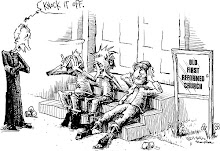
Brooklyn, New York—For his Atlantic Yards project Bruce Ratner promised a grandiose "urban room” and a tax generating office tower at the gridlocked Atlantic and Flatbush intersection at the heart of Brooklyn. He also promised to build "affordable housing.”
None of that is going to happen.
Instead, today the developer unveiled designs for an outdoor "public plaza” where the tower and atrium structure were promised, and told reporters at a press conference that his firm has no plans to build 15 of the 16 towers he promised to build, which would include nearly all of the "affordable” housing Ratner used to sell his plans to Mayor Bloomberg, Governor Paterson and a long list of other politicians.
"Ratner's not-so-pretty drawings of a barricaded, exhaust-enveloped plaza—including the absurd rendered fantasy of a traffic-less Atlantic and Flatbush intersection—is not the Atlantic Yards news of the day. The news of day, which is not surprising but is very troubling, is that Bruce Ratner admitted that he has no plans whatsoever to build the affordable housing he promised or the office tower he promised. It is crystal clear that Atlantic Yards is nothing but a scam, a money-losing arena, surrounded by massive parking lots, in the middle of a housing and unemployment crisis,” said Develop Don't Destroy Brooklyn co-founder Daniel Goldstein.
"Bruce Ratner has broken every promise he has made to the public—Mayor Bloomberg, Governors Paterson, Pataki and Spitzer, Marty Markowitz, Senator Schumer, and all the politicians who rammed this debacle down Brooklyn's throat, owe the public a big explanation, and need to take this land back from Ratner since he is not going to meet any of his promises.”
There is one outstanding lawsuit challenging Atlantic Yards. The suit awaits a ruling from a Manhattan State Supreme Court judge. The case made by DDDB and its 21 community co-plaintiffs, is further bolstered by today's admission by Ratner that Atlantic Yards needs a new environmental review as it is not the project that received a rubberstamp environmental approval in 2006. The case was argued on June 30th.
Tuesday, September 28, 2010


Friday, September 24, 2010
An Albino Gray Squirrel in Prospect Park

Photo taken just north of the Picnic House, September 13, 2010
Sermon for September 26, Proper 21: Prayer is Asking for Help

You can't always get what you want.
You can't always get what you want.
You can't always get what you want.
Buf if you try sometime, you find
You get what you need.
(The Glitter Twins)
Jeremiah 32:1-3a, 6-15, Psalm 91:1-6, 14-16, 1 Timothy 6:6-19, Luke 16:19-31
This is the only parable in which Jesus gives a character a name, so the name of the beggar is a key to the parable. What "Lazarus" means is "God helps."
At the beginning of the parable the rich man doesn’t think he needs God’s help, because his life is just fine. At the end of the parable he’s asking Lazarus to be sent back to help his brothers who are just like he was. Abraham answers that sending him back will not help them. They want to be blind. They want to be deaf to the words of Moses. They want to be self-indulgent and self-satisfied.
The parable has play in it—the rich man was being helped by Lazarus all along, just by lying at his door, just by his painful presence, he was offering the rich man a chance to be caring and kindly and generous. He was giving the rich man the chance to practice what Moses said about helping the needy and the poor. Lazarus was helping the rich man to be righteous and godly and faithful and loving and patient and gentle. But the rich man refused the help.
(You know we’ve been praying in this church for passionate spirituality. I wonder if God has answered our prayer by sending us Joe and Lacey. We cannot help them except by practicing passionate spirituality.)
What kind of help do you want from God? What kind of help do you pray for? It is right for you to ask for ordinary kinds of help. Jesus tells you this, in the Lord’s Prayer—you pray for your daily bread and you pray that God will save you from the time of trial. And when you pray Psalm 91, you pray for rescue and deliverance, you pray for safety in time of trouble. And in the Psalm God promises that, "When they call to me I will answer them."
People have been praying for help to the gods and goddesses since our evolution from the other primates. Help us when we hunt for meat. Help us when we plant our crops and harvest them. Help us in childbirth, help us in sickness, and help us when we die. The prayer for help is the most basic kind of prayer there is. You should do it. And the kind of help you pray for depends on the kinds of gods or goddesses you believe in.
The God we believe in is the God of Israel. The God we believe in is a covenantal God. A covenantal God is a God of faithful relationships, a God of promises, a God who talks to us, to everyone of us. The talk of God is recorded in the Bible, for the purpose that everyone of us can know what God says equally and publically. And what God has said is how God helps us. God helps us in many subtle ways, but the basic way God helps us is by what God has said.
That’s how God was helping the rich man, by what God said through Moses. God was helping the rich man to be a righteous man, but the rich man refused that help by ignoring what God had said.
God does not help us like the other gods and goddesses were thought to, by special favors here and there, by special preferences depending on how they like us. I know that many believers have this view of God today. "God help me with this, God give me that." Now I am not saying you should not pray like that. You should. "God help me get this a job. God help me with this task. God give us success, God bless our crops and industry, God heal me from this illness, God save me from death." Yes, pray that way. But you must pray this way by faith in God.
Whatever help you ask from God, you also need to say, "And let your will be done." Whatever particulars you ask of God, you also need to trust God’s providence. You need to trust that the providence of God for you may differ from the help you’re asking for. I know it personally. For many years I prayed for help in one thing and what God helped me with was something else, which now I’m very grateful for. But I still pray for help in terms of what I can see right now.
You see the dynamic with Jeremiah. Jeremiah was in jail and Jerusalem was under siege. The help that they were asking for was different than the help that God would give them. God would not free them now, because the siege was from God’s judgment. But God would give them back their future. They could count on it. You can invest in it, even if it’s right now under evil occupation. The help God gave to Jeremiah was help for his faith and for his hope.
This is the second sermon in my series on prayer. This week I’m saying that prayer is asking for help. Last week I said that prayer is managing the contradictions of our lives. These two aspects work together. Because as soon as you ask for help, you deal with the contradiction of your predicament against God’s promises. This disconnect, this gap, this chasm sometimes, this evident contradiction is what drives you to live by faith and hope and love. But God helps you with your faith and your hope by giving you all these wonderful words that feed your faith. You needs these words to keep believing, there are so many contradictions in the Christian life that if you don’t keep repeating the words of God your faith will fail.
But God helps you with another gift as well, the gift of the Holy Spirit, inside you, which you must believe is given to you without your having to feel it. This is the gift of God’s own power and personality inside you to help you understand God’s word that you can believe it, and the fire of God inside you to give you the hope you need to cross the disconnect, and the love of God inside you to give you the love you need to manage the contradictions in your life.
So what is the help that you should pray for? Let me repeat that you should keep on praying for the usual kinds of help. You should pray for help in time of need, in time of birth or illness or death, help to get that job, help to get that house, help to make ends meet, help for daily bread and help in time of trial and temptation. The typical particulars.
But you should also pray for the special help of the God of Israel, which is the help of God’s word and God’s spirit. Help me with your word, O God, and help me with your spirit, and then help me with these other things as well. You can keep on praying for the typical particulars if you also pray for the help of God’s word and God’s spirit.
But now let me exhort you to some atypical particulars, some unusual kinds of help to pray for. They’re in the epistle, chapter 6:11: "pursue righteousness, godliness, faith, love, endurance, gentleness." The way that I suggest you pursue them is to pray for them. Pray for help in getting that job, and also pray for help in righteousness. Pray for help in doing your job, and also pray for help in godliness. Pray for help in your finances, and also pray for help in living by your faith. Pray for help in dealing with your family, and also pray for help in love. Pray for help in healing your sickness, and also pray for help with endurance. Pray for help in having success in your life, pray for help in achieving your dreams and purposes, pray for help in making a difference in the world, and also pray for help with gentleness. Not just for yourself, but for our witness.
Our nation needs it desperately right now. Our nation is being ruined by the love of money, which is the opposite of godliness. All the evils that our nation is facing today have entangled roots, but at least one root of all of them is the love of money. And Christians who love money cannot be godly in their Christianity and cannot be gentle in their way of life. The religion that is needed by America is one of gentleness. Not a godliness of wars or violence or opposition or of burning books, but a godliness of gentleness. Not from weakness, but gentle from the strength of our endurance, gentle from the long endurance of our love, gentle from the toughness of our faith in God, gentle from our desire for righteousness.
God help us to be righteous and godly and gentle. God help us with your spirit and help us with your word. And having helped us with these first, then help us with everything else as well.
Copyright © 2010, by Daniel James Meeter, all rights reserved.
Wednesday, September 22, 2010
The Ordeal of the Sermon
Click right here for a link to my short essay on preaching which was just published in Perspectives: A Journal of Reformed Thought.
Thursday, September 16, 2010
Sermon for September 19, Proper 20: Prayer is How To Manage Contradictions

Jeremiah 8:18-9:1, Psalm 79:1-9, 1 Timothy 2:1-7, Luke 16:1-13
Some of Jesus’ parables are difficult. Like this one. Does Jesus really approve of a the dishonest manager? Is Jesus really advocating kickbacks? Doesn’t this contradict morality?
Remember that a parable is a story told on a curve. Jesus throws it like a curve ball. The pitch comes at you looking straight, and then at the plate it suddenly drops, and it moves inside and outside, where you don't expect it. A parable has play in it, it teases you, it resists you, it offends you, it judges you, and you have to let yourself be judged. To get it you have to give in to it. You can't stay standing in your normal stance. Your ideals of the good fall short of the actual reality of the world, the fallen world, the world which God loves but which is also under judgment.
A couple details. Verse 9: “Eternal homes” is literally, “pavilions of the age,” the pavilions of the kingdom that is coming. Think of great big party tents, pavilions of public feasting in the age to come, after the final judgment. To be part of that celebration then suggests you live right now in contradiction to including yourself among the best and the brightest. And you will be a lonely person in the kingdom of God if you try to stand on the goodness and the rightness of your morality and your mind. Give that up. Be accepted for the silly reality of what you are.
The word “wealth” is “mammon.” It doesn’t mean great wealth, but the common wealth of common people, your ordinary capital, your ordinary equity, your share in the economy of ordinary life. “Dishonest wealth” is a better translation than “unrighteous wealth.” Unclean wealth, unkosher wealth, crooked wealth. Like Jesus’ people having to use the Roman coinage with Caesar’s image on it, a constant violation of the second commandment. Just to participate in the economy was to keep breaking the commandment, making all their wealth unrighteous, no matter how honest their dealings or innocent their intentions.
Like our own participation in a world economy with its capitalist concentration of economic power, in a global system which increases the wealth of the wealthy and the poverty of the poor, exhausting our natural resources, and polluting the planet. We enjoy its benefits, but if we hold to the stance that our economic life is morally respectable or acceptable or even neutral, then this parable whizzes right by us, and we strike out. This parable has judged us. We are trying to serve two masters. We want to serve God, but we want to preserve our economic loyalties. So we all of us have to let ourselves be judged in order to face the reality of the contradictions of our life in this world every day. None of us can claim the stance of having solved it or of gotten it right. The wisdom here is for each of you to admit that whatever wealth you have is somewhat crooked.
The manager in the parable solved his problem by giving kickbacks. But the real point is that he did not try to defend himself or even plead his case. He just faced his own unrighteousness. You do the same, don’t stand on your innocence, just come to terms with your unrighteousness, be as shrewd in your own predicament as the manager was in his. Accept the judgment of God, don’t argue it or deny it. Accept yourself as contradictory. Don’t try to show the rightness of your mind or your morality. Don’t keep swinging. Just take the four balls. Get on base with a walk. Forget about your batting average. Live by grace, God=s grace, live by undeserved grace.
This sermon is the first in a series on prayer. Each week I’ll be asking the scripture lessons what they might tell us about prayer. This morning I’m saying that prayer is how we manage the contradictions of the world and the contradiction of our own selves. Look at the prayer which is Psalm 79. The Psalm comes to God with a problem. O God, we are supposed to be your chosen people, but look at our predicament. “The heathen have conquered the promised land, the temple is defiled, and Jerusalem is a ruin.” What happened to your promises, what happened to your faithfulness? “The harvest is past, the summer is ended, and we are not saved. How long, O Lord, will you be angry forever? Help us, deliver us, and forgive our sins, for your name’ sake.”
The prayers of Israel hold up the contradictions. The prayers of Israel are not idealistic, they do not smooth things over, they do not try to solve the contradictions or make things all add up. The prayers of Israel manage the contradictions just by holding them up to God. “Here is the situation, we cannot solve it or resolve it, we will not pretend we understand it, we will not pretend that we are in the right, we will only say that we need you desperately, and your forgiveness.”
The spirituality that is popular today prefers an idealistic unity. You know, everything comes together as one, and it all makes sense. But organized religion confronts us with contradictions. The liturgy in church gives words to the contradictions you live with every day, not least the contradiction of yourself. They way you manage your contradictions is by holding them up to God, by trusting in God=s mysterious responsibility, and kneeling down in your mind and body.
In St. Paul’s day, the greatest contradiction was to be the citizen of an empire that would kill you if it really understood what you believed. There was no separation of church and state, and Caesar claimed to be Savior, Lord, and Son of a God. When St. Paul made that very same claim for Jesus, he was being seditious. To be a Christian in the Roman Empire was to be in constant contradiction. The eventual persecution was inevitable, once the authorities figured it out. And yet St. Paul exhorted Timothy to keep praying for God to bless the authorities.
We do that too. We pray together, we hold up to God this world of contradictions and conflict, and we hold up to God the predicament of our own inescapable unrighteousness. Prayer is not a solution, it’s not a resolution, but it is an engagement, and an action, and an active reconciliation. And it’s the only way to live in love within the midst of all the frustration and the anger and the hatred.
I have told you this story once before, and it’s not a parable, so I’m telling it to you straight. I know a woman named “Deborah”, from Chile, in South America. She is a jeweler, but she was also a political activist, and she had worked in opposition to the dictator General Pinochet. She got arrested and interrogated by the CIA and tortured. They broke her fingers and her hands were soft like rags. One of the torturers demanded that she maker her a ring like the one they had taken from her. How could she do this? With her hands like this? For her torturer? She said she would do it if she could also make something special for herself. The torturer shouted, “Nothing political.” Deborah answered, “No, I want to make a Star of David. I am a Jew.”
It took her five days to make that piece of jewelry. As she made it she could feel her fingers heal and her hands made whole. She told me that the whole time she was making it, she could sense the Shekinah of God—the glorious presence of God—right there in the prison with her.
You can believe this story. It is true. Her making that jewelry was a kind of prayer. You can do the same thing when you pray, if not so extreme. If you want to pray, begin by choosing one of the psalms of contradiction, giving words to the contradiction of yourself and of the world. Pray that same psalm over every day. The solution will not come to you in the logic of philosophy or science or even theology. And it will not come to you in your feelings but in your faith. Your solution is the humble silence of the knowledge of God, the knowledge of the mystery of God and the grace of God.
Yes, you can start your praying with the Psalms of Israel. And I can offer you real hope, from my own experience and the experience of many other people, that if you keep on praying the Psalms, you will make yourself be present to God and God will be present to you. The hope you have is not a feeling but a being. God’s own person is your hope.
Copyright © 2010, by Daniel James Meeter, all rights reserved.
Please note: the piece of jewelry at the top of this posting is the actual piece of jewelry that Deborah made in prison.
Saturday, September 11, 2010
Sermon for September 12, Proper 19, Nine Years After Nine Eleven


Jeremiah 4:11-12, Psalm 14, 1 Timothy 1:12-17, Luke 16:1-13
Jesus poses these two parables as questions. “Which one of you, having a hundred sheep,” and then, “What woman, having ten silver coins.” To the second one the answer is obvious: “Any woman would.” But to the first one the answer is the opposite: “No one would.” No one would stupidly risk the ninety-nine for the sake of the one. You would simply write off that last sheep as normal business management. What’s a one percent loss, when standard depreciation is ten percent?
The answers are opposite, but Jesus combines these two parables. He means that your answer to the second question makes you go back again to the first question and answer it contradictorily.
Not “No one would,” but “Anyone of us should risk the ninety-nine to save the one.” Jesus is saying, “Maybe you wouldn’t do it, but I would.” The Messiah would. The Messiah would because God does. To God, every lost person is of inestimable worth, the most despicable, the least acceptable, the most unfit. To bring such a one is what God rejoices in.
It’s what the cops and firemen and rescue workers did, nine years ago, while the buildings were still burning, and then in the first days after the attack. They counted every last lost person to be of inestimable value, no matter who it was. Even at the cost of their own lives. Which one of you would do the same?
You know that my coming here as your pastor was bound up with 9/11. Nine years ago, on the Sunday after the attack, I preached my candidating sermon, and on these same scripture lessons. They were remarkably relevant, especially the Jeremiah text, which gave words to the disaster. First, God speaking:“A hot wind comes from me out of the desert, toward my poor people, not to winnow or to cleanse, a wind too strong for that. Now it is I who speak in judgment against them.” Then the prophet reporting, “I looked on the earth, and it was waste and void, and to the heavens, but they had no light. I looked, and the birds had fled, I looked, and the cities were laid in ruins before the Lord, before his fierce anger.”
Nine years ago some fundamentalist preachers interpreted the terrorist attack as the judgment of God on America, for this sin or for that. They were wrong. I can tell you that God does not use such violent means to judge us. Our Reformed tradition teaches that all such violent kinds of judgment came to a definite and discernible ending at the death of Christ. God’s judgments are simply and cleanly offered in the words of the scriptures, God’s judgments are freely and earnestly offered for your reading and your understanding. God does not communicate with us by sending us sickness or loss or terror, God does not use violence of any kind to judge us. God judges us graciously in the words of Jesus and the apostles, God judges us faithfully in words of the law and the prophets. We read and mark and learn these words, we inwardly digest them, and by God’s grace we judge ourselves.
9/11 was not a judgment sent from God, but it was certainly an incentive and opportunity for our self-examination. Not to excuse the terrorists, but for us to fall to our own knees for mercy. To return to the Gospel, to judge ourselves by the Law of God again, because it’s always our privilege to be judged by God. Yes, it is our privilege to judge ourselves by the Word of God.
Those preachers were wrong to say that God had sent those terrorists as a judgment on America, but I prefer that mistake to so many of the later co-options of 9/11, as we are seeing now again. To stir up anger against the rest of the world and to respond to the violence with our own violence and our own Christian holy war. As if America had the right to righteous anger, as if we are a special sacred Christian nation about to be profaned by the knees of Muslim men at prayer. As if it were God’s job only to bless America and not to judge us. As if our society does not stand in constant need of mercy. And losing our conviction of needing mercy, our nation is losing our capacity for joy.
The gospel reveals the truer legacy of 9/11, that of the shepherd risking everything for that one sheep, the firemen in the stairwells giving their lives to save the lost, and then digging in the rubble for one more survivor or their last remains, the legacy that every single person, no matter what race or religion, is a silver coin of absolute value. We Christians stand for a society which spares no effort in the rescue of every victim—the victims of terrorists, but also the forgotten victims of our ordinary way of life, the unnoticed victims of the underside of our economy and those who live in the shadows of our great society. We Christians stand for an America that is rich in reconciliation and most powerful in mercy.
Our scripture lessons speak of judgment and of joy. These two words are joined by the hinge of mercy. Mercy is rich. Mercy is grace and generosity. Mercy is self-giving and self-sacrifice. We stand in mercy, we can stand up straight in mercy when we have bowed down low in receiving mercy from a righteous God who judges us in love and reconciliation. We accept the privilege of being judged by God, we come to know ourselves in terms of mercy, and what that yields in us is joy. From judgment through mercy to joy. We Christians and Jews and Muslims are alive to the mysteries of mercy, and we stand for a society which God blesses by judging, not by violence but in God’s word, which calls us out to joy. Not this anger that we see today, not this hatred, this bitterness, this self-righteousness, this fear. But judgment and mercy and joy.
I don’t remember what I said in that sermon I preached nine years ago. I don’t remember having noticed that I preached it on the twenty-first anniversary of my ordination. As Abraham Lincoln said, “the world will little note nor long remember what we say here.” I don’t expect you to long remember what I tell you on my thirtieth anniversary. But I offer you my testimony, which echoes the testimony of the Apostle Paul in our second lesson.
I can tell you without reserve that I have never been so joyful in my life. Oh yes, I have my burdens and frustrations, I have my own share of grief that I live with, but these are only the sandbars in the daily river of my joy. When I came back from Canada I found myself joyful to get back to work. It gives me so much joy to be the pastor of this church, that I should be here now, with you.
It gives me so much joy to have you people in my life, with all your personalities and your talents and your interests and your desires and your trouble. It gives me joy to face the challenges we share. It gives me joy to have the privilege of leading you, of preaching to you and teaching you, of interpreting the Bible for you—that I get to study the Bible on your behalf, that I get to pray for you and be prayed for by you. Who am I? That I should serve a church that has welcomed an imam to pray here? That I should serve a church that hosts a synagogue for High Holy Days? That I can worship with Jews right here in our own sanctuary is a high point in my ministry. That I should serve a Reformed church that celebrates holy communion every week, that I serve a church that welcomes everyone no matter what their sexuality, that I serve church that welcomes me, that I should serve a congregation 356 years old—O brave old church, that has such people in it.
But most of all it gives me such great joy that I have been the recipient of so much mercy. Mercy from my children, mercy from my family and my friends, mercy from the consistory, mercy from the classis, mercy from those who love me and mercy from those who don’t. I accept all of your judgments of me as true. And I thank you for your mercy. Especially the mercy of my wife, my companion and my lover and the chief joy my life. But most of all, the mercy of God. New every morning, I stand in mercy every day, and that’s what generates my joy.
Look at that stained glass window there, the triptych in the north wall. Notice all the colors in it, the joyful colors in it, the signs of the bread and the wine, the banquet of our joy. And look Jesus and the sheep. That’s where I see myself today. The Lord Jesus there, he daily comes to find me in his mercy. He counts me worthy to stand next to him, and he carries me when I need carrying. He is the savior who saves me and brings me safe to God, and I am joyful to serve him as my Lord.
Copyright © 2010, by Daniel James Meeter, all rights reserved.
Sunday, September 05, 2010
Sermon for September 5, Proper 18, "The Unbearable Lightness of Being"
 (Painting by Sir Stanley Spencer) Jeremiah 18:1-11, Psalm 139:1-6, 13-18, Philemon 1-21, Luke 14:25-33
Why was Jesus so extreme, that you have to give up all your possessions? Does it even work? Wouldn’t you just be dependent on someone else who has possessions? Like a Buddhist monk? ike St. Francis of Assisi and Mother Teresa? Or let’s say you have small children—there’s a lot of plastic toys you could give up, but all your possessions would be irresponsible. Now I don’t like to resort to not taking Jesus literally. His words are clear. But how do we obey him and still have a realistic life?
Jesus is on his campaign toward Jerusalem. The crowds keep increasing. They think that Jesus is leading a regime change, and they want to be on his side when it happens. They’re excited, his kingdom is at hand. So Jesus gives them fair warning. "I want you under no illusions. What I will deliver is not what you’re expecting. It may cost you everything. Whatever you value, let go of it now, or do not follow me."
That was the message for them. What’s the message for us? Does God mean to scare us off? You want to get close to God, that’s why you’re here, you are drawn to Jesus, you want him to make a difference in your life, but when you get close to him, he turns around and talks like this, to renounce all your substance and your relationships and all that you hold precious.
We should not soften this hard saying of Jesus. "To follow me you must give up all your possessions." Let’s keep it as something hard and challenging, something to reckon with. If you have a place on your refrigerator for nice sayings, add a place for hard sayings, and put this one there. Jesus presents us with a problem we cannot solve, or make to go away. He gives you a problem to live with all your life. You have to keep coming back to this and measuring yourself against it, examine yourself, judge yourself. Always question the reasons by which you convince yourself that you need this thing, or that connection, or this arrangement.
God places no value on your affluence. God has no interest in protecting your possessions for you, or of getting you more of them. That’s not what God does for you. God’s opinion about your possessions is right here in Luke 14. We have to keep coming back to that. We keep returning to the sober realization that the Christian life is as often a life of loss as it is of gain. It will cost you. Especially when you’re aiming for justice and righteousness in a world that is bent towards injustice and ungodliness, then you will often feel like you are losing, not winning. In this world, to accomplish any real kind of moral change requires that you must sacrifice, maybe even your life.
That’s the meaning of carrying your cross. When Jesus said these words to the crowd, the cross was not yet the religious symbol of Christianity. When Jesus said these words to the crowd the cross was a symbol of Roman domination. Rome had occupied their country, they were a subject people, they had no civil rights, even in their own land they were not citizens. The punishment of crucifixion was one of the things that kept them in line. It was a slow and painful death in the full view of the public, to keep the people down. When they saw you carrying your cross, you were a dead man walking. Unfairly or not, you were a goner.
"Jesus, is that what you’re saying, that we should live as losers to the power of the world, surrendering to injustice? Can’t we be winners, can’t we be heroes? Are you saying not to arm ourselves against oppression, not to stand with courage and fight it, risking death with pride? You mean to surrender to it, like losers with our crosses on our shoulders?"
No. It’s precisely because Jesus did not surrender that they killed him. It’s because he kept saying exactly what he wanted and did exactly as he willed. In that sense they had no power over him. He was free to the end, but he knew it would cost him. How much do you want to be free?
If you are carrying your cross, you cannot carry a sword. When will the world ever learn this? That the only way to accomplish any justice and progress in the world is not by carrying weapons but by carrying the cross. Every movement, and every nation, must return to this.
Notice that Jesus says, "Your own cross." Not the Roman cross. Three times he says it, "one’s own cross." The Romans may seem to be the problem, and while it is true that they are unfair, the real problem is always yourself. It also means that it’s not your possessions themselves that are your problem, but you who possesses them. It’s your possessing that you have to renounce and let go of—the world you build around yourself, how you define yourself, what you’re invested in. Your problem is not what you have but your having. Your enemy is you.
I once had a parishioner whose husband treated her badly. She put up with it, and always said, "He is my cross to bear." No he’s not. That’s not right. She was bearing her husband’s cross instead of her own. As long as she was bearing his, he didn’t have to, and she was kept from bearing her own. The possession she had to give up was her marriage to that man. But had she done that, all her family would have reviled her. Her husband’s family, yes, but her own family too. They would have accused her of disloyalty and selfishness.
That’s what Jesus means when he says you have to hate your father and mother, he doesn’t mean the internal emotion, he means the external reputation, that your family accuses you of not considering them, or of not loving them enough. They act all offended at you, and sometimes that’s the cost of discipleship. They may cut you off from their good graces and their sympathy; and that’s when you realize that you have begun to carry your cross. "If you follow me to Jerusalem, these are the issues and trials and temptations you will face. Are you ready for it?"
Discipleship is a stretch. Christians have to stretch towards obedience and devotion. Yet your discipleship is the most important thing in your life, even worth dying for. Not as a hero—heroes don’t get crucified, they win. No, in the far less glamorous service of ordinary life, of family life, the way you deal with your parents or your spouse or your kids or your own siblings, that’s where discipleship is costly. And in ordinary economic life, the things you buy and sell, the things you own, what you take care of. Everything counts. We’re always counting the cost of discipleship.
The crowd got bigger anyway, even as he entered Jerusalem. But when the pressure got too high they deserted him. He cost too much. Finally even the twelve disciples deserted him. They didn’t want to get near any crosses. So on the basis of what he says here, did that mean that they could no longer be his disciples? Does this mean that none of us can be his disciples?
You know, ironically, Jesus didn’t carry his own cross even though he died on it. An African named Simon of Cyrene carried it for him. There’s a mystical exchange in the gospel. Jesus did the dying so that you don’t have to. Jesus does the dying but not the carrying, You do the carrying but not the dying. His death has virtue for you, to free you from the domination of death. If you carry your cross, you will die not on it, but in peace. You are not carrying it towards the crucifixion but away from it.
There is a mystery of exchange and substitution here, of ransom and replacement. Your cross is for yourself, your reminder of the challenges of Jesus in terms of the life ahead, very down-to-earth. You measure yourself only by his words, and that gives you freedom. You discover that the cross is light. It looks terribly heavy until you shoulder it, and then it’s light. When you have given up everything, in the way that Jesus says, you discover that the unbearable lightness of your being is not unbearable but joyful. You carry your cross away from the crucifixion, you carry it lightly, as a testimony of your gratitude and thanksgiving.
Copyright © 2010, by Daniel James Meeter, all rights reserved.
Thursday, August 26, 2010
Two Poems from 1984
Both are by my wife, Melody Takken Meeter, and originally published in the Reformed Journal.
Easter Sermon
The Pastor’s hands rise lightly as petals
above the lilies massed around the pulpit.
My eyes challenge him:
this week I read some theology, a book by Pannenberg,
and held my breath to watch him coolly discarding miracles
like the first drafts of the early church.
Virgin birth, angel chorus, healed lepers, Cana wine, demon swine,
none passed through his literary ordeals.
But at the Resurrection Pannenberg paused,
like an amazed reporter watching the unknown runner
win the big race.
He saw the body,
running secretly through the long years,
Body that rising burned its shroud
and burned its way through history home to us.
Today I challenge you, Pastor,
to spare us the pastel prose
delivered with eyes averted
as from His own naked body:
if Christ died for good, two thousand years ago,
then I confess nothing but that
a rose is not a rose
and those lovely lilies smell like death.
Baptism
i.
A nurse brings our new daughter
plus the new Time magazine
from its cover stares a child
whose tiny cranium curved toward death
forms a bony question mark
whose ribs like razors
pierce the sweet skin from the inside out
to underline the question:
Where is God?
while my daughter, placid as a frog,
sucks abundant life from me
center of her universe.
ii.
I dream about a demon
a charred face bloody face
calls me from a doorway calls
my name
His robe of pleated light
fans in and out like gills
in each fold I read my fear
in fear I follow
down stairs that fall forever into black
I fall but reaching wildly out
the only solid thing I touch is terror
I cry and shake myself awake
certain that my daughter died in sleep.
iii.
Drops of water on my daughter make her frown
buried in water down she goes
down to the hell that Jesus knows
down to the blackness in my dream
down in the darkness to get clean.
Father, Son, and Holy Ghost, here’s our daughter,
be pleased to make the most of her.
Open her instinctive fists,
like ours, ready to protest
any lowered standard of living
or one pinch more than a tenth of giving.
We give her, with misgivings, to the One
who sometimes like a demon comes
and takes us down to sight-see hell
where starving children wait in cells.
Daughter, receive your dripping crown
with its dubious title to travel down
shouldering your pain and everyone else’s;
gloria in excelsis.
Easter Sermon
The Pastor’s hands rise lightly as petals
above the lilies massed around the pulpit.
My eyes challenge him:
this week I read some theology, a book by Pannenberg,
and held my breath to watch him coolly discarding miracles
like the first drafts of the early church.
Virgin birth, angel chorus, healed lepers, Cana wine, demon swine,
none passed through his literary ordeals.
But at the Resurrection Pannenberg paused,
like an amazed reporter watching the unknown runner
win the big race.
He saw the body,
running secretly through the long years,
Body that rising burned its shroud
and burned its way through history home to us.
Today I challenge you, Pastor,
to spare us the pastel prose
delivered with eyes averted
as from His own naked body:
if Christ died for good, two thousand years ago,
then I confess nothing but that
a rose is not a rose
and those lovely lilies smell like death.
Baptism
i.
A nurse brings our new daughter
plus the new Time magazine
from its cover stares a child
whose tiny cranium curved toward death
forms a bony question mark
whose ribs like razors
pierce the sweet skin from the inside out
to underline the question:
Where is God?
while my daughter, placid as a frog,
sucks abundant life from me
center of her universe.
ii.
I dream about a demon
a charred face bloody face
calls me from a doorway calls
my name
His robe of pleated light
fans in and out like gills
in each fold I read my fear
in fear I follow
down stairs that fall forever into black
I fall but reaching wildly out
the only solid thing I touch is terror
I cry and shake myself awake
certain that my daughter died in sleep.
iii.
Drops of water on my daughter make her frown
buried in water down she goes
down to the hell that Jesus knows
down to the blackness in my dream
down in the darkness to get clean.
Father, Son, and Holy Ghost, here’s our daughter,
be pleased to make the most of her.
Open her instinctive fists,
like ours, ready to protest
any lowered standard of living
or one pinch more than a tenth of giving.
We give her, with misgivings, to the One
who sometimes like a demon comes
and takes us down to sight-see hell
where starving children wait in cells.
Daughter, receive your dripping crown
with its dubious title to travel down
shouldering your pain and everyone else’s;
gloria in excelsis.
Monday, July 05, 2010
Thanks for the Time Off
Dear Friends:
1. My previous sermon I had posted on July 2, but I considerably revised it in the preaching, and that version is now posted in its place.
2. On Thursday, Melody and I will leave for a couple weeks' vacation at Bobs Lake, Ontario. After Melody comes back to Brooklyn to work, I will stay at Bobs Lake for a week of reading (Kiergekaard, among others) and then two weeks of writing. Thank you, Old First, for your wonderful support.
3. One of our young church members, Derek Keire, said a wonderful thing to me yesterday morning. He's only six, but this is what he said: "Pastor Meeter, I still get thrilled every time I get to go to church."
Do you see how I have the best job in the world?
Love, Daniel
1. My previous sermon I had posted on July 2, but I considerably revised it in the preaching, and that version is now posted in its place.
2. On Thursday, Melody and I will leave for a couple weeks' vacation at Bobs Lake, Ontario. After Melody comes back to Brooklyn to work, I will stay at Bobs Lake for a week of reading (Kiergekaard, among others) and then two weeks of writing. Thank you, Old First, for your wonderful support.
3. One of our young church members, Derek Keire, said a wonderful thing to me yesterday morning. He's only six, but this is what he said: "Pastor Meeter, I still get thrilled every time I get to go to church."
Do you see how I have the best job in the world?
Love, Daniel
Thursday, July 01, 2010
July 4, Proper 9, The Kingdom of God Is Near (revised July 5)

2 Kings 5:1-14, Psalm 30, Galatians 6:1-16, Luke 10:1-11, 16-20
The kingdom of God, the kingdom of God, the kingdom of God. It’s the key to understanding Jesus in the gospels, what he said and what he did. It’s also the key to understanding the Pharisees, who were trying to earn their version Kingdom of God, and the Sadducees too, who were trying to hang on to their version of the Kingdom of God. They had a three-way debate about the Kingdom of God.
The kingdom of God, the kingdom of God, the kingdom of God. It’s the key to understanding Jesus in the gospels, what he said and what he did. It’s also the key to understanding the Pharisees, who were trying to earn their version Kingdom of God, and the Sadducees too, who were trying to hang on to their version of the Kingdom of God. They had a three-way debate about the Kingdom of God.
What does it mean, the Kingdom of God? The reign of God, the dominion of God, the sovereignty of God, the Lordship of God, the government of God, the policies of God, the laws of God, the economy of God, the Gross Domestic Product of God, the commonwealth of God, the realm of God, the nation of God, the population of God. A kingdom is political, but it is also more personal than a republic, because a kingdom has a single person at its center, who is the object of your loyalty.
In our gospel story Jesus is acting like he’s the king of the kingdom of God. In a double way. First, he’s acting like his ancestor David in his approach to the city of Jerusalem. While in previous years he had come to Jerusalem as a rabbi, this year his approach is a campaign. Second, his appointment of the Seventy is a recapitulation of what God had told Moses, in Numbers 11, as the campaign of the Israelites approached to occupy the Promised Land, liberating it from the demons who were worshiped by the Canaanites. At that time the only King of Israel was the Lord God, so here in Luke, Jesus is not only acting like David and but even acting like God. It was a daring thing for a man like Jesus to act like the God of Israel—who does he think he is. Well, the Lord!
The Kingdom of God, the Lordship of Jesus is approaching, and to every town and village his seventy reps are announcing he is coming. The people will be nervous. What does it mean he’s coming, with his kingdom? Will it mean judgment? Yes. But it also means peace, and healing, and liberation from the demonic powers of the world. You might call it counter-insurgency, you might compare it to NATO moving through the villages of Afghanistan to liberate the people from the power of the Taliban, or you might avoid that comparison, because the strategy of Jesus is the epitome of peace. The only weapon of Jesus is the power of his Word—the good news of his Lordship and that all that he taught and did these last three years are true.
Now let me make this personal. What does it mean for you to be a Christian? In functional terms, for most of us, it means we go to church. Which is good, and necessary. Now I suppose you don’t absolutely have to go to church to be a Christian, but that’s like saying you don’t have to eat vegetables to be a human being. Going to church is the vegetables of being a Christian. But the church is not the goal of being a Christian. The church is the means, the necessary means, a means ordained by God and even expected of us by God, but it’s still a means and not an end.
So, while in functional terms, to go to church is what it means to be a Christian, in Biblical terms it means to live within the kingdom of God. To live within the realm of God and the sovereignty of God, in the economy of God and among the population of God. We do church in order to be gathered into this kingdom and protected within this kingdom and to learn and to practice this kingdom’s policies and economy and ecology—the policies of peace and the economy of reconciliation and the ecology of love.
The kingdom of God is the favorite theme of Jesus in the gospels. In Matthew, Jesus calls it "the kingdom of heaven", because heaven is its capital, and because the kingdom arches over everything. In John, Jesus calls it "life" and "abundant life" and "eternal life." St. Paul’s phrase for the kingdom of God is "the power of the resurrection." When the Book of Acts talks about "salvation," it means being rescued from the power of sin and empire of death and preserved for the life of the Lordship of Christ. Salvation is not just a private and personal thing, it’s a whole campaign, it’s a movement, a movement of history, in the principalities and powers of the world. It must be as large as a new creation, considering who the Lord is at the center of this sovereignty.
But it is personal. It is for you. The kingdom of God is for you in your particular personality and circumstance. You can see it in this wonderful story in our first lesson, from the book of Second Kings. I love this story for its charm and irony and gentle humor.
Look, why didn’t God just heal Naaman from his leprosy right there in Damascus, directly, without any prophetic intervention? God could have done so, which we know because God had given Naaman his victories in battle with the Kingdom of Israel, directly, without any prophetic intervention. But that’s not what God did, because this story is about the Kingdom of God and its affect on Naaman, and how he entered it.
At that time the Kingdom of of God had a particular manifestation in the Kingdom of Israel, with its capital in Samaria. And because of its idolatry and its disobedience to the Torah, God was judging it, and using Naaman’s victories to do so, though without Naaman’s recognition. Naaman must have regarded the God of Israel a very weak god indeed, unable to defend his people from their enemies. But the Sovereignty of God is never limited to its particular manifestations.
Indeed, in Israel, the Kingdom of God was not bound to the pretenders in the capital, but represented by the loyal opposition, the community of the prophet Elisha; humble, and without an army, and comparatively powerless, but loyal to the name of God.
Naaman has to come here to be healed, to the hidden realm of God within the Kingdom of Israel. And once he gets here, yes, the prophet could have come out and waved his hand and ordered the leprosy to go away, but there’s a reason that he’s commanded to wash in the Jordan River. He has to pass through the waters. The Children of Israel had to pass through the Red Sea on their way out of Egypt, out of the empire of their bondage, and they had to pass through the Jordan River on their entrance into the promised land, the realm of God. The water is a boundary, a kingdom boundary. You have to enter the kingdom to be healed. Even Naaman has to enter the kingdom to be healed. And his entering the kingdom is the same thing as his healing.
The story tells us he was tempted by his pride. Just the thought of standing naked on the river bank before his retinue—in Middle Eastern culture it is a shameful thing to show your nakedness. And even more shameful they all would see his leprous skin. But I guess he was a brave man to begin with, and I guess that "for the sake of the hope that was set before him he could despise the shame."
And I am guess that he was tempted by his fear. For what if it didn’t work, and all this self-exposure was for nothing? Suddenly I love this man, this Naaman, not only for taking the advice of his little slave girl, but also for taking the admonitions of his servants, how truly brave was that (the greatest bravery is to be humble and to admit your mistake), and so desperate to be clean.
Sympathize with him, going in once, and coming back out still leprous. Going back in and coming back out, still leprous. A and all his retinue are watching, and hiding their eyes, and counting, four, five, six, seven, and then the relief, and the joy, and the vindication of the name of God, that this God of Israel really does have power to save, and that the power of God’s judgment, if you just accept God’s promises, is very much the power to save. You, yes, you in your particular personality and circumstance.
You can be saved from yourself, from your pride and from your fear. You can have power to despise your shame, though that requires going through some salutary humiliation. You have to let yourself be washed, and that requires some exposure, and humility, for it’s like the elderly in nursing homes. But your retinue is on your side. We are your retinue, this congregation.
So is the reason to be a Christian. This what it means for the kingdom of God to come near you. That a sovereign God does this with you, personally, but not narrowly, as if it’s for yourself, but for your full participation in the people of God and policies and plans of God. You don’t have to rise to it, it has come near you, just keep coming every week and believe the words you hear and accept the forgiveness of your sins and eat with everyone else the food that is set out before you.
Every Sunday, when you confess your sins and accept the absolution—this is not just a merely personal thing, a self-help thing. This is a kingdom thing, this is your renewal of your citizenship, you reclaim your loyalty to your sovereign and your freedom from other bondages. And when you pass the peace, that’s not just a "nice hello," it’s a kingdom thing, because this is the peaceable kingdom. You are doing what the Seventy did in every town and village.
Some last words about the playfulness in this story, and the irony. The prophet Elisha doesn’t want to leave his crossword puzzle just to see Naaman, so he sends his servant out, which Naaman takes as an insult. You know, the gospel is that matter of fact, it’s nothing magical, it’s almost too simple for us to believe. And then the servants of Naaman are wiser than he is, as the little exiled slave girl was smarter and more confident than the king of Israel.
I think the irony expresses our real experience of the Kingdom of God in this world, how often weak it seems, and powerless, and how silly the church can be, and how halting our efforts at righteousness, and often other religions are ahead of us on some good things and other charities outperform us on healing the world. Take some comfort in the irony, and get used to it as good and Biblical. The irony is a judgment on us and on all our personal pretensions, but the playfulness is a sign of how good and gracious and peaceful is the result, and the laughter we hear from heaven is not mockery but the joyful laughter of recognition and love.
Copyright © 2010, by Daniel James Meeter, all rights reserved.
Tuesday, June 29, 2010
June 27, Proper 8, The Ninefold Guide

2 Kings 2:1-2,6-14, Psalm 77, Gal 5:1,13-25, Luke 9:51-62
Love, joy, peace. Patience, kindness, generosity. Faithfulness, gentleness, self-control. These are the fruits of the Spirit. These are what God the Holy Spirit wants to produce in us, to bring to fruition in us, to display on the branches of our lives for all the world to see. These are the fruits for the healing of the nations. Love, joy, peace. Patience, kindness, generosity. Faithfulness, gentleness, self-control.
These are what we want. Well, sort of. These are what the world wants. Kind of. We go chasing other things, we fix on the works of the flesh, we run our economy by the satisfaction of the desires of the flesh, our advertising keeps pushing the demands of the flesh, and when we find ourselves unsatisfied, or sick, or polluted, or in conflict, or at war, then we ask, what happened to love, joy, and peace, and where is that patience, kindness, and generosity, and how can I be faithful, and gentle, and self-controlled. God wants you to have them, but you can’t have them at the same time that you’re keeping the works of the flesh, so you have to ask how much do you really want the fruits of the Spirit, how much will you give for them? How much cost will you pay
or them? How much of yourself will you clear away to give room for the fruits to grow in you?
There is an urgency to this. There is a crisis here. You have to make some judgments. You have decisions here, and choices to make. And you have to keep repeating those choices. The flesh is natural and powerful, it keeps coming back, it keeps rising up, it keeps on pressing its case. It’s just part of the natural world. God does not desire that you flee from the natural world, God wants you in it, and so you cannot escape from its advertisements and the claims it makes, its pressure and attraction, its urgency.
Jesus says the choice is all or nothing. One road or the other. Not both—all or nothing. Strange to say, it isn’t black or white. Nothing is black or white. The roads are side by side; they cross a single landscape; they take the same gap between the hills, they can even merge for a stretch, and then you have to watch the signs and pay attention and choose again the one you want. It is not black or white. You can’t go about it legalistically. The legalistic solution is rejected by the Apostle Paul in the previous chapters of Galatians. As if what God wants for us is submission to a code of law that tells us what to do and not to do. That may feel safe, but Paul says that that is its own kind of slavery. Do not submit to a yoke of slavery. For freedom Christ has set us free. Freedom means it is not black and white. Freedom means you have to keep on choosing (your life is not all programmed for you), you have to keep deciding, and that is the reason for the constant urgency.
Do you sense that urgency in the gospel? And yet that it is not black and white? Jesus says that to follow him, the normal patterns just don’t count. It is one of the Ten Commandments to honor your father and your mother. Twice here Jesus suggests ignoring that law. If you honor your father, and your father has just died, your very first obligation is to bury him. "Lord, I will follow you, but first let me go and bury my father." That guy thought he was proving himself worthy of Jesus’ kingdom. But it’s not about worthiness, it’s about being open to the urgency. If a tidal wave were coming, if a volcano were erupting, you would run, you would flee, you would save your own life and let your father’s body be numbered with all the other casualties. "Let the dead bury the dead." It’s that urgent.
"I will follow you, but let me first go home and wish my family peace, honoring my father and my mother." But don’t you see how all or nothing is your loyalty? How bad do you want to live by the Spirit? How much do you still want to give to the life of the flesh, which quite naturally ends in death?
Jesus makes it a crisis here. Sometimes it’s the crisis of desperation. Most often it is far more subtle. You have to make the judgment in terms of where the choice will lead. Often it just feels like a guess. That’s the risk of freedom. It may look good, it may look bad, so will it lead to love, joy, and peace? Well, to get there, does it require faithfulness, gentleness, and self-control? When is love love, and when is love just lust? Here’s the test: does it require faithfulness, gentleness, and self-control? And is it expressed by patience and kindness and generosity? If you keep working these nine nouns, if you keep intermixing these nine characteristics, if you keep cross-breeding these nine fruit trees, you will develop a life that has a share in the kingdom of God. And the crisis will become an opportunity.
So often we respond to urgency with impatience. It’s natural to respond to the crisis with fear, and then we cover that fear with anger. So often when we have to make judgments we get judgmental. The disciples felt that urgency and they wanted to call down fire on the Samaritans. Jesus rebukes them. They thought they were serving God but they were in their flesh. It is natural. It is always with us. It is what nations do. If you don’t respond to the opposition by being stronger, you end up just a sitting duck. Like Jesus, hanging his weary head upon the cross. If we feel we’re in a crisis, then love, joy, and peace are counter-intuitive. They have to come from the Holy Spirit, they cannot come from natural human initiative. They take the miracle of God in you. This miracle is what the Holy Spirit offers you, and wants to make in you. Do you want it?
All you need to do is ask for it. That’s all. Honest. No other practices or disciplines, just asking. Like Elisha. Just ask for it. It’s as simple as every day, just saying two things: I confess my works of the flesh, and I ask for the fruits of the Spirit. I call it a double portion of God’s Spirit, the first portion of the Spirit is the Spirit of humility and grace, to be able to confess your sins and accept the forgiveness, to clear out the space, and the second portion of the Spirit is the Spirit of new life tenderly growing in that cleared out space. It’s a double portion of the Spirit for the double duty that you do every day, by simply saying, O Lord, I confess my flesh, and O Lord, give me your Spirit.
God wants you to enjoy the fruits of the Spirit. The flesh in us doubts that we can really live this way. Notice he doesn’t say the evil in us. He says the flesh. The skin. The meat on your bones. Your hormones and your nerves. Your stomach. Your allergies. Your headaches. Your credit card debt. Your need to go out and party on a Friday night. Can I have fun and still have self-control? Can I be funny and smart and still be kindly and gentle? Yes, you can. Can you love without lust? Can you have joy without indulgence? Can you have peace without surrendering?
Yes, you can. The Lord Jesus shows you the way, so follow him; the Holy Spirit empowers you, so clear yourself inside, and the community of Jesus will support you. We’re on this road together. A couple of us are strutting, but most of us are limping. We are limping to Zion. When you wander off the road, we will come and get you. When I take the wrong turn, you will nudge me back. Endlessly. Even tackle me and drag me back. No matter how many times.
And we help each other see. We are prophets for each other. Not so much Elijah, as Elisha to each other. "Father, father, the chariots of Israel and its horsemen." To see the true power of God in the very midst of an apparently powerless situation. To see the Kingdom of God that is already here and here among us and all we need to do is receive it.
How do you know that you are acting within the Kingdom of God? Not by following some new set of laws, but when you feel free. And not a freedom of self-indulgence, but the freedom to practice love, joy, and peace, and the freedom to indulge in patience, kindness, and generosity, and the freedom to exercise the power of faithfulness and gentleness and self-control. Our horses are love, joy and peace, our chariots are patience and kindness and generosity, and faithfulness and gentleness and self-control is the mantel we put on whenever we come together here.
Copyright © 2010, by Daniel James Meeter, all rights reserved.
Thursday, June 24, 2010
Rachel Daley in South Africa

Rachel Daley is in South Africa. Rachel is a member of Old First, and a seminarian in training for ministry. She's on a summer internship in the Parkwood section of Johannesburg. She's got a blog, so read it. http://rdaley.blogspot.com/
Wednesday, June 09, 2010
Fifth Annual Brooklyn Blogfest

I attended the Blogfest last night, a remarkable event altogether, and a grand success. I tend to be quiet at such events, but the people sitting next to me were right in it with Lemon Anderson's "Ode to Brooklyn" and were cheering Spike Lee. I really enjoyed the "Blogs Aloud" quotations from the blogs (as if I were not self-interested) and I loved the Photo Bloggers video.
I was impressed by how many people gathered after the main program for the "Blogs of a Feather" workshops. I was spent, and wanted some food and drink. But all these other people stayed involved, and were serious about their blogging enterprise, and kept working for another good half hour or more.
As for the Panel Discussion, I was intrigued by Andrea Bernstein's continuing question which was something like this: "Is there something special about Brooklyn which generates all this blogging, and if there is, what is it?"I think there is, and I think it's more than "creativity versus money". Three things come to mind:
First, Brooklyn is a multi-cultural international city but not a "capital". Manhattan is a world "capital", and its creativity is big time, and its creators are stars. The blogging medium is too egalitarian for a capital like Manhattan. But it's an extremely convenient medium for Brooklyn's people-centered, less famous, non-starring creators. (Which is maybe why Spike Lee and Woody Allen don't feel at home here anymore; we're not their chosen orbit.)
Second, Brooklyn has a sense of itself. That's the "attitude" thing that Heather Johnston mentioned. Queens is even more multi-cultural and international than Brooklyn is, but Queens has almost no sense of itself. (I can think of lots of examples.) Queens does not have a great internal conversation going on, while Brooklyn has a constant internal conversation, at a high pitch, with lots of humor, anger, and emotion. We are in each other's faces, for better or worse. People in Brooklyn shout at each other across the street, strangers calling out comments to each other about the idiot who just made that stupid left turn, etc. Well, that all goes with blogging.
Third, our stoops and sidewalks. It's never just the stoops, it's also the sidewalks, and the relationship of stoops and sidewalks. We sit with each other on our stoops, but we meet each other on the sidewalk. More than with any other borough, and certainly more than Manhattan, our sidewalks are social places, they are social media, they're not just for travelling over, they are where we meet each other. The traffic pressure of Manhattan does not allow this nearly to the same extent. I suggest that blogging is an electronic version of stoops and sidewalks.
Well, that's the post-mortem. Geez Louise, a great event, and thanks. You're on to something, Louise Crawford.
Wednesday, May 26, 2010
Atlantic Yards Confession

On May 21, I participated with Eleni Zaharapoulos and some Fine Arts students from Brooklyn College in a ritual of blessing for the Atlantic Yards. It was very moving. On hands and knees Eleni led a small procession around the site with incense and music. She asked me to make the Confession for reconciliation and to pray the blessing. And then a choir sang Alicia Keyes' New York State of Mind. It's hard to imagine at this distance how moving and wonderful the whole thing was, and I consider it a privilege to have been asked. (Full disclosure: I am a strong and loyal supporter of Develop Don't Destroy Brooklyn.)
A CONFESSION
There were trees here once. There were woods and meadows and animals. They are gone, we removed them all. Once the native tribe of the Canarsees lived here. What form their violence and violations took we do not know, but we know that they died from our diseases and we removed the few who did survive. We took the land and we felled the trees and spread our pastures and our sweet little farms on the sandy soil, and we used the labor of our slaves. After some years we covered the ground with our houses and our streets, and the native animals were gone. Let their memory rest in peace. Requiescat in pace.
The railroad came and the streets were widened and we built our shops and factories and tenements. We paved the ground over to be hot in the summer and lifeless in the winter. The flowers and the fruits were gone, and the birds all fled. That’s what we did here, but we are the beneficiaries. If not for that we could not have come here. The loss of the land was in our interest, and the grief of the ground for our prosperity. We confess our complicity, and we ask forgiveness. Let the lives beneath us rest in peace. Requiescat in pace.
And then this city became despised and rejected, and it suffered the distresses of racism and poverty and violence, the long slow poisoning of the soil and the water and the air, the sadness of the buildings, the garbage on the ground, the evaporation of community, and the emptiness of love. And underneath it all a spirit of frustration, a spirit of bitterness and loss and unrequited grief, a simmering spirit of anger and resentment. These spirits have had their power here.
But then people came back with love, and people came back here with hope, and people came here with faith, looking for each other, looking for new life on this land, a city on a human scale, of small shops and of local enterprise and ownership, a city of people for each other here.
And then others came looking for power and prestige and wealth and fame. The Empire State Development Corporation had visions of empire. They wanted not community but evidence of empire. They used the power of empire over enterprise. They overpowered the small things that were growing here.
What they did here was immoral, according to the standard of the laws of God. They coveted this neighborhood, and they coveted their neighbors’ houses, and they did not love their neighbors as themselves. There were spirits here at work. The spirit of possession took over here, and the spirits of manipulation and deceit.
The media were used and the laws abused. The politicians participated and the deals were made and the payoffs paid. The judges did not do justice and the public servants were subservient. This community was ignored and others were co-opted, falsehoods were repeated, and people were removed and silenced. We were set against each other, and our motives impugned, and our persons insulted. Might was made the right. The ground was blighted by intention. Sturdy old buildings were demolished and lovely decorations were destroyed. The simmering spirits of anger and frustration were inflamed. And this is the desert we are left with. We confess it and we lament it. Requiescat in pace.
There must be truth for reconciliation. Forgiveness is not forgetting, but remembering and still forgiving. So we name these spirits of anger and unfairness and injustice and we tell them to be gone. We will not let them keep on having their way with us. Anger is just too heavy a burden to keep on bearing. We confess our own complicities, and we acknowledge our fears and our sloth. We grieve at what we have lost and how we have lost it, we mourn what might have been, and we bless what still may be. Those who will come here in the future, we set them free from our righteous anger and frustration, and may they be free from any evil spirits in this land. We bless them to be free and innocent for hope and joy. May the empire that develops here be an imperium of love.
We bless this ground for her generosity to us. We bless this land for her hospitality to us and her patience with us, for her long enduring us. We bless the people who will stand here and walk here and live here. May mercy and truth embrace, may peace and justice kiss each other. Who makes peace in his heights, may He make peace upon us. And say, Amen. Oseh shalom bim'romav hu ya'aseh shalom aleinu. v'im'ru Amein.
(For Eleni )
Thursday, May 13, 2010
Doubting God
I think it was Fred Buechner who wrote once that "Doubt is the ants-in-the-pants of faith." Well, then, let me direct you to a new blog started by one of our parishioners. It's called Doubting God, and if you want to know who it is who's writing it, you'll have to find out that for yourself.
Friday, May 07, 2010
Faith, Hope, and Love
St. Paul writes, at the end of his famous chapter (1 Corinthians 13), "Now there abide Faith, Hope, and Love, these three, but the greatest of these is Love."
Right. So when I was recently in Grand Rapids I noticed a Faith Reformed Church and a Hope Reformed Church, but no Love Reformed Church. Indeed, there are pleny of Faith Reformed Churches and Hope Reformed Churches in many towns and cities, but when do you ever see a Love Reformed Church?
I mentioned this to my wife, and she said, "That's easy. Sex."
Right. So when I was recently in Grand Rapids I noticed a Faith Reformed Church and a Hope Reformed Church, but no Love Reformed Church. Indeed, there are pleny of Faith Reformed Churches and Hope Reformed Churches in many towns and cities, but when do you ever see a Love Reformed Church?
I mentioned this to my wife, and she said, "That's easy. Sex."
Monday, April 26, 2010
April 25: Guest Sermon for Easter 4, Good Shepherd Sunday

Note: This sermon was preached by our seminarian, Ms. Rachel Daley. I am very proud to post it here.
Sheep abound in today’s lectionary readings. I don’t know why sheep should make such a special appearance on Easter 4, but there you have it - sheep at every corner.
Sheep appear first in the much-beloved Psalm 23. These sheep are living the good life -they go in paths where the footing is secure so they will not fall. These sheep eat from ideal pastures; they drink from the best waterholes - quiet and dammed up - where water is abundant and the sheep may satisfy their thirst without haste.
Then sheep in the Gospel reading. Jesus finds himself in yet another dispute with the religious leaders of the day. He won’t answer the questions they plant as traps, because the works Jesus has been doing speak for themselves. Jesus teaches about the sheep who have been given to him by the Father. Jesus’ sheep hear his voice - they recognize him even as he knows each of them by name. They follow Jesus in obedience, and nothing can snatch them out of Jesus’ hand.
The vision recorded in Revelation offers a glimpse of the heavenly worship of the Lamb who is also shepherd. The Lamb is surrounded by a multitude who have been washed in the blood of the Lamb so that their robes are now white. They wave palm branches and - with the elders and the four living creatures - they sing praise to the Lamb day and night. They no longer hunger or thirst or suffer under the heat of the sun - for the Lamb they worship is also their shepherd.
The Bible comes to us from a world where sheep and shepherding were commonplace. Sheep were an important economic commodity, and their care was entrusted to shepherds who found food and water and guarded them from prey. That much seems pretty obvious, but I still don’t really know what sheep are like. I don’t know sheep the way you would if your family’s livelihood depended on protecting them from predators and disease.
I do have a small connection - not to sheep, but to goats. For much of my childhood and early adolescence, my family lived in a farming community in rural Iowa. And before they sold it, my best friend lived on a small family farm. Can you imagine the love a pair of nine-year-old girls can have for such a place? The farm meant adventure, room to run, places to hide, contests of strength and endurance, scraped knees, calloused feet, and always enough dirt and foul smells to shock my parents when I returned home.
The farm was my personal petting zoo, with a rotating cast of pets, flocks, and 4-H projects. When a pair of goats arrived, the kids quickly took to naming and befriending them. My friend’s parents, I think, quickly repented of this decision. The goats were always eating, exploring and climbing. The goats were very difficult to keep contained and had a knack for testing and escaping from most enclosures. A favorite goat pastime, we quickly learned, is climbing on top of cars. To this day, any mention of goats will remind me of this pair standing so proudly atop the family station wagon. Not unlike we kids who roamed the farm, the goats were curious and independent.
Sheep, however, are not like goats. Sheep behavior more closely resembles the kind of scene I remember from the middle-school cafeteria. Sheep have a strong flocking instinct, they grow anxious if separated from the group, and they require the presence of at least four or five other sheep to maintain a visual link while grazing. In the case of sheep, flocking is an important survival strategy, because a group of sheep are more likely to detect danger early enough to have time to escape.
I have to be honest though, I don’t really like this sheep thing. I don’t like drawing a comparison between myself and an animal that instinctively follows the animal in front of it. Sheep are notorious for following - they will follow over the edge of a cliff and will follow to the slaughter. Sheep are vulnerable and in need of protection. We might use the word “sheep” to describe someone who is timid or meek, someone who thoughtlessly follows the crowd.
Isn’t sheep-like behavior part of the problem with the world? Too many are unquestioning followers of violent ideologies. Too many stand by silently while the weak and defenseless are trampled. Critics of organized religion say that the sheep metaphor is precisely the problem with Christianity. Christianity’s talk of meekness and mildness enforces social hierarchies, trains a mute and unquestioning following, and has silenced generations of women. We see this in the church abuses and cover-ups that are so often before us in today’s news. Too many have been trained to submit to leaders who were not worthy of their trust. When church policy conspires with male domination and rigid hierarchies to conceal rather than address situations of abuse, we start to wonder if such texts lead us very far astray.
In light of all this we must be clear that when Jesus talks about his sheep, he is not teaching mindless following, not instructing us to unquestioning submission. Jesus is teaching about radical trust and obedience to God. Despite the impression you might get from Sunday School pictures of a soft, fair-skinned Jesus cradling lambs, Jesus was hardly a pushover. I find it hard to imagine that anyone would have accused him of being sheepish. Jesus speaks about sheep as a metaphor, his real concern is the obedience of those who belong to him. The point is not the meekness of the sheep, but that they are trained to hear and respond to the voice of their shepherd. Jesus uses two verbs to describe his sheep: hear and follow. “My sheep hear my voice. I know them and they follow me” Jesus says.
The sheep hear Jesus’ voice and they recognize who he is. The abuses of power remind us how important it is to follow a shepherd who is good and trustworthy. When the sheep hear Jesus’ voice, they know that he is the one who will lead them safely and will allow no harm to come to them. Obedience is automatic; with this shepherd you are secure and well-tended. For the people who have already been delivered by the power of this shepherd, there is nothing left but obedience.
The sheep hear and follow. Some tell Jesus, “If you are the Messiah, tell us plainly.” Jesus doesn’t really answer, because words will not evoke faith in those who have hardened their hearts. There is something mysterious and irreducible about faith; something that goes before explanation or understanding or decision. In Jesus’ words there is a sense that you are placed in Christ’s hand and on the path of obedience before you are quite sure what has happened. Belonging to this flock isn’t about your choice, but God’s ownership of you.
I like the idea of having the shepherd, but I wish I didn’t have to be the sheep. When it comes down to it, obedience to God runs counter to my instincts. I don’t believe that Jesus is telling us to be docile and passive, but I still don’t like being told where to go - even if by the Good Shepherd. I don’t think I’m the only one in this predicament. The shepherd image speaks to some of the things we most desire - like belonging and love and protection - like safety and being at peace with ourselves and with God. But then the sheep image speaks to some of the things we are most reluctant to surrender - like independence and pride and self-sufficiency. I would like to reserve the right to opt for the path that goes around the darkest valley, for example. That guiding staff is also a bit of a sore subject. Of course I need that gentle nudging to get back on the path. I could be wondering away from the rest of the flock or stubbornly headed toward danger. Maybe if I were a parent I would better understand how discipline and correction are really about love; maybe in time we can learn how much we need the love that we don’t always like.
Like many of us, I’m pretty attached to the myth that I can basically take care of myself and supply all of my own needs. This is strange, isn’t it? It’s strange that I would turn down God’s security, the protection and love of the Good Shepherd, for a glimmer of security - which is really just the illusion of security - when I am free to govern my affairs as I please. Though Jesus teaches that his sheep respond with automatic obedience; it seems that the surrender can be long, and that our wills are like beasts that will not be tamed, or like children who will not heed the voice that speaks out for their well-being.
Maybe that is why Psalm 23 is a song of trust that emerges, not in a moment of effusive piety, but in the wake of deliverance from a very real danger. Those words, “The LORD is my shepherd, I shall not want” remind us of the trust and innocence of children, but I think this Psalm comes from a heart much older and wiser. It is not the blissful unconcern of youth, but a spirit that has been chastened by bitter experiences and continues to find communion with God. This singer is peaceful and childlike even in the face of danger. There is a wisdom that has learned that the staff is a comfort; knows that God’s guidance leads in right paths - through the paths that lead to salvation. Obedience is a gift. It comes not all at once, but slowly and often painfully. It comes as we know the power of God’s deliverance, the saving help that comes in the valley of shadow and darkness.
The Psalm begins on a hillside, and it ends in the house of the LORD. This is where God acts as a host, setting the table. In this sanctuary the people enjoy the goodness and the presence of God; their heads are anointed with oil. God’s saving help leads to the temple and to the table, because these are the places where God has revealed God’s saving power. Worship teaches us the trust of the Psalmist, the very fact of your presence trains you in obedience. This worship prepares us for the heavenly worship of the great multitude who, robed in white and holding branches, stands before the throne and the Lamb. This is a peculiar scene. But if we really desire the peace of sheep with their shepherd - not just the peace of being free from danger - but the peace of obedient communion with God - this vision is a hope and a promise. Those among the multitude are pure and bright, they celebrate the shepherd who has brought them safety and victory, and in obedience they direct their cries only to Christ.
To him who loves us and freed us from our sins by his blood, to him be glory and dominion forever and ever. Amen.
Tuesday, April 06, 2010
Strong Love, Healthy Fear

Previously published in The Church Herald: Serving Members of the Reformed Church, March 2009, LXVI:3, pp. 24-25.
Note: the boat pictured is a South Bay oyster dredger, which only approximates the South Bay pound boat which I mention below.
I loved Joe MacMillan, and I feared him. I worked for him; he was my boss. I was afraid of him, but I would do anything for him. He was an important man in my life.
Joe had a fish market on Fire Island, New York. The village of Ocean Beach was a summer resort for New Yorkers. Ethel Merman and I. F. Stone were among our customers. I worked in the store with Joe and his two daughters, Jean and Betsy. We were three blond, blue-eyed teenagers from the Dutch town of West Sayville, on the south shore of Long Island, on the Great South Bay, and Joe would joke that he was a "converted Dutchman."
Success Story
Joe was Scots-German, from Patchogue. He dreamed of becoming a doctor, but he had to quit high school to work and support his mother and grandmother. One day, the story goes, he was hitchhiking on Montauk Highway and he was picked up by Esther Verspoor, a Dutch girl from West Sayville. They dated, and married, and her father got him work on the Great South Bay.
Joe was strong and smart. He was enterprising and hardworking, and he got accepted by the Hollanders of West Sayville. He fished and clammed and scalloped with them, and he learned the Bay and its bottom. He got to be known as one of the best baymen around. He became chief of the fire department (a big deal in West Sayville), and a deacon in the Reformed Church (for just one term).
He got a job at Whitecap Seafood in Bayshore, cutting fish and learning retail. Then Joe bought Al Klassen’s store on Fire Island and made it a great success.
There were no cars on Fire Island. Everything had to come across by ferry. The Bay was five miles wide. If you had your own boat you could cut your costs. Our boat, the South Bay, was a thirty-six-foot "pound boat," built in the 1920’s for emptying fish traps. It had a catboat hull, a wide beam, and shallow draft. It had a low deck for working the water, a big hold in front with a mast and boom, and a cabin aft. Its tiller was out back, old fashioned.
Lots of Love
I loved that boat. I loved its lines and its wood and its paint. I loved working on it and washing it down every night and getting out on the salt water twice every day. I figured I had the best summer job in West Sayville. We loaded the boat every morning, lashed it all down, and ran across the Bay, a forty-five minute trip. In the evenings, coming back, Joe counted the cash and did his paperwork and the girls and I took turns steering home. Mostly we’d perch atop the cabin and steer the tiller with a foot out behind. Vacationers would cruise by and stare at us like we were specimens.
I loved working in the fish market. The customers would be lined up at the door when we arrived. We’d often have to work straight through till afternoon without a break. Joe cut the fish, and the girls and I sold it and worked the grocery end and the cash register. We had to work hard, but he trusted us. If a customer complained, and we held our ground, just let the customer go too far and Joe would come over and tell the customer to get the hell out and never come back. Then on the trip home he’d want to know what really happened.
He had charisma. And he was honest. The regulars loved him. He was strong. He could lift a full fish box on his own. He knew the winds and tides of the Bay. He could navigate in bad weather with just his compass and his watch. He could swear to raise your scalp (though never with vulgarity) and he had a fierce temper. One Friday night we were making hamburgers in the back and he wanted a pickle and he couldn’t get the jar open and finally he just smashed the jar on the floor and took his damned pickle and walked away, and without a word we cleaned it up.
I loved him. I admired him. I spent the whole day in his presence. I helped him load and unload heavy boxes full of ice and fish. I helped him sell filet and clams and lobsters. I followed his instructions and watched his every move. I learned from him continually, and the more I learned, the more he let me do. He let us open clams and cut fish. The fourth summer, he went back to manage Whitecap three days a week, and he let his daughter Betsy and me run the store on the days he was away. On that Labor Day he handed me a bonus of a thousand bucks in cash.
I loved him for what he brought into my life by giving me that job. I loved him for his boat. I loved him for my being out on the water on mornings when the water was like glass and on other mornings when it blew so hard we had to hold on. I loved him for his knives and how he took care of them and his skill — six strokes to filet a bluefish. I loved him for the complexities in my life that he was at the center of. I loved him for what he had done with his own life.
Healthy Fear
And I was scared of him. I was afraid of him. I could not predict him. I never feared him hurting me, not in the least, nor did I ever experience him as unfair. But he was such a force and he was so free of me. I had learned, like many kids, how to manage my parents in certain ways. But Joe MacMillan was beyond my power to get what I wanted or even to influence. He was so totally his own man. For his own reasons he had asked me to work for him, and for his own reasons he was good to me.
One of the questions I get asked in my ministry is why the Bible says we should "fear God." People are troubled by this. How can "fear" be good? Mind you, it seems to me that "loving" God is even less comprehensible, but that doesn’t violate our biases.
Love and fear are both complex. Both are ethical as well as emotional, and actions as well as attitudes. I suppose they can occur in combinations that don’t make sense or are not good. But sometimes they do hitch up like strands of RNA, or like a Patchogue boy and a West Sayville girl. My explanations of how it’s good to fear the God you love are rarely convincing, but the combination does feel right to me. I learned that from Joe MacMillan.
Monday, March 15, 2010
Doubt-Full Faith: By Anonymous
This is a true testimony from someone at Old First. I asked if I could post it, because I think it documents that real transformation can happen in our lives, and it suggests what real transformation is like.
“That which does not kill you makes you strong.” I hate hearing that when I’m going through difficult times, and yet I think it’s true that overcoming adversity leaves us stronger than before. Similarly, exercise creates tiny tears in our muscles that, when healed, leave the muscles stronger.
So why have I been thinking that my faith is supposed to start out and always remain strong, without those pesky doubts sneaking in? I’m finally beginning to see that questioning my faith, and working my way through the doubts, leaves me with a stronger foundation, a surer faith.
For three years, ever since I found God again, I’ve been convinced that I’m not a good enough Christian because I so frequently have doubts. I also have a lot of trouble with the concept of prayer – I don’t know how to do it properly, I don’t remember to do it often enough, I don’t do it long enough. I get distracted and find myself thinking about all sorts of things, so that my prayers, rather than really ending, just sort of fade out. And I’ve been convinced that I’ll never learn how to do it. So what kind of Christian does that make me?
I never quite give up, though, and it’s finally paying off. During my recent experiences with recurring depression, I have wondered how a kind and loving God could allow me to suffer like this, and have at times been convinced that I’m not going to make it through to the other side.
I’m finally seeing some improvement that I think is going to continue – I see that as a reminder that I haven’t been alone in this, that God has been through it with me. He may not always work as fast as I think he should, but somehow things always work out in the end.
I can’t remember how many times in my life I’ve been convinced that some situation was hopeless, or dreaded facing something because I was sure it was just too awful to contemplate. I’ve been wrong every time. The next time I feel that way, I remind myself that nothing has ever been quite as bad as I feared it would be. Rather than taking comfort from that thought, though, I always answer myself by saying “Yeah, yeah – but this is the time it will finally be true.”
But this week I realized that I’m looking at my current unemployment differently. It’s been upsetting, and I really don’t know how things are going to turn out in the end. But, for perhaps the first time ever with such a serious situation, I have no doubt that things will indeed work out.
I have no idea how, but I know they will. Somewhere along the line, while I was busy doubting, the foundation of faith has gotten much stronger than I realized.
And somewhere along the line, I also seem to have opened myself to prayer. Last night I started out with my usual spiritual mumbling, got distracted, dragged my mind back to praying . . . .
And then I seemed to settle into the prayer, and was able to express myself more eloquently than I’ve been able to while praying. After some time I started to recite the Apostles’ Creed, as I often do. But this time was different – as I spoke the familiar words, I was nearly overwhelmed by the feeling of my heart swelling, a physical sensation that made it hard to even breathe for a brief moment. I have never felt so at peace, so sure that my prayers were being heard.
I’d like to think that I’ll never doubt again, and never feel awkward about praying. I know better than that, though. But perhaps I’ll move on to new and different doubts, giving me a chance to move on to a new and different faith. And if I lose the sense of ease I felt about praying last night? Well, at least I can pray to recapture it!
“That which does not kill you makes you strong.” I hate hearing that when I’m going through difficult times, and yet I think it’s true that overcoming adversity leaves us stronger than before. Similarly, exercise creates tiny tears in our muscles that, when healed, leave the muscles stronger.
So why have I been thinking that my faith is supposed to start out and always remain strong, without those pesky doubts sneaking in? I’m finally beginning to see that questioning my faith, and working my way through the doubts, leaves me with a stronger foundation, a surer faith.
For three years, ever since I found God again, I’ve been convinced that I’m not a good enough Christian because I so frequently have doubts. I also have a lot of trouble with the concept of prayer – I don’t know how to do it properly, I don’t remember to do it often enough, I don’t do it long enough. I get distracted and find myself thinking about all sorts of things, so that my prayers, rather than really ending, just sort of fade out. And I’ve been convinced that I’ll never learn how to do it. So what kind of Christian does that make me?
I never quite give up, though, and it’s finally paying off. During my recent experiences with recurring depression, I have wondered how a kind and loving God could allow me to suffer like this, and have at times been convinced that I’m not going to make it through to the other side.
I’m finally seeing some improvement that I think is going to continue – I see that as a reminder that I haven’t been alone in this, that God has been through it with me. He may not always work as fast as I think he should, but somehow things always work out in the end.
I can’t remember how many times in my life I’ve been convinced that some situation was hopeless, or dreaded facing something because I was sure it was just too awful to contemplate. I’ve been wrong every time. The next time I feel that way, I remind myself that nothing has ever been quite as bad as I feared it would be. Rather than taking comfort from that thought, though, I always answer myself by saying “Yeah, yeah – but this is the time it will finally be true.”
But this week I realized that I’m looking at my current unemployment differently. It’s been upsetting, and I really don’t know how things are going to turn out in the end. But, for perhaps the first time ever with such a serious situation, I have no doubt that things will indeed work out.
I have no idea how, but I know they will. Somewhere along the line, while I was busy doubting, the foundation of faith has gotten much stronger than I realized.
And somewhere along the line, I also seem to have opened myself to prayer. Last night I started out with my usual spiritual mumbling, got distracted, dragged my mind back to praying . . . .
And then I seemed to settle into the prayer, and was able to express myself more eloquently than I’ve been able to while praying. After some time I started to recite the Apostles’ Creed, as I often do. But this time was different – as I spoke the familiar words, I was nearly overwhelmed by the feeling of my heart swelling, a physical sensation that made it hard to even breathe for a brief moment. I have never felt so at peace, so sure that my prayers were being heard.
I’d like to think that I’ll never doubt again, and never feel awkward about praying. I know better than that, though. But perhaps I’ll move on to new and different doubts, giving me a chance to move on to a new and different faith. And if I lose the sense of ease I felt about praying last night? Well, at least I can pray to recapture it!
Subscribe to:
Posts (Atom)