Thursday, September 26, 2013

September 29, Proper 21, Contradictions 5: Poverty and Wealth

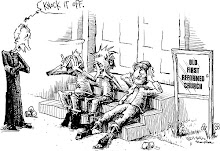
Cartoon from the Brooklyn Paper, November 2007

Amos 6:1a, 4-7, Psalm 146, 1 Timothy 6:6-19, Luke 16:19-31

I am very proud of our congregation’s work for the relief of homeless men. It was only six years ago that I first started working with the homeless. Not that I wanted to; it’s not my specialty, but there they were, sleeping on the church’s stoop and begging out front. At that time the Bloomberg administration was initiating an optimistic vision to really address homelessness, and the Department of Homeless Services regarded me as their local agent. I was able to get housing for all of our guys, and for nine more guys besides.

Suddenly the door slammed shut. I couldn’t get housing for anyone. The policies had changed. The men now had to prove that they were homeless, and they had to prove it by being sighted, sleeping out on the sidewalk, by an observer driving around the city, on any given night over a period of several months. The guys wouldn’t do it, they know it’s not safe to sleep out there, so they never got sighted.

We figured out why the policies had changed. The new priority was simply to get the homeless off the streets and out of sight of the tourists and visitors. Out of sight, out of mind. That earlier optimism had crashed against the realities. The new vision failed because it never addressed the root cause of homelessness, which, in the aggregate, is very simple, and that is the cost of housing. When real estate goes up, when rents go up, then homelessness goes up. It is not a contradiction that an increase in wealth brings with it an increase in poverty. What the realities do contradict is the “trickle down effect,” except for the “down” part.

The “trickle down effect” is what the rich guy in the parable was practicing, quite literally. The crumbs would trickle down onto the floor, and the servants would sweep them out the door, where the beggar could pick at them. Well, at least the beggar could lie there at the gate. Here in New York, he’d never make it into the lobby of your building, and if he dared to camp out under your stoop he could be arrested for trespassing.

But the really nasty thing was the licking of the dogs, which, in the culture of Jesus’ day, was shameful and humiliating. Dehumanizing. The beggar was dehumanized, so the rich guy owed him nothing. He could just step around him when he left the house and step over him when he came back. There’s a contradiction: proximity with invisibility. Not out of sight, out of mind, but in sight and yet out of mind. Up close and impersonal. We practice it in this city every day. We feel like we have to, it’s nothing personal, there are just too many people, but in the aggregate it’s dehumanizing.

Both of them die, they’re both in Hades, Lazarus in the Paradise part and the rich guy in the Gehenna part, burning up. He sees the beggar there with Abraham, but still does not respect him. “Father Abraham, tell him to do this, tell him to do that.” No respect. Father Abraham said that there was a great chasm fixed between them, so there was no crossing from one side to the other, but there was a chasm inside the soul of the rich guy, a portable chasm he carried around inside him, by which he could remove the beggar from his life. The danger is there for all of us, to have fixed such a chasm inside ourselves, and portable, to keep us untouched by the great need of the world outside our door. Proximity with isolation. I do it too. How else can you function in this city?

It is costly to have this chasm inside ourselves. It takes energy to maintain it. We get defensive, and defensive even to ourselves. You hear it when the rich guy complains to Abraham. He acts like he didn’t know. He acts like he wasn’t told, that it was unfair, that it’s not his fault because it was not made clear to him. But it was made clear to him. He didn’t want to hear it. He didn’t want to pay the cost of the enjoyment of his wealth so he ended up paying the cost of himself.

This parable has several layers of meaning. One of its meanings is the judgment on Israel for not believing in the Lord Jesus when he came back from the dead. I spoke about that three years ago. Today I will stay with the economic meaning, and that’s to continue our themes from last Sunday. My message today is not for America, or for the American economy, or the political economy of New York City, although our scripture lessons apply to all of that, but I am not sufficiently expert to make those applications. My applications are for the church, to us, to you specifically as Christians.

First, consider this contradiction to conventional wisdom: that poverty is actually the cost of wealth. That our wealth is costly to the poor. I suppose in some principle of theoretical economics you could have increasing wealth without increasing poverty, but what about actual reality, when we have to factor in the practical truth of human sin and the aggregates of sin, and the awful truth that the more successful we are, the more accomplished is our sin. Let us consider this, let us not walk around it nor step over it. Can anyone show us, either from scripture or from human experience, that our wealth is not costly to the poor, somewhere, whether far away or proximate, or that it is not so that as our own wealth increases, so does poverty for someone else?

We do know this for sure, the wealth is costly to us who are wealthy. I’m talking now about the social cost, and the spiritual cost, and the moral cost. Again, in theoretical principle wealth should be morally neutral, but the clear witness of all three of our lessons today is that in actual reality it’s not. As I said last week, your wealth, your ordinary wealth, is your constant moral problem, no matter how much or little of it you have. It offers you enjoyment and security and it demands your attention and your service and it becomes an idol. It seduces you and it becomes a jealous lover. So that your love of your money is the root of so much evil in your life. Evil to yourself, evil to others like yourself, and evil to the poor. This message is uncomfortable. It is uncomfortable to be preaching it, and I hope Jesus talks about something else next week, but there it is.

This week our scripture lessons do not contradict each other. What they contradict is us, and any exemptions we might claim because of our basic decency or even our indebtedness. Let it contradict you, don’t try to negotiate or defend yourself. Say to yourself, “Okay, even if I don’t see it I will admit it, to God and to others and most important to myself.” From the Reformed Church point of view, repentance is less about self-examination than simply believing what God says about us. So that this repentance is a step towards freedom. The second step is your giving in to eminent domain of the Lord Jesus. Your wealth is not your own, neither to possess as you see fit nor even to enjoy as you see fit. The government should treat it so, but you should not within your soul.

And the third step in your freedom is to share your wealth. Your wealth is loaned to you by God for you to share. The epistle agrees with what Jesus advised last week. Not that you have to become poor yourself. But that the increase of your wealth means an increase in your obligations for loving your neighbor as yourself. In the sharing of your wealth you loosen its grip on you and lessen its hold on you. The name Lazarus means “God helps.” Do you see how God was helping the rich guy all along, by giving him such a close by neighbor whom he could love as himself?

The tragedy of the rich guy was a tragedy of unawareness. He was unaware that he could love the beggar, and that loving the beggar would add more richness to his life, a richness greater than in the sauces on his table. What turns this tragedy into comedy is the laughter of love, and the effort to love, the effort which brings awareness, and that means freedom. So, if you want to know what to do with your wealth, think in terms of love. You love yourself. How do you spend your wealth on yourself? So then love your neighbor as yourself.

Do it freedom, do it in creativity, use your wealth as currency for love. You might have to confess that this is what God has done for you. I mean that if you have any wealth at all, you really don’t deserve it any more than some other person on this planet who did not enjoy your circumstances. It is a mystery what you should have it, so finally you have to chalk it up to the mystery of God’s love for you. Lazarus means God helps you. God helps you because God loves you.

Copyright © 2013, by Daniel James Meeter, all rights reserved.

Saturday, September 21, 2013

September 22, Proper 20; Contradictions 4: The Crooked Commended

Amos 8:4-7, Psalm 113, 1 Timothy 2:1-7, Luke 16:1-13

This gospel lesson is considered the most confusing speech that Our Lord Jesus ever made. But we can make sense of it, as long as we think in terms of contradictions. The lesson is in two parts, and I think they’re intentionally contradictory.

The first part is a parable, verses 1 to 8. The parable is comic, it’s meant to be a little funny. It’s in the form of a fable, like Aesop’s fables, with a wily fox, or like Uncle Remus, with Bre’r Rabbit, who outwits his enemies, or even like Bugs Bunny, who gets away with everything.

So there’s this wealthy man, the master, and he’s a decent guy. He owns an estate, with tenant farmers on it, like sharecroppers, who pay their rent in kind. He employs a manager to run the place. He hears complaints that his manager is squandering his goods, so he calls him in. “What’s this I hear about you? Hand over your records. You’re done.” Uh oh.

The parable switches to the manager. He doesn’t bother to defend himself, he doesn’t waste his breath. And at least he wasn’t thrown in jail, which was decent of his boss. “But now what am I gonna do?” (Think cartoon here.) “I could dig. Nah. I could beg. Nah.” Light bulb comes on. “I got it. He still wants the accounts, and they don’t know I’m fired yet. If I work fast I can put them in my debt.”

He goes to the tenants. “How much do you owe the master? 800 gallons of olive oil? That’s a lot of olive oil! (It’s a fable, folks.) Quick, rewrite your contract and reduce it by half.” No problem. “And you, how much? 1000 bushels of wheat? That’s an awful lot of wheat you owe. Reduce it by 20%.”

It’s like when the Fed reduces interest rates. You go change your mortgage quick to get that rate. My bank didn’t like it so much when we refinanced our apartment, because of how much less interest they would collect from us, and they kept adding new paperwork to hold us off, but they finally yielded and we refinanced. And so the master, when the manager’s scheme comes out, is not going to force his tenant farmers to pay their former rate. He’s already shown he’s not that kind of guy. He’ll be as decent to his tenants as he was decent to the manager.

Which is what the manager was counting on. That’s where he was shrewd. He calculated on the decency of the master. He did not bother to excuse himself or defend himself. He counted on the mercy of the master, that the master would never be untrue to himself, no matter how crooked the manager was. That’s the shrewdness that’s commendable.

So when it comes to God, you can count on God to be true to God’s self, and God is merciful, and the quality of God’s mercy is not strained, no matter how often or how much you need it. So just don’t bother to be self-righteous, don’t stand on your rights or reputation, don’t waste your breath on your explanations and excuses. No matter how good or bad you are, no matter how much you have gained or how much you owe, all you really have to stand on, all you can resort to is God’s mercy. And you can also thank the Lord Jesus for being that wily rabbit, that crafty manager who comes to you and who cancels your rightful debts to God for you. That’s the good news.

The second part of our lesson is the bad news. It’s as critical as the first part is comical. The second part is a poem. It’s hard to recognize as such, because the form of the poem is not typical in Western literature. The form is more like Arabic poetry, or like the verses of the prophets of the Old Testament.

I will skip the literary analysis, but only say that the poem develops like a wave upon the beach. It gathers, it rises, it crests, and then crashes and spreads and recedes. Its climax is in the middle, at verse 11. Its climax is the challenge, “If you then have not been faithful with unrighteous wealth, who will entrust you with the true?” The true? The true what? True wealth? Or the Truth? Either, or both. It’s ambiguous and suggestive. What is of real value? In the world? In your own life? What are you really worth? What is your true value, what do you value?

What does the Lord Jesus mean when he says “unrighteous wealth”? He means to be allusive and imprecise. This is poetic language play. His term for “wealth” is the Aramaic word mammon. You may have heard this word before: “You can’t serve God and mammon.” Mammon means ordinary wealth, ordinary capital, your savings, your 401k, your equity in your home, all that you have to report when you apply for a mortgage or a loan. All of you have mammon, more or less.

Why is it unrighteous? In principle, wealth itself is morally neutral. It can be good, as with the landed property which God had guaranteed in the Torah to every Israelite. It is your security, and the birthright of your children. But the Lord is saying that it’s really never neutral and always compromised and crooked, no matter how respectable you are. It always tempts you and it always pulls on you, no matter how upright you are. It is your constant moral problem. Do not pretend to yourself that your small amount of wealth is righteous, or deserving, or clean. You could have an ethical investment policy, you could divest, you could boycott, you could even occupy, but you cannot escape the corruption of what you value and hold dear. You’re all complicit, not one of you is innocent, no one is exempt.  No excuses. Don’t waste your breath.

The Lord Jesus has assaulted your integrity. Don’t defend yourself. He has impugned your reputation. Don’t defend it. Accept it. Plead his mercy. Fly to his mercy. He gives you the parable to show you how to survive the wave of his judgment crashing down on you. He shows you your place of refuge for when he comes to assault you. He has given you the place of grace in which we stand.

Grace and forgiveness, righteousness and morality. Mercy and justice. These can be contradictory. What is the purpose of being a Christian? What are we baptized for? Is it not to become a better person, more righteous, more ethical, a better example of humanity? Or is it to keep coming back for mercy, coming back again and again as diggers and beggars who have nothing to stand on but God’s mercy? Which is it? It is both. God calls you to be ethical. Yet all you have to stand on is God’s mercy. Being a Christian is to work them both, to learn the interplay, to work the balance.

Today we will baptize Clyde Li Williams. He knows how to walk, he has learned to balance in his body the opposing forces of tension and compression and of gravity and thrust. He’s learning to balance his food on a fork. Before you know it, his parents will be teaching him how to balance on a bicycle. And they will also teach him the balance of mercy and morality. The God he belongs to expects him to be moral. The older he gets, the more that will include. The more he comes to value the more pressing it will be. His parents will teach him how to take care of his things, to put his toys away, to clean up after himself, to respect the rights of others, to only take his share, but also how to have a share, to build up capital in the world, to be thrifty but also generous, a model citizen. I am not joking. And they will also teach him how much he needs mercy. How much in need of it he is, with no excuses, and how endlessly he can find it in the God he belongs to.

All of us are complicit. All of us enjoy the benefits of a global economy that is increasing the wealth of the wealthy and the poverty of the poor, exhausting our resources, and risking our very planet. What do we do? Don’t waste time defending it or denying it. Deal with it from out of mercy. Which means don’t waste time feeling guilty either. Do what you gotta do. The trick is in that strange advice which is the bridge from the parable to the poem: “Make friends for yourselves with your crooked wealth, etc.”

Okay, you’ve got it, so now be generous. Share it as if you believe that you don’t really have the right to it. The Rev. James Forbes famously said that, “Nobody gets into heaven without a letter of reference from the poor.” You have some wealth? Okay. Maintain it but don’t fool yourself. You’re always more in bondage to it than you think, so be more generous with it than makes sense. This is not for guilt. It’s for joy. It’s for welcome. It’s for celebration. Your resort is not in anything you can do, your first and last resort is in the mercy of the God whom you belong to, who gently laughs at your pretensions, and who loves you like you’re a little child.

Copyright © 2013 by Daniel Meeter, all rights reserved.

Thursday, September 12, 2013

September 15, Proper 19, Contradictions 3: If God Finds Us, How Did God Lose Us?


Exodus 32:7-14, Psalm 51:1-11, 1 Timothy 1:12-17, Luke 15:1-10

Jesus poses these two parables as questions. “Which one of you, having a hundred sheep,” and then, “What woman, having ten silver coins.” To the second one the answer is obvious: “Any woman would.” But to the first one the answer is the opposite: “No one would.” No one would stupidly risk the ninety-nine for the sake of the one. Realistic management simply writes off that last sheep. A one percent loss is not so bad, and it’s way less than standard depreciation.

The answers are contradictory, so you have to work the parable back and forth. You use the second answer to reverse the first answer, as in, “Any woman would, who having a hundred sheep,” and you feel like the parable is playing with you, and then it finally hits you that Jesus is saying, “I’m with the woman, I  would too.” This Messiah would. This Messiah would because he thinks God would. Every last, lost person is of inestimable worth to God, the most despicable, the least acceptable, the most unfit. To bring in such a one is what God rejoices in.

Is it really true? Does God come after you like this? Will God come hunting high and low to find you? You are one of seven billion people, and our planet is one speck in the galaxy, and our galaxy is one of billions in the universe, and is God so aware of you? Does God get that specific? Does God get that personal? Do you, your little self, make God happy?

Would you like it to be true? Would you like God to notice when you’re missing? Would you like God to come and find you? Do you want God to be so personal? Or should God be more objective? More the like spiritual energy of the universe? Less sentimental, more philosophical?

How can it be true? If God is God, then how can God ever lose us in the first place? If God is God, then God already knows where the coin is, and God already knows where every last sheep is. These parables are contradictory to the doctrine of God’s omniscience and omnipotence.

There is another contradiction underneath. Let me draw it out. Jesus eats with tax collectors and sinners. And we saw two weeks ago that he also eats with scribes and Pharisees. Jesus does not discriminate, he treats everyone the same, saint or sinner, pious or polluted. He’s not against your being a good person, it’s good that you’re good, but he’s going to treat you the same as he treats a bum. He believes that every single last person, irrespective of performance, has the very same value to God. And that value would be immeasurable, infinite.

How can that be, really, that any one person should have infinite value to God. How can this balding primate weighing 93 kilograms have more relative value than, say, the planet Jupiter? Maybe that made sense 500 years ago, when we thought the planet earth was the physical center of a very much smaller universe, but not with what we know about the universe today.

It might help to remark that “infinite” does not necessarily mean “vast”. That’s a category mistake. The interior of an atom is also infinite. Some scientists suggest that the size of the human body is about half-way between the size of an atom and the size of the universe. It might help to remember that our categories of space and time do not apply to God, God can enter space and time but is outside them, so God is neither conditioned nor limited by the laws of time and space in which we live, so at least it’s conceivable that God is so aware of you, that God finds you that important, and that God is so personally invested in you.

But what about the contradiction of our life experience. Doesn’t God abandon some people anyway? All the suffering millions we pray for every week, the starving children and their dying mothers? Isn’t it our experience that God allows some people to get lost and stay lost? Why didn’t God save Joseph Stalin? Little Joseph started out a lamb like everyone else, and in his youth he studied to be a priest, so when he wandered off, why didn’t God go find him and bring him back, especially before he caused the death of seven millions? And you have some acquaintances whose lives are unfortunate or miserable, and you grieve their loneliness and bitterness, but God just seems to let them go. If it makes God so joyful, then why doesn’t God save everyone? Why does God let anybody go?

These parables attract us and resist us, positive and negative, because they suggest a God who is passionate and emotional, a God who reacts. You see it in our first lesson, how God reacts to the quick and easy idolatry of the Israelites, and it’s Moses who is the steady one, the more mindful one, who gets God to settle down. So which is it? Does God react and change his mind, is God passionate and personal, or is God constant and faithful and ‘unchanging as light”? Most of our friends and neighbors prefer a God who is impersonal, that spiritual energy of the universe, more mystical, less historical, less hysterical, less jealous, less angry, less passionate.

It is a problem. The Christian doctrine of God has built-in contradictions, and Our Lord Jesus only adds to them. He allows the contradictions in order to protect this truth: that whatever else does not add up, this has to be maintained, that this God is such a God as to be able to say, “I want,” and “I desire,” and “I prefer,” and “I choose,” and “I will,” and “I do,” and “I love,” and “I love you.” Do you want that to be true, do you want to believe in a God who can talk like that?

The down side is that such a God can also say, “I do not want” and “I do not desire” and maybe even “I do not love.” Someone who can love can also get angry. Whoever can desire must also judge. The god that is just the spiritual energy of the universe does not judge and has no anger.

Passion means heat. What if God has to burn me to save me? What if God has to judge me to rescue me? If God seeks out the lost sheep, will God also seek out a lost wolf? As in the case of the Apostle Paul. He confesses in our epistle that he was the worst of sinners, a blasphemer, a persecutor, a man of violence. He was a wolf in sheep’s clothing, and yet God sought him and found him. And knocked him down and blinded him and sent him off to the desert for a few years. Paul always regarded his salvation as a surprise, a wonder, he never took it for granted.

I cannot explain to you why God lets some coins not get found and some sheep not get rescued. I can say that it’s not a matter of the value of the coin or whether the sheep is worth the rescue. Worthiness is immaterial. We are all worth it, infinitely. But why some and not all?

We should not infer from this that God doesn’t care, that God doesn’t passionately care. That God doesn’t love them too, the coins not found and the sheep not saved. Many things are not explained to us, and this is one. Salvation is like physics, that getting certitude about one factor forces uncertainty on something else. We have to hold up the contradiction, that God loves everyone infinitely, and that it is you whom God is coming to find.

You are left with this promise: Your little life is huge to God. God chases you fanatically. God is the woman with the broom, and she’s moving the furniture of history to find you, she is sweeping the dust of your life to expose you and to grab you. Can you be so childish, so silly, as to regard yourself as the center of God’s universe, if only for yourself, and even momentarily? It is what Jesus is inviting you to believe.

But why else repent, why do such a risky and vulnerable thing, unless the sacrifice that Jesus made of his own life exposes the deepest secret of the universe? When you repent of your sin you are opening yourself to that infinite person, that passionate being whom we call God, the one who is behind all the matter and energy of the universe. Your repentance gets at the joyfulness of the universe. The joy that God has over you is the excess of the God’s love for you.

Copyright © 2013 by Daniel Meeter, all rights reserved.

Thursday, September 05, 2013

September 8, Proper 18. Contradictions 2: Choose God or Choose Life.


Deuteronomy 30:15-20, Psalm 1, Philemon 1-21, Luke 14:25-33

The first contradiction is obvious, between the lessons from Luke and Deuteronomy, between what Jesus says and what Moses says, between possessions and possessing, between possessions to be given up and possessing the land as a gift. Which is the way of life, the way of blessing?

Moses was giving his final summation to the Children of Israel as they were poised to cross the Jordan and take the Promised Land from the Canaanites, who were already possessing it, thank you very much. Moses had just reiterated the Torah, with all its commandments and decrees and ordinances. It was their constitution and their code of law. Moses summed it up with God’s deal: you observe the commandments and decrees and ordinances, and God will keep you in possession of the land, God will bless you in it with prosperity, and God will protect you from the enemies around you who will soon enough attack you to plunder your prosperity. God will protect you and bless you but only if you keep the commandments and decrees and ordinances; that’s the deal. Choose it, Moses tells them, choose life, choose for prosperity.

But Jesus says to choose death and adversity. "Whoever does not carry his own cross cannot be my disciple. If anyone comes after me and does not hate father and mother and wife and children, even life itself, cannot be my disciple." Hate life, not choose it. Hate your parents. What about the fourth of the commandments, that we should honor them? Jesus contradicts the commandments and decrees and ordinances. No wonder so many good Jewish people declined to follow him. Which is the result he seems to want. He makes it hard to follow him.

The contradiction is less extreme if you look into the commandments and decrees and ordinances which Moses had reiterated. The deal that God offered them would make them sitting ducks, from the Egyptian or Syrian or Philistine point of view. The constitution of the Torah made absolutely no provision for an organized defense. The radical equality which the Torah gave to every man in Israel meant there was no upper class, not any nobility, and thus no military officers. The deal was that the Lord of Hosts would defend them if they just observed the commandments and decrees and ordinances. Is that a deal that you would take? If you were Senator John McCain, what would you advise? If you were Barak Obama? Would you not hedge your bets? Would you count the cost? Would you have your intelligence services evaluate the numbers of your enemies and the realities of their threats? Is the deal God offers too great a risk of death and adversity?

The commandment and ordinances included the decree of the Sabbath year, when they should give the land a rest, and every seventh year plant no crops, and have no harvest, and depend on God to somehow give them daily bread, and they should forgive all their debtors and any land they’d bought during the last six years they’d give back to its prior owners, all of which looked like a recipe for recession and adversity and hunger and death. No investments, no capital, no crops, no harvest, no food. If you were Timothy Geitner, would you advise this deal?

So from the worldly point of view, from the perspective of conventional wisdom, the deals of Moses and Jesus are about the same. They come at it from opposite ends and meet in the middle, at an deeper contradiction, the general contradiction between the blessing which the Lord God offers us and our experience, and thus what our experience teaches us about the realistic way to security and prosperity. We have facts in our lives which give us doubts that we can count on God to protect us and defend us and give us life. We get sick. We lose jobs. Our enemies attack us. We experience no less than unbelievers do all the vicissitudes of life, the unfairness and injustices and pain and loss.

We want to choose for God and thereby get God’s blessings. That isn’t wrong. I pronounce a blessing on you every week as the last thing in the service. I don’t say that as empty words. We give you personal blessings at Holy Communion after the passing of the cup. We mean them to be real. But we don’t control these blessings. My benediction is not a blessing from myself, I only dare to say it on behalf of God, and I have to leave the reality of that blessing to the promise of God and the mystery of God. And how long do you wait, how often don’t you go for very long stretches when you cannot feel that the face of the Lord is shining on you.

Do I wish I could say that there is a cause and effect connection between choosing for God and getting blessings? I understand that is the message of Joel Osteen on television, and that’s why he’s so popular. I don’t think he’s faking it, I think he must really believe it, and it’s only natural to want to believe it. It’s the most natural kind of religion, that if we do the right things with the gods then they have to bless us, that’s their job.

But this convenient god is not the god of our scripture lessons. Both Jesus and Moses are warning us of the necessary contradiction between the promises of God and our experience of prosperity, between the offer of God and our ordinary vision of the good life. We want to take the short cut by hedging our bets and squeezing the law and gospel into the expectations we prefer, but Jesus tells us we have to go the long way round, the whole way to the cross, and there give all that up.

So from what Jesus tells us here we all have to give up our possessions and our families and take vows of poverty and celibacy and become like monks and nuns. No, that’s not the right take home. That misses the deeper contradiction. That suggests that your righteousness is something you can achieve by means of sacrifice and exercise, like good grades or great muscle tone. Now, we do need to say that God really no interest in blessing you with possessions. The expansion and protection of your material prosperity is immaterial to God, doesn’t care either way, except God does care about how much we are tempted by our possessions.

So here’s the right take-home. You may choose to keep your possessions, but then you must repent of your possessions every day. “Oh God, I ask you once again today to forgive me for my possessions. I confess that I cannot justify any last one of them by any righteous reasons I propose. I admit that I may hold on to them only on your sufferance, only on your indulgence, as they are yours.”

In my reading of this passage I am quite certain that the Lord Jesus is telling you to give up your self-possession, to give up your right to your own life. He’s telling you to surrender your self-determination. Your life belongs to him. Everything you possess about yourself. Your mind, your soul, your ambitions, your opinions, your self-control. He’s talking about abandonment. He’s talking about surrender. He’s the king who comes against you with his 20,000 troops, and you must sue for peace with him. He has conquered you and he requires as his booty not less than everything you possess, from your coffee-maker to your marriage to your children to your own image of yourself and your hopes and dreams. He is your adversary, he is your adversity, he is your death, he is your contradiction. That is how he saves you: he conquers you and you must abandon yourself and all you have to him.

This all is parable, and as with every parable he is telling it about himself. That’s why his words are so hard, because of how hard it was for him. He has to surrender himself, he has to abandon himself. He is the rightful king of Israel with only 10,000 troops who is facing his Father in Heaven, the Lord of Hosts with 20,000 troops and he must give up, he must give up himself and all his possessions, even the right to his own life. He is the best man that has ever lived, and does God protect from his enemies? He is the most honest man who ever lived, and does God defend him from the lies they use to convict him? He is the most loving man who ever lived, and does God bless him with a wife? He has honored his father and his mother, so the fourth commandment says he should live long in the land that God has given him, but all he gets is thirty-three years. Jesus is talking here about himself, and the contradictions of his own life.

Why does he do this? To get to the cross, that constant contradiction. To accomplish the atonement, that troubling resolution. To win the forgiveness of your sins before the face of God, the only lease on life you have. He died the death of a slave to set you free from your slavery that you might be his brothers and sisters. So once again it’s love. Behind the hardness is his suffering, and the motive for his suffering is his love. The situation is desperate, it is the only way. Yet once again it is the love of God for us.

Copyright © 2013, by Daniel James Meeter, all rights reserved.

Thursday, August 29, 2013

September 1, Proper 17, Contradictions 1: Fear God, Fear Nothing


Proverbs 25:6-7, Psalm 112, Hebrews 13:1-8, 15-16, Luke 14:1, 7-14

This past July 21st I was in Newfoundland, Canada, in the fishing village of Lark Harbour, and I tried to go to church. Across the road from the gas bar is St. James Anglican. It has no sign of the service time, so on the Saturday, when I saw some people standing out back, I asked them the time of the service and they looked at me strangely and said 11 AM. Okay, so I got there at 10-of, and I was impressed. There must have been fifty cars parked around the church, and even young people entering in Sunday clothes. Wow, the locals are pious! Inside the usher handed me a bulletin and asked if I was family. What? No, I said, and went into the sanctuary.

The organ was playing and the acolytes were busy at the altar, and all the front pews were full and all the back pews were full and the middle pews were empty. That’s strange. I went back out to the usher and asked where I should sit. He said, Are you family? Then he said, This is a funeral.


I stood there stupidly for a moment, and then I asked if there would be communion. No. I think that’s tonight at 6. Oh, I’ll be on the ferry to Nova Scotia. Well, I did try to go to church.


If I sat in the middle, all by myself, everyone would have been watching me. If I sat up front they’d be watching me: Who is he and how did he know Billy Cavendish? If I sat in the back, the usher would not come and tell me to sit up front, nor would he tell any of the Cavendishes to go sit in the back, or there’d be trouble in Lark Harbour.

Seating has its protocols, and Jesus tells a parable on it, and like most of his parables, this one has several layers, and you have to keep working your way down into the layers, you have to unlock it like a combination lock, turning it back and forth. The outer layer is the good advice on how you can be deferential to your own advantage. Did we need the Messiah to tell us that? It’s already in the book of the Proverbs. You could get it from Emily Post. But thank you, Jesus, for confirming that we may look to our advantages. And you can leave the parable right there and be satisfied.


You could turn the parable the other way and go a layer down. Does it really matter where you sit? Do you care whether people think you’re either high or low? You can be free of that. Be free. Be free to sit alone. Wherever. The status that you need is what’s in your own mind, your advantage is your own to give yourself. There is wisdom in that.


But then Jesus adds those words about inviting the poor and the lame and guests who can’t invite you back, which turns it back the other way and goes another layer down. It’s not about yourself, do not sit alone, do not be free of other people, gather them around yourself but to your potential disadvantage. You give advantages away. When you are standing on line for tickets, you let other people in ahead of you. Practice a freedom of radical generosity and selflessness. God does.


That’s inspiring, but how much chaos will result from that. We need order, we need structure, we need patterns in our lives. We are animals, not angels. The customs of society have wisdom in them. If you let people cut in line ahead of you, what about the people behind you. At weddings and funerals it makes realistic sense for friends and family to have their special places. We cannot leave the parable at this point.

We have to go one more layer down. We turn it the other way again. The final combination is what Jesus says at the center of our lesson: “For all who exalt themselves will be humbled and those who humble themselves will be exalted.” Is that true? Is that really true about the world? Often, but not always. We can think of plenty of humble people who are made to stay that way and worse. But Jesus does not say this as a truth about the world, he is giving the riddle of what God does within the world. God humbles the exalted and God exalts the humble, all the time, round and round, up and down.


Jesus was taught this by his mother. She sang of it in her song, the Magnificat, thirteen chapters earlier in this same gospel, and he echoes the language of his Mum. It’s about what God does. God freely acts this way in the world, with no regard for our advantages or our status or our sense of our deserving what we get. That’s the center of this parable, the freedom of God, the freedom of God from where you sit, God’s freedom from our conventions and patterns and good behaviors and predictions, which, of course, we know is right but still it is a fearful thing.


The Pharisees feared Jesus because he was so free like that. That’s why they were watching him closely. And we would have to say that the kind of fear they had of him was a negative thing. So why is it that the Bible tells us to fear God as a positive thing? Isn’t the fear of God a contradiction? Isn’t it a contradiction for us to repeat what repeated in Psalm 112, “Happy are who fear the Lord”? How can that be good?


I get that question frequently and it can’t be answered easily or quickly. You have live with it, you have to give this contradiction time and space within your life. You to let it open up a space in you, maybe a new space inside yourself for that special kind fear which is a good and loving fear.


They say that lion tamers have to love their lions but never lose their fear of them. You can’t domesticate a lion, it’s finally always wild. And powerful and dangerous. God is wild, and powerful and dangerous, and is absolutely free in front of us. In such a relationship fear is natural, and it’s why we should fear God. We cannot manage God, we can’t control or predict God, except only upon the promises which God has freely made to us. You can hold God to those promises, but you can’t even predict how and when those promises will be kept. Even when God is faithful God is free. And dangerous.

To fear God is to enter that space inside yourself where you feel the implications of the dangerous freedom of this God, this God who loves you for your good, but who has no regard for your status or your advantage or even your self-respect. What God has any regard for, as far as you’re concerned, is God’s own promises to you which are conditioned only upon God’s self. Which leaves you uneasy, to say the least.


But from this we get two benefits, but to get to them you have to make a couple jumps. The first jump is the benefit that if you fear God, you need not fear anything else. Fearing God, fear nothing else. You repeat to yourself what our epistle says, “The Lord is my helper, I will not be afraid, what can anyone do to me?” It’s not your courage, it’s your hanging on God’s promise, “I will never leave you or forsake you.” God reminds you of that promise time and again in scripture.

Once God confirmed it to me silently, by suddenly becoming present to me, locally but not physically, next to me in our back room on President Street, when I most needed it, when I was more than humbled, when I was humiliated. “I will never leave you or forsake you.” Upon that promise I am still learning not to fear, not to fear other people or situations or possibilities of loss or disadvantages and even not to fear myself. Fear God, fear nothing.


The second jump is the benefit that your freedom from fear is your freedom to love. You see that today in both the epistle and the gospel. You can love despite the restrictions of the conventions and the familiar order in the world.

So let me tell you a story which is true. Her name was Brenda-Lynn. She was a member of my second congregation, in Ontario. Brenda-Lynn was a nurse practitioner. She worked in a group home for the mentally-handicapped, some of them severely so, including cerebral palsy. That was her job. Brenda-Lynn got married to a guy named Evert, whom we all loved, and I did the wedding. They represented two big Dutch families, and it was a big reception.

Have you ever been to a Dutch-Canadian wedding reception? There’s nothing like a Dutch-Canadian wedding reception. And I think more than half our church was there. And you know whom the bride had seated up at the head table with her and the groom: the residents of her group home; they were the special honored guests of Brenda-Lynn. I watched them off and on, how they were watching her. They loved her, they were proud of her, because Brenda-Lynn was a beautiful bride. And she was beautiful in her freedom from the conventions of receptions, and we could see in her what God's own love for us is like.


Copyright © 2013, by Daniel James Meeter, all rights reserved.

Friday, July 05, 2013

July 7, Proper 9, A Geography of Prayer 6, The River


Isaiah 66:10-14, Psalm 66:1-8, Galatians 6:1-16, Luke 10:1-11, 16-20

Dearly beloved, this is the sixth sermon in my series entitled “A Geography of Prayer.” This week’s feature of geography is the River, from Isaiah 66. For the most part, until my final paragraph, I shall be using the image otherwise than Isaiah did. I am lifting the image out of Isaiah and applying it to our Psalm today, Psalm 66, with its verse after verse of praise to God.

I’m calling the prayer of praise a River (allow me an epic simile): like the mountain stream which is its source, to the length of the river as it bends through the landscape, as it defines the valleys it flows through, and cuts its way through canyons, as it gathers its tributaries and develops its current and increases its power as it goes, and then widens in its lower length and meanders through its plain until it forms its delta in the sea, like the Mississippi, or, like the Hudson, it widens into a great long channel and an inland sea and then into its greater bay. The river is life-giving to every thing along it and destructive to whatever stands against it, peaceful in its reaches and raging when resisted, forceful in fluidity, inexorable, inexhaustible, ancient, primeval, eternal, the prayer of praise to God.

What is praise? What do we mean by Praise? It’s when we call God “Holy, Majestic, Great, Wise, Beautiful,” and other attributes. Praise is close to Thanksgiving and of course they overlap, but we can distinguish Thanksgiving as what we offer God for what God has done for us, and Praise is what we offer God simply for who God is, irrespective of what God does for us. Of course, we believe that we can only know who God is by what God has done for us. So Thanksgiving comes quicker to us than praise does. But I think the ultimate is Praise, for it is the least self-interested form of prayer and the least regarding of ourselves. I don’t mean we lose ourselves. We still maintain our minds and skills and our abilities, we fully use our arts and crafts, the fullest efforts of our speech and song and dance. The point is that the pay back is irrelevant, and you could call it, as one writer has, a “royal waste of time.” That’s the point.

There is legitimate self-interest and self-regard in prayer. That’s usually where we start in prayer, with our petitions for ourselves. Let me remind you that for Christians there are six kinds of prayer, in three pairs:  Petition and Intercession, then Confession and Lamentation, and then Thanksgiving and Praise. From Petition to Praise you move from the most self-interested to the least.

You can think of it as a continuum, but Jesus remarkably bends the line around into a circle, from Praise back to Petition. He does it in the Lord’s Prayer. The way he teaches us to pray is to  make our first petition all about, not ourselves, but God’s self: “Hallowed be thy Name.” You are asking God to be honored as “the Lord” in the world, and that implies that the desire for God is in your deep self-interest. Then you petition that “Thy Kingdom come, thy Will be done,” which must include the business of your life, and then you petition, “Give us this Day our daily bread,” when your self-interest is obvious and legitimate and as basic as a little child’s. And then you move to legitimate self-regard, when you pray, “Lead us not into temptation but deliver us from evil.” Implied in this Petition is also Confession, and also Lamentation. And because you make your petitions in the first person plural, using “our” and “us” instead “mine” and “me,” these also are Intercessions. This prayer comprises so much in such small compass, it is a wonder and a sign. It is a very good thing that everybody knows it, out of everything else in the Christian faith.

But there is so much more to prayer, and there are so many prayers the people used to know but now we don’t, especially the prayers of praise. I’m not saying that Christians are not giving praise. I’m saying that in our freedom of invention and our desire to be relevant we have lost the disciplines of prayer and the rich traditions of doxology. Our contemporary praise is strong when it’s immediate, like a thunderstorm upon the grass, and the weather changes and we dry up. I’m speaking of knowing how to sing the Te Deum. Or the Gloria in Excelsis. I’m speaking of knowing the Psalms from memory. These are almost lost to us today, and we are the less for it.

So here’s a take-home: The secret to the prayer of Praise is to not depend on generating praise from within yourself, and with our own ideas, but on stepping into praise, the praise which is around us and has been before us and extends beyond us, which does not depend on us, and which carries us in its current. You step into this stream when you praise God, and you give yourself to it. It offers you a force and motion greater than your own. You say things you did not come up with, but what you heard was said before and what you repeat. You don’t lose yourself — you gain a world. Psalm 66:3, “All the earth bows down before you, sings to you, sings out your name.”

Praise wants company. Even when you praise God privately, in your closet or your room, you know that you are praying along with millions of other people round the world. That’s why I like to pray from a prayer book which is being used by many other Christians at the very same time that I am using it. No matter how far away they are from me I know that I am praying in their company.

So yes, you can praise God in the woods. The other creatures do. You should. But the prayer of praise is richer and fuller when it follows on the other forms of prayer. As it does within our Sunday morning liturgy. After the sermon we pray the prayer of Confession. After that we pray our prayers of Petition and Intercession, and sometimes Lamentation. Then we gather round the Table for the great Prayer of Thanksgiving. We render thanks to God for our creation and our redemption. And then we rise to the climax of the service every week, pure exalted praise of God for who God is, “Holy, Holy, Holy, Lord God of Hosts, heaven and earth are full of your glory.” We sing it together with angels and archangels and with Catholics and Orthodox and Protestants and Jews. God is worthy to be praised.

Maybe you’ve heard the criticism that God must be a narcissist to have set up the world in such a way as to be getting all this praise. Well, who can presume that God’s experience of praise is like our own? Who of us know how our praise engages God? I do think we can say that God deserves our praise, but does not need our praise. We say that God requires our praise in the Aristotelian sense that a knife requires to be sharp, or good food needs to be eaten, or music requires to be heard. I think it entirely appropriate that God requires our praise. And it is appropriate for us, and good for us.

I love that in my life, that I can give such praise, I like what it brings out of me and where it takes me. I for myself would be less of a person if I did not praise God. That’s the conviction of the Westminster Shorter Catechism, when it asks, in other words, “What are people for?” The answer is, “To glorify God and enjoy God forever.” That is what it is to be a truly human being.

I love this river. I like to get into it and then get out of it and camp along it as I live my ordinary life and do my business in the world. If I were not a Christian I would miss it very much. It’s one of the chief reasons I believe in God. I have close friends who do not. They raise the very credible arguments that there is no God, especially not the barbarian god of the Bible stories. I find myself inadequate to answer all those arguments, though other brilliant writers have (Marilynne Robinson comes to mind, for one.) But apart from all the arguments, I know for myself that I want to believe in God, I want what I get from this belief, and not least is the entry into praise.

And it is God I want to praise. Yes, there are others in my life to whom my praise is due: my wife, my children, my seminary students, so many of you within the congregation. But my praise for you all cannot help but be conditional. There is only One whom I praise without condition and without second thought, and who is free from needing anything back from me. The praise of God is pure.

Now I come back to Isaiah’s meaning of the River. It comes from God. Yes, the praise of God begins with God, it flows from God, and out into the world, including us, and back to God. Just like God’s love. I think you could call praise and love the same thing but in different states of matter: praise is liquid (the River) and love is vapor (the Wind, the Breath). God’s love embraces you and so does praise, and so, of course, you praise the one you love, and you love the one you praise. God invites you into this great stream because God loves you.


Copyright © 2013, by Daniel James Meeter, all rights reserved.

Sunday, June 30, 2013

June 30, Proper 8, A Geography of Prayer 5: The Boundaries


1 Kings 19:15-16, 19-21, Psalm 16, Galatians 5:1, 13-25, Luke 9:51-62

Dearly beloved, this is the fifth sermon in my series entitled “A Geography of Prayer.” For this sermon in the series, I’m relying a great deal on the reflections and insights of my wife, Melody. My geographical feature this week is the Boundaries, from our Psalm, verse 6, “My boundaries enclose a pleasant land, indeed, I have a goodly heritage.”  Both Jesus and Elijah are crossing the boundaries of that pleasant Promised Land which was the goodly heritage of the Children of Israel.

In the case of Elijah, he gets his message while he’s over the southern border down at Mount Sinai. His message will take him back over the northern border into Syria to anoint the next king of the Aramites. After he anoints Elisha as his successor he will cross the eastern border over the Jordan where he will be taken up, as you remember, in the fiery chariot.

In the case of the Lord Jesus, he crosses the border between Galilee and Samaria on his way down to Jerusalem. Samaria is unfriendly territory for Jews. The Jews and the Samaritans regard each other as heretics, like the Shiites and the Sunnis, and their religious feud goes back for centuries. So it’s with righteous anger that the disciples James and John suggest to Jesus that he call down fire from heaven on the Samaritan villagers who have not welcomed them.

They got that from the stories of Elijah. Two times Elijah called down fire from heaven on the soldiers which the king of the Samaritans had sent to get him. Elijah is on the mind of James and John. They had just seen him for themselves, up on the mount of the Transfiguration, conversing with Jesus — maybe giving him advice? And they are excited now, for they heard the voice from heaven confirm their leader as the Messiah, the Son of God, the rightful king of the Kingdom of God. Should he not judge his enemies, like these no good Samaritans?

The Samaritans had no interest in the Messiah. They believed that the whole thing about the house and lineage of David was an heretical innovation of the Judeans and in contradiction to the Torah of Moses, which certainly said nothing about Jerusalem as the holy capital. So why is Jesus taking this way to Jerusalem, instead of going around along the Jordan? Is he making his claim that this province rightly belongs within the Messiah’s goodly heritage, and that by right his kingdom’s boundaries enclose this pleasant land? So the disciples seem to think.

But Jesus does not push his claim. Nor does he deny it. He calls himself the Son of Man, and then he has these off-putting encounters with individuals along the road. Jesus is a powerful and charismatic figure who approaches people in both predictable and unpredictable ways, and he is also constantly being approached on the road by all sorts and conditions of humankind. Why does he push them off? What he says to them we should not take as reasonable. He is speaking recklessly and in extremes.

It’s like he’s clearing the space in front of him as he goes, pulling on people and pushing them off from side to side. Not out of anger or vengeance, like James and John, but because he has set in motion a lava flow, a river in its flood, a great migration, a world in motion within our world but with a different energy and with different rules. The boundary is not a static border but a dynamic edge in motion, pushing and pulling on the ground it’s passing through.

The momentum is from the entry of God into history, in the person of Jesus. The urgency is not of Jesus’ own making, and you need not take it as a general behavioral model, that you as a disciple need to follow Jesus this recklessly, this hastily. Yes, be awake and be ready to move, but the point here is God’s activity in history, in the person of Jesus Christ. It’s not about our making the kingdom come by our haste. So Jesus tells his disciples to cool it with the Samaritans. “Guys, we don’t have time for that anger stuff now.”

God’s kingdom is coming. God is doing it. We don’t make it come. We don’t bring it. Despite what many Christian leaders say, we don’t advance the Kingdom of God, we don’t build it, and we certainly don’t have to defend it. God can do all that, and God does all that. What you need do is receive it. Pray for it. Desire it. Recognize it. It often contradicts the world, as with freedom and slavery. In Galatians St. Paul writes, “For freedom Christ has set you free. Stand firm, therefore, and do not submit again to a yoke of slavery.” Good. And then he writes, “through love to become slaves to each other.” Not so good. What does that mean? Realistically? At a congregation like Old First? Do you really want to be a love-slave to other people in this congregation? Is that how you receive the Kingdom of God?

Recognize slavery in the so-called “works of the flesh” and recognize freedom in the “fruits of the spirit.” The list of the works of the flesh is long and specific; the list of the fruits of the Spirit is short and sweet, and oddly vague. (Paradise is less interesting than hell.) These sins don’t feel like slavery; they feel more like strategies for dealing with slavery. They feel like ways to forget your suffering for a while. Or to actually do something about your suffering. Some of the strategies don’t sound like fun, like “strife, jealousy, anger, quarrels, dissensions, factions,” but those strategies are seductive and they feel righteous when you are caught up in them. Most of you avoid fighting, but don’t you feel righteous when you’re in the middle of a fight you had tried to avoid?

So here is where we come to prayer. We are used to praying for what we want, but we have to learn to want what we pray for. We pray for what we desire, and we keep praying in order to desire what we pray for. We pray for God’s kingdom to come in order desire that kingdom and what that kingdom brings.

This is why it’s important to pray more than the prayers we make up ourselves. Yes, you need to pray for your own desires, but you need to develop your desires, you pray the prayers that have been written down by other people, the prayers that are still a bit beyond you, the prayers you don’t yet understand. You pray the Psalms beyond your understanding, the prayers of the liturgy, the prayers of the Christian tradition, praying things you never thought to pray for, to develop your desires. You can pray for what you desire, but you can also desire what you pray for. Pray outside yourself, pray beyond your current boundaries.

Pray to want what is freedom in reality. Who wants to be generous? Who wants to be patient? The fruits of the Spirit. Who wants self-control? Nobody likes to be told, “Control yourself.” If someone says of you that you are “controlled,” that means you are no fun, or you can’t access your emotions. It’s an insult, it’s feeling constricted. When Jesus rebukes his disciples on their desire for righteous judgment, he’s inviting them to freedom, to cross the boundary from the normal life of paying-back into the moving stream of love, joy, and peace.

We live on both sides of the boundary. The Kingdom side is fluid and dynamic, and it makes us nervous, while the normal side feels more solid and familiar. But the good news is that the two sides are unequal. On the Kingdom side, the fruit of the Spirit is successful and the works of the flesh are powerless. On the normal side the works of the flesh claim much success. But the fruits of the Spirit are no less powerful here as well, although in different ways, in ways that you can learn to recognize. It is his power that works on both sides of the boundary, and so you work it best by praying for it. And when you’re praying it’s like you’re breathing only on the one side, you’re breathing the fresh wind of that side instead of the stagnant air of this side. The breeze of the Spirit makes this urban jungle still a pleasant land.

Pray for what you desire, and pray so that you may desire what you pray for. Pray for that new job, if you desire it. And pray for faithfulness and gentleness and self-control, to desire to be faithful and gentle and self-controlled. Pray for patience, kindness, and generosity, so that you desire them. You pray for peace, you pray for joy, and you pray for love, to grow in your desire for them. The first fruit of the Spirit is love. You grow your love for others out of the love God has for you. You love God back with the love God has for you. The first way to love God is to pray.

Copyright © 2013, by Daniel James Meeter, all rights reserved.

Sunday, June 23, 2013

June 23, Proper 7, A Geography of Prayer 4: The Slopes


Isaiah 65:1-9, Psalm 22:18-27, Galatians 3:23-29, Luke 8:26-39

Dearly beloved, this is the fourth sermon in my series entitled “A Geography of Prayer.” Last week was The Desert, and this week is The Slopes, as in the steep slopes of the hills around the See of Galilee. That’s our setting today, it’s where the Kingdom of God has landed for a little while in the person of Jesus Christ. And that’s my theme, to pray under the Kingdom of God, to pray for yourself and your needs under the Kingdom of God.

This gospel story is difficult all around. We could wish that Luke had given us some footnotes. It’s difficult to tell when it’s the demons talking or the man, or both, and the verb forms shift from singular to plural. We are not told why Jesus went to that region in the first place, on the far side of the lake. The country of the Gerasenes was across the border, it was pagan territory, and the inhabitants would have had no interest in the Messiah of the Jews and maybe some hostility. We are not told why Jesus so readily gave in to their resistance, when in the story just previous he had commanded the wind and the waves to yield to him. We are not told why, after Jesus saves the guy, he commissions him but does not baptize him.

It’s difficult to know what demons are and why they like to inhabit people and animals, or need to, and Luke does not assist us. I can tell you this: the demons are not the demons of Christian mythology. They do not come from hell. They don’t want to go there, as they tell Jesus. Try to imagine these demons as the displaced spirits of the landscape. Their home is on the landscape, which for the pagan mind is very spiritual. But they are spirits out of whack. They are less like devils and more like diseases, like viruses, or like velociraptors gone berserk. They are not so malicious and malevolent as they are hostile and fearful and destructive. They do not have super-powers, and they are not super-smart. Notice how stupid was their very idea of entering into the swine, in which they get the very destruction they begged Jesus to be spared of. They are destructive and self-destructive.

As for the local population, when they tell Jesus to leave, I doubt the main reason is the cost of the pigs. The reason they ask Jesus to leave is because of how fearfully they see the world, and with good reason. In my first church, in 1982, I pastored an elderly Hungarian woman whom I came to love. She was born in Uj-verbas, a town outside of Belgrade in what now is Serbia. When she was born it was a part of Hungary, and then after World War I it was part of Serbia, and after World War II it was part of Yugoslavia. I forget how many armies came through her town as she grew up, armies in battle, taking their food and abusing her sisters and her, the Austrians, the Russians, the Serbians, and then the Germans, and the Chetniks, and then the Russians again. Her life was not in her control.

We want to control our lives, we want to control our environment, we want to control our economy and political events and protect our national interest in the world. But so much of the world is outside of our control and resistant to us and even hostile. We can establish a bit of order around us, and outside of that is chaos. That is the natural way to see the world, the law of club and fang.

It looks to me like that’s how the Gerasenes saw the world, and you’d have to say the rampage of their pigs confirmed their worldview. So while they couldn’t solve the troubles they lived with they could manage them at least, or keep them at bay, which is what they had done with the demoniac. And then here is this new power who has landed on their shore and who has just added to their uncertainty, so of course they prevail on him to leave. And this foreign power which they are rejecting, a power outside of their control, with new uncertainties, tragically this foreign power they’re afraid of is the Kingdom of God. Which is the case for all of us.

A lot of what we moderns call religion is the attempt of human beings to manage the spiritual powers which we feel are there but are outside of our control. The way the religions do this is by means of rituals and incantations and formulaic prayers. Those are the practices that are being condemned by the prophecy of Isaiah in our first lesson. God was saying, “Yes, pray to me, I want you to pray to me, I’m waiting for you to pray to me, but not like that, not like that, if you pray to me I like that I will not listen and I will judge you.” I believe that the prayer which is rejected by Isaiah is the prayer that we pray in order to manage our world. Sort of like using medicine, or insurance, or your personal financial advisor. We pray to God for help in management, especially when things get tight and the chaos seems to get too close.

But on the other hand, in our gospel lesson, the demons make their request to Jesus and Jesus listens and grants to them what they ask for, self-defeating as it might have been. What’s the difference?

I think it’s because they recognize his authority. When they see Jesus, they recognize the Kingdom of God has come. He has landed. It’s D-Day. It’s General MacArthur striding onto the beach. It’s not the end of the war, and there will still be blood, much suffering and great hostility, but the end has been revealed. Even the stupid unclean spirits can see that there is some new emperor here who has the greater power over them, some Alexander, some Julius Caesar, with his own legions more than theirs.  They don’t know enough to know that he is gracious. They can’t imagine him not torturing them, so they are terrified. But he is gracious even in granting them their request.

“Thy kingdom come.” Thy kingdom come, thy will be done. It’s the beginning of all our prayers. When we pray for salvation, it’s under “thy kingdom come.” When we pray for healing, it’s under “thy kingdom come.” When we pray for that new job, it’s under “thy kingdom come.” When we pray for our daily bread, it’s under “thy kingdom come.” When we pray for that new bicycle, it’s under “thy kingdom come.” And so our prayers need not be formulaic rituals or rain dances or anything else. We make our request, and we explain to God why it fits so nicely under the Kingdom of God. And then we remember who we are and what we really know, and we pray, “Thy will be done.”

Even when we’re living on the edge. We’re always living on the slippery slopes. Prayer is how you keep your balance on the steepness of the slopes. The cliffs, the palisades, the rock-slide, the scree, the precipice, the very steep bank that goes right down into the water.

I’m talking about the prayers we pray within the danger of the world, the liminality of our lives, the chaos that surrounds us and threatens to overwhelm us, especially those of us who are weak or who have made mistakes. But it may be it just happens, even when we’re innocent. I’m not talking about prayers of repentance and confessing of your sin, I mean the prayers we pray to God from just the danger of the world, from how close we really do live to the edge, how close we live to the abyss.

Jesus did not make the world a paradise, a gated community, a pleasure cruise. God did not do that with the resurrection. The resurrection stands in the middle of the world as it is. The Kingdom of God most certainly does bring order to the world, but God has willed it such that it has not yet fully changed the world, and it comes into the world as it is, and it comes only partially and provisionally. And so there’s a gap between the world as we can imagine it should be and the dangerous world as we experience it right now and that gap is what we bridge within our prayers.

"Help us, save us, release us, free us. Not according to my list, not to make this world work for me, but according to your kingdom come." Is this a helpful distinction for you? Can this settle you down like that man, and put you in your right mind, and in some simple clothing?

So look at Psalm 22, in the course of just a few verses it goes from “help me, help me, save me from the beasts, from the dogs,” to “I will praise you in the great congregation.” “You are great O God. You are just plain great and wonderful, quite apart from what you do for me.” You have to do both. You have to let yourself pray both. You have to give voice to your lamentation in order to give voice as well to praise. That’s the way it works when you are praying under the Kingdom of God. It might not seem a natural dynamic, but the experience of believers over the centuries has found it to be true, that the prayer of lamentation is one half the pulse, and the other half is the prayer of praise, and in your heart you generate them both, and you can’t have the one without the other.

If you think about that, that fits with love. You can harden yourself to keep the chaos of the world at bay, or you can love it and lament it. You can harden yourself to your fate and to your destiny, or you can praise God, which is what you do for love. If we find that these two come so close together, lamentation and praise, that’s because it’s love that’s pulsing in it. Don’t you want it always to come down to love?

Copyright © 2013, by Daniel James Meeter, all rights reserved.

Monday, June 17, 2013

June 16, Proper 6, The Geography of Prayer 3: The Desert


2 Samuel 11:26—12:10, 13-15, Psalm 32, Galatians 2:15-21, Luke 7:36—8:3
Heidelberg Catechism Lord’s Day 45

This is the third sermon in my series entitled “A Geography of Prayer.” My title is from our Psalm, verse four: “My moisture was dried up as in the heat of summer.” When I say desert I mean desiccation and desertion, I mean the drought of desolation and the aridity of alienation. I mean that God is gone from you and you are gone from God, when this mutual desertion is caused by guilt and shame. I mean when the silence between you and God is a guilty silence and not a quiet repose.

The sinful woman does not say a thing. It is Simon who can talk. He’s the one who claims the right of moral discourse. He’s a good man. He works at being good and keeping good, which is why he is a Pharisee. He’s so good he will have Jesus over for dinner, even though he opposes Jesus. He’s so good he lets the poor people in to gather up the leftovers, which is why the doors are open. He’s so clean he never once touches Jesus, because Jesus is notoriously unkosher. So he will not honor Jesus with the customary kiss  or water for his feet and oil for his head. Which could be considered rude, but Simon can justify himself in terms of ritual restrictions. “Look, am I not trying to be a nice guy?” It ends up as a patronizing hospitality, and an insult is implied, if Jesus wants to take it.

But Jesus doesn’t hold it again him. Jesus is more gracious than his host. Jesus has been forgiving Simon all along, without Simon asking for it or understanding that he needed it. There’s a point: God forgives you long before you ask for it, and God forgives you of far more than you ever ask forgiveness for. In God’s economy of grace, forgiveness comes before confession. God has forgiven your sin before you ever confessed it. The reason you confess it is not to get God to forgive it, the reason you confess is to honor the truth of God’s grace and how much you need it.

The woman knows she needs it. She does not hide her status as a sinner. The nature of her sin is strongly suggested, but it’s only suggested and we do not have to know for sure. In fact, whenever it comes to another person, you really can’t know anyway. Simon thinks he knows, but what does he really know about this woman and her predicament and why she might have sold herself, if that in fact is what her sinning is. Not that we need to justify her choice. She does not attempt to justify herself, she offers no explanations or excuses. All she pleads is the expression of her love. And again, we are not told why. We do not need to know. That’s a second point: the true confession of your sins is not an accurate enumeration of your sins. No, it’s far more simple than that: You just say, “I am a sinner. For what I have done I make no excuse, and I do not try to justify myself. I believe you, O God. I am a sinner. Be merciful to me. I want to love you.”

She washes his feet with her tears. How is that possible? Who is physically able to cry out a whole pint of tears? And how long is her hair? How sexual was it when she loosened her hair before them all? Or when she rubbed the cream on his skin. Propriety is threatened here. But it also threatens propriety if the forgiveness of God is so extravagant. If God forgives us so freely how shall we protect morality? How shall we keep things good and right, with good boundaries, and keep things safe for children, and responsible, and respectable? These are right considerations, but they do not capture God, and God’s capacities, and God’s extravagance.

I hear it often said that God will forgive you if you are truly sorry for your sin and if you repent of your sin. Your forgiveness is conditional on your repentance. That was the import of the Old Testament, as you saw in Psalm 32, and it’s still the official teaching of some Christian churches. They teach that a sin is not forgiven unless it is repented of, and it might not be forgiven if you are not sorry enough. That is certainly not the official teaching of the Reformed Church. Our teaching, which we got from Martin Luther, is that your forgiveness does not depend on you or on the depth of your sorrow or even on the value or veracity of your repentance.

Your forgiveness is an absolute and unconditional gift of God which comes from the cross of Christ, once-for-all, for all of time and all of humanity and all of human sin, past, present, and future. There is therefore now no condemnation, there is no more punishment, no more little babies dying because of the sins of their fathers like King David. That’s all completely done with as of that first Good Friday. Your forgiveness does not depend on how truly sorry you are or whether you repent or whether you stop doing the sins you say you’re sorry for. Which is apparently too drastic and radical and lavish and extravagant for many churches to believe, because that means that all of your future sins are already forgiven too, before you have confessed them, before you’ve even done them. That’s right.

Then why do you confess them? Not to get them forgiven but because they are forgiven. You confess to let the load off of your guilt. You heard that in our Psalm today. “God’s hand on me lay heavy night and day, while stubbornly I hid my guilt away.” Guilt is what you deserve when you’re a sinner, it’s what you really do deserve. So knowing this, and in fear of others knowing what you deserve, you hide your sin, and when you hide your sin, your guilt weighs down on you. And that cuts you off. That drains you and it dries you out. You know what it’s like when you’re hiding something, you know what’s it like to feel the weight of guilt, and you know how you get. So you confess your sin in order to release the guilt you feel. You will have to pass through the shame of it, like the woman in the story, but that’s the death you have to die in order to be free.

You confess your sin to tell the truth about yourself. You learn to tell the truth about yourself, even when it’s an inconvenient truth, especially when it’s an inconvenient truth, because it is a liberating truth. That your goodness is a goodness given and not a goodness gained, which frees you from the hardness of trying to keep good like Simon the Pharisee, in order to be free like the Lord Jesus, who let himself enjoy the wet and fragrant contact of the woman’s love. You confess your sins to tell the truth about yourself, which, if you accept the humiliation, gains you liberation.

You confess your sin to tell the truth about God. Your prayer of confession is also a confession of faith. When you confess your sins you’re saying that you believe God, and what God says about our human race, and you believe in the value of what God had to do in Christ for the salvation of the human race. That’s why in our liturgy we first confess our faith and then we confess our sins, because the confession of your sins is also a confession of your faith, you confess your sins to say, Yes, God, I believe it when you say that I have not loved you with my whole heart and I have not loved my neighbor as myself. You confess your sins as a statement of your faith.

Which is why in the Reformed Church we keep our prayers of confession very simple. We don’t generally enumerate our sins. Sometimes there’s value in this, in doing a searching moral inventory, or in therapy, or in spiritual direction. But even then you cannot fully know yourself, and you have to come back to trust in what God says about you, and trust the promise that as far as God is concerned you are fully justified, just receive it and believe it. And be grateful.

You confess your sin as an act of gratitude. How much God has done for you, thank God!

You confess your sins as an act of praise. Let me tell you how great God is, how gracious, how merciful, how lavish and extravagant.

You confess your sin as an act of love. You love the Lord because you have been forgiven much. To recite in your prayer that “you have not loved God with your whole heart nor your neighbor as yourself,” even that recital is act of loving God with your whole heart.

This story is like a parable, and it is mystical. The woman stands for Jesus. The woman is Jesus, who became sin for us, Jesus weeping, Jesus with his dirty hair, smelling of your sweat and your dirt, and his oil on your desiccated skin. The woman is also you, when you confess your sins, and then Jesus is God, whom you are grabbing for, in your broken love and your bad attempts at love, and God accepts your love, and you need not speak, because of how much God loves you.

Copyright © 2013, by Daniel James Meeter, all rights reserved.

Thursday, June 06, 2013

June 9, Proper 5, The Geography of Prayer, #2: The Pits

I Kings 17:17-24, Psalm 30, Galatians 1:11-24, Luke 7:11-17

Dearly beloved, this is the second sermon in my new series entitled “A Geography of Prayer.” Last week was the Planet of Prayer, and today is the Pits of Prayer. My title is from our Psalm, in the tenth verse. In the Bible, the Pit is that deep cavern in the earth where the dead went. In the geography of Israel it was a real place but undiscoverable. The Pit was also a metaphor for them, as it is for us, of the despair of human life, the deep despair.

In both of our stories today, a widow is in the pit of loss and grief from the death of her only son. The widow in the gospel is silent in her grief, while the widow of Zarephath lashes out in anger and resentment, as well as with the guilt we often mix with grief. Neither of the widows ask for help. Neither one has the idea to ask to have her child raised again.

Elijah does it because he is convicted by her accusation. He does it to defend the honor of God against her charge.  But the gospel widow makes no accusation. God’s honor is not at stake. Jesus could have done nothing. He does it for himself as much as for her. It is his idea, not hers. He does not wait for her request. He does not expect it. He does it freely. Or as a Calvinist would say, he does absolutely freely in his sovereign grace.

So if neither widow has requested it, what does this have to with prayer? Last Sunday it was clear. We saw the petition of the centurion and the intercession of the elders. But the widows do not petition and the pall bearers do not intercede. Because it was too late. You can pray for healing while a person is alive, even in extremity, but as soon as that spark of life goes out it is too late. So if you’re a normal person you’re not going to ask for it, even if you believe these Bible stories. Most of my own family believes the Bible stories more or less, but at the funeral of my father, a year ago yesterday, none of us prayed for God to bring my father back to life right there. We prayed for many other things, but not that.

Jesus did it for her without being asked. Here’s a take home: So much of what God does for you is what you've never asked for. We never thought to request the great part of the good God does for us, nor do we think to credit God for it. I suppose God’s used to that by now, and God is not resentful or bitter. The joke’s on us, and when the angels are having happy hour it’s our stupidity they joke about.

There is another point. Just as the raising of their sons was not the idea of the widows, so too, in a general way, doctrinally, the resurrection was not our idea. It is God’s surprise. If you look at religions globally, it isn't resurrection that humanity was ever asking for. Not that we haven’t always hoped for immortality. People say they want to go to heaven when they die. The global idea of humanity has ever been the immortality of our souls, whether that’s immortality with the angels up in heaven or, in some religions, reincarnation through the transmigration of our souls. But God’s idea is the resurrection and renewal and sanctification of your ordinary bodies. It’s an idea that even the church finds hard to believe, and we keep sliding back to the easier idea of the immortality of the soul.

It’s easy to believe that evil and sin are natural to the ordinary world. It is taught by most religions that Evil is just as natural and necessary as the Good. Even Christians give in to this, and we are taught that this ordinary world is so unsalvageable that we have to leave it behind for heaven in order to enjoy eternal life. But God’s idea is that the world is meant to be good, and the ordinary world is very much worth saving and redeeming. God’s idea is that sin and evil are neither natural nor inevitable to the ordinary world, and that the presence in our lives of sin and evil tells us that there’s something wrong. God’s idea is to make it right, not to abandon it. God intends to make it right, and we shall have a second chance to live in it as right. God’s idea is to raise us again and put us back into the world when God has made it right. And it’s also God’s idea to make things right, right now, even if only provisionally and partially. When we pray we are saying, “Come on God, make things right.”

But what’s so wrong with dying to begin with? Why not just accept our deaths as other creatures do? Why can’t we accept our biology like other animals, that when our time is up we’re done? Cicadas get seventeen years, gerbils get two, elephants get sixty, and we get about seventy. Why does our species presume to be eternal, or even to have a second go round? Why does Christian doctrine set this up? Why does God offer this to us?

It’s not about us. It’s about God. It’s about God’s investment in the world, and what God made us for and wants from us. We are the animals who belong to God and not to ourselves. We are the species that doesn't make sense to ourselves. (How much our tragic history confirms this.) Our species makes sense only in terms of God and the judgments of God. Humanity makes no sense apart from God. Which means that we should not expect the idea of resurrection to be reasonable on its own. The resurrection of human beings is about God, and it’s God’s idea. God will raise us again because this jealous God will not surrender us to sin and evil and death. God will restore us to God’s self. In both stories, the mother — she stands for God. God is the mother, and you are the child, and Jesus is the prophet, and it’s his idea.

The stories are specific. Elijah gave the boy back to his mother. Jesus gave the son back to his mother. God has compassion on these widows in their circumstance and God desires their restoration. God wants a good life for these widows, that they experience their existence in the ordinary world as good. It’s for their mothers that these boys were raised again, in order to care for them in their widowhood. It’s not for yourself that you will be resurrected, but for loving others as yourself as you’re supposed to, and especially for loving God as you should, for once! Your resurrection is because you belong to God and God desires you and is jealous for you, and God will not let death succeed in cutting you out of the enduring communion of God’s love.

Which is why you pray. Yes, you pray because you count on the compassion of Our Lord, but you also pray because you count on what the resurrection tells you, what it tells you of God’s commitment to your life within this ordinary world, which God has made you for and put you in. Now, you get it that to be resurrected you have to die first, you know you have to go down to the Pit, and you know there’s going to be pits and valleys in your life, and you may fall down a pit so deep you can’t see out, and all you have left is a prayer of desperation. But you keep praying as a way of believing in God’s promise of life beyond the pit. You keep praying as a way of trusting in God’s commitment to what life must be like in this world, not because of what we deserve, but because of God, and what God is like.

And what God is like is to be compassionate, and gracious, but also free, and sovereign. And there is no mechanical relationship between our prayers and what God does. Your prayer is not a toggle switch. It’s more like a letter you put in the mail, or an application to college or an application for a job.  And you live with the gap between your prayer and God’s response, and you have trust God in that gap. The gap is not in God, who is constant and eternal, the gap is in us and in our knowledge and our limits and our mortality.

So now my family is praying for my little niece Ragan. She has leukemia. You could say that leukemia is just natural to the world, and you’d be right, and all of us have to die. But God has strange ideas, and in your prayers you claim those strange ideas. And you cannot see beyond the gap so you have to trust in the goodness of the sovereignty of God. And, on my word, you can believe that all the energy that empowers the sovereignty is love. God’s love. Not just compassion, but love, and desire for you and delight in you. God’s been loving you before you even thought to ask for it. You can pray because God loves you.

Copyright © 2013, by Daniel James Meeter, all rights reserved.