Isaiah 65:17-25, Psalm 118:1-2, 14-24, 1 Corinthians 15:19-26, Luke 24:1-12
Look at the painting above me. We can enjoy it again after seven years of missing it. Other churches have their video screens, but this sanctuary has that wonder. It’s entitled The Empty Tomb, and it’s by Vergilio Tojetti, who was a not very famous salon painter. It’s dirty, I’m sorry—we will clean it in Phase 2 of our restoration. How really good it is I cannot tell, but it’s a wonder that it’s here at all—there’s nothing like it in any other church in our tradition. It is inexplicable to me that the sober Calvinistic businessmen who planned this building in 1889 should have envisioned such an extravagance. We are told that the painter based his depiction on the results of a careful study of the gospel accounts by our pastor, Dr. Farrar. Careful study, maybe, with some juggling. The gospel accounts diverge in their details, though all of them report the empty tomb, and that it was women first, and always including Mary Magdalene or her alone, and one or two angels or mysterious shining men. Only St. Matthew has the angel seated outside on that stone that was rolled away, but with two women, like in that window over there. The three women are in St. Mark and St. Luke, but they have no angel outside the door. So the best we can say is that one side of the painting is from St. Matthew and the other side is from St. Luke!
Your eye goes first to the angel. Vivid, brilliant, generating light. Androgynous, neither male nor female, or both. Her hand is raised in power and command. Behind her is the slab of the door that had fallen when the stone that held it tight was rolled aside. It’s a nice touch—the slab that was a barrier is now a pavement and a threshold, making the space above it the center of the painting. Across that space your eye moves from the angel to the women, their clothing colored but less bright. Their headscarves are aflutter, as if caught in turbulence. They are stopped in their turning toward the tomb, and held there, suspended, cyclonic, as if in an inadvertent dance. Their hands are up to their chests in their surprise and bewilderment, and the one in back has her hand up on her head in her distress. They are caught and turned and held and suspended.
St. Luke reports their names: Mary Magdalene and Joanna and another Mary. Mary Magdalene is the one behind, depicted, as always, with loose long hair, and holding her jar of ointment and spices. Those are to counter the stench of his dead body. The women knew that he would stink by now, from putrefaction. They had come expecting quiet, the silence of the dead. But they are met by a sudden voice they did know and they are held within its power.
That space between them: you sense it not as empty but as connective space—that the space is energized, and energized by the angel, and energized with tension and power to hold the women in suspension. That space connects the angel’s power to their uncertainty, the angel’s light to their confusion. The unknown embraces their intentions and the inexplicable turns the sad plans of their grieving. The connectivity in that space is the announcement by the angel, her announcement before the understanding, her greeting before the arrival, and her challenge before the comprehension. You can sense the power in her upraised hand and in her words.
What the angel said is varied in the gospels. More or less, “He is not here. He is risen. Why do you seek the living among the dead?” To which the answer is obvious, “Because he is dead! This is where his corpse is.” And if they had some cheek, “You wouldn’t be sitting here if you didn’t know why we came here!” But angels in the Bible are unsympathetic to human emotions, and the angel is impatient. “He is not here, he’s ahead of you, so go on, get moving to meet him.” She holds them in her message and she turns them. After this moment they race back with the message, but the men do not believe them, so Peter goes to check it out and come back and mansplain to them all. That message and that suspended moment is now offered to you by this painting. And the space above that threshold reaches out into this great space of the sanctuary to hold you in its greeting. The message of the angel suspends you in your ordinary time, and the power of the resurrection offers to turn you in its great dance of repentance and reconciliation and renewal even where you are. Welcome to this space, this opening space, this widening space of welcome and offer and invitation. What else were you seeking when you came here today?
Let me ask you, “Whom do you seek?” In Latin, Quem queritis? That’s what the angel asks the women in the medieval mystery plays, though it’s not in the gospels. One of our members is an historian of theater, and he was part of the volunteer crew last month that raised the chandelier after having been down for a year. As it went up, he got a good look at the painting, and he spontaneously said, “Quem queritis.” Then he explained that in the medieval mystery plays the angel always opens with with “Quem queritis, whom do you seek?” I thanked him right there for giving me my sermon! Whom did they seek? A dead man, a corpse, no one alive, not anymore, so for them it was more like “what did they seek,” an object, a stiff, unmoving, already decomposing back into the elements. As certain as death. To them familiar, predictable, and they had their means in hand to mitigate its worst unpleasantries. What we do. What were you seeking when you came here today? Something more positive, because you know the story, some hope, some joy, some inspiration? You can find that here today, but I think the medieval mystery plays were right, that for us who by the centuries are separated from this moment, the angel’s question is rather “Whom do you seek, Quem queritis?”
But he isn’t there! He is risen from the dead, and he is not there. He may be somewhere else, on his way to Galilee in St. Matthew, or on the road to Emmaus in St. Luke, or off-stage in St. John, but he is not in the picture. Unless he’s in the space, and therefore within the angel’s words and within the suspending energy that connects the angel and the women. That is not empty space, it’s not a vacuum, that space is the medium of light, like the outer space that is the universe, in which the celestial bodies are lit and suspended in their turning, the galaxies and planets like the women. In this great space that embraces you, whom do you seek? Quem queritis? We offer this space to you. In a city where space is at a premium, and guarded, and defensive, the volunteers of our congregation have worked very hard for the last four years to restore this space to you, free space, open space, beautiful space, transcendent space, space without judgment, a space of unconditional welcome, no matter who you are or what you believe or don’t believe, room for your practice of worship and service, and a vault for your vision of the kingdom of heaven. But not impersonal space. Whom do you seek here? That same one whom the women sought, only now not dead but raised alive again, according to the witness of those women. He is risen from the dead to make his open space within the confinements of time and human history, he rises to extend the expanse of his resurrected life to all of you fast-bound in bondage or discouragement, he rises to open up the great room of his love to all of you who are burdened with your rejection or exclusion, he rises to spread the shelter of his peace to all of you sick of war and longing for relief. Whom do you seek? Begging the pardon of my colleagues beside me—the one who claimed to be the Messiah and to embody the words of Psalm 118 and to keep alive the promise of Isaiah’s prophecy for all the world, and to be such kind of Messiah that my colleagues and I should share our space and pray as one to this One God, to whom he will hand back his kingdom in the end, according to St. Paul, when the One God will be all in all.
Joshua 5:9-12, Psalm 32, 2 Corinthians 5:16-21, Luke 15:1-3, 11-32
I think the Lord Jesus must have used this parable frequently in his preaching, as it is so rich in its suggestions and applications. I’m sure that Our Lord embellished it depending on the audience, adding color and description—here for humor and there for poignancy. The version of the parable that we have today is from the combination of a great author and a great editor. St. Luke was the editor, who shaped it to fit his own narrative, and placed the parable in a specific context and pared it down to concision, with not a wasted word. Even then it invites several applications.
Of course it depicts repentance—the repentance of the younger son, his turning and returning, from where he was to what he had despised before, his suing for mercy. It also depicts the hope behind repentance, that if you do it, you will be taken back with mercy and love, and unconditionally.
What’s easy to miss is the subtlety of how faulty his repentance is. His fault is not that he begins his repentance with self-interest, that he repents because he’s in a very bad spot and he’s got little choice. I doubt that there’s any repentance without some measure of self-interest in it. You don’t have to be so pious that the motive of your repentance is selfless and pure. The fault is in his careful planning of his repentance—that he wants to control the outcome, and preserve his independence, and not have to endure the radical grace of full and undeserved restoration. He will have his father as a boss and not a father, for the food and the security, and not for the fellowship.
His solution will shame his father no less than his departure did. He had shamed his father by asking for his inheritance ahead of time, which meant, “You are dead to me.” Then he sold if off quick, without bargaining or investing, so that his father had to watch half of his ancestral land being taken by someone else who got it on the cheap. But now for his son to come back as no better than a servant in the fields? The other servants and the neighbors will shake their heads at the father with a son like this, so shameful even in his return. Is it true repentance to further shame his father?
There is something here about how we deal with our guilt, and how we handle the temptations of guilt. The first temptation of guilt is alienation. Alienation is a presumption in the story. The son must have been alienated from his father to begin with, and then he alienates himself totally, living in an alien country. Then his plan for repentance continues the alienation, but right up close.
You can see this in the case of Adam and Eve. Before they ate the fruit, they had easy fellowship with God every evening, when God took his walks in his garden. But when they ate the forbidden fruit they felt naked and ashamed and they hid from God in the trees of the garden. That’s the guilt, when you want to hide. The alienation. The separation from God, and then also from each other, as Adam blamed Eve, and from the world, as Eve blamed the serpent. I think that the serpent represents the seductive desire of Nature, but if there is a tempter, he is not interested in your actual sin. Human sin is boring to the tempter. His interest is the guilt that results from your sin. We learn from the Book of Job that the interest of Satan is your alienation from God, your alienation from your rightful status as the image of God in the world. Your guilt corrupts you, cripples you, makes you unhealthy, consumes you and slowly kills you, and it corrupts your relationships. The destructiveness of guilt is the topic of half the operas in the opera-house.
And then we try all different strategies to relieve the guilt. Oedipus, Hamlet, Macbeth, Otello, Il Trovatore, Boris Godunov. To relieve the guilt while keeping control. To relieve the guilt without humiliation. And that’s the second temptation of guilt—the manipulation that we do to deal with it. Deception, secrecy, our devices on top of our desires. The careful planning of the prodigal son.
The third temptation of guilt is judgment of others. You see that in the older son. He judges his brother. But look how he is guilty too! He shames his father too! He compares his working for his father all those years to slavery, corrupting their relationship. He accuses his brother of spending his money on prostitutes, but how does he know? Is that what he would do? He will shame his father by not sitting next to him at the party. He judges his brother and he judges his father and he alienates himself from both in his self-righteousness.
It’s the third temptation that is the religious one. You know that old joke that basically all religions are the same—it’s just guilt with different holidays! Whenever I see somebody particularly loud in judgment of others, I wonder what his secret is.
The fourth temptation of guilt is also in the older brother, and that is to refuse the radical grace of God who simply cancels the guilt. Our refusing to accept it goes with keeping up the alienation and trying to maintain the manipulation. To accept the grace is to surrender the control. But that’s hard. Your guilt tempts you to believe that there can’t really be a grace that is so free.
Well, you have experience to back you up. Haven’t you had it that you when you did come clean you still had to pay for it? That your full exposure got you in even more trouble? So you find it safer just to deny your guilt, that it was not your fault, that you had no choice, or you didn’t know any better. But the strategy of God is different. The strategy of God is despite it all, unconditionally, to accept you and embrace you, so that in your state of safety and security you can admit your guilt, as much to yourself as to anyone else. God reconciles you first, so that you reconcile yourself.
There is gospel for you here. Your own repentance will always be imperfect, impure, and like the prodigal son always at least a little selfish and self-interested. God knows it, God is no fool, and your forgiveness never depended on your deserving it anyway but on the prodigality of God.
That’s a relief for us miserable offenders, who have no health in us! We can laugh in repentance—the joke’s on us. And that’s in operas too, in the comedies like Falstaff, and Cosi Fan Tutte, and The Magic Flute. It’s a wonderful little stage-play St. Luke has given us—no wonder he’s the patron saint of artists.
There is a deeper layer to this parable. Jesus tells it autobiographically. It’s about himself. The parable depicts these strange words from Second Corinthians, that in Christ God was reconciling the world to himself, not counting our trespasses against us, and that for our sake he made him to be sin who knew no sin. St. Paul understood the deeper parable, that the younger son is a picture of Jesus Christ himself, when he left his Father in heaven for the distant country of human flesh, and squandered the wealth of his divinity. He ate with sinners and prostitutes, the comfort women of Roman soldiers and the mothers who sold themselves to get the cash to feed their hungry children. He ate their unclean food and got unclean himself.
And he brought this back to his Father in his unclean sacrifice upon the cross. Here is Rembrandt’s version of the Prodigal Son. Here is Jesus, the prodigal son of God, with nothing to show for himself but his part in our misery. He who knew no sin became sin for us, in order to bring us back to God.
Notice the older brother. That’s us, the church. Do we stand off in judgment? Do we wonder how to enter in and share it? And then share the reconciliation out, to be ambassadors of this God who in Christ is reconciling the world to Godself. That’s our witness, that’s our mission, and it goes out into the world, reconciling the alienated, loving the manipulators, blessing those who have been judged, and practicing the impossibly unconditional welcome of God’s embrace.
Exodus 3:1-15, Psalm 63:1-8, 1 Corinthians 10:1-13, Luke 13:1-9
In Charleston, South Carolina, at the Mother Emanuel AME church, nine people were killed. In Cairo, Egypt, at the St. Peter Church, twenty-nine people were killed. In Pittsburgh, Pennsylvania, at the Tree of Life Synagogue, eleven people were killed at prayer. In Christchurch, New Zealand, at the Al Noor Mosque and the Linwood Islamic Centre, fifty people were killed at prayer. In Jerusalem, in the Temple, how many Galileans were killed by Pontius Pilate while they were praying? Sacrificed to Rome while they sacrificed to God. So what if it was legal?
All of the victims were peacefully at prayer, in sanctuaries, spaces of safety and innocence. But they were guilty, in the judgment of their murderers, guilty of being black, guilty of being Christian, of being Jewish, of being Muslim, or of being Galilean patriots. Or revolutionaries. What are you guilty of being? Just guilty of being alive within a violent world? Is no one allowed to be innocent?
In the Gospel story they are saying this to Jesus in order to warn him off. They assume he wants to lead a revolution against the Romans, and they expect Pontius Pilate to slaughter him just like he slaughtered the last ones who tried it.
As usual, Jesus does not answer them directly, but he turns it back on them by bringing up another disaster, the collapse of that tower on eighteen victims. “God did not prevent it. God does not stop the world from being the world. Towers fall, on people. And Romans kill patriots, that’s what they do, and they’ll do it to you if you act like that (which will happen thirty years later). But all of that won’t turn me ’round from doing what I am doing!” The threat of violence is a temptation. The threat of suffering is a temptation. Suffering itself is a temptation. If you think you might suffer you back off from what you ought to do, or you might do what you ought not do. And then when you suffer anyway you are tempted in a different way, you are tempted to want a reason for it, some cause and effect, some karma—is this payback, did I do something to deserve this? Suffering is a teacher, but not always a good one, and you can learn the wrong lessons from your suffering and fail the test of your temptation. You get defensive and closed off. You limit your suffering by desiring less, hoping less, believing less, loving less. You figure the world is a hateful and dangerous place—so keep your guard up and get what you can. Defend your school with guns, lock your sanctuary door. That is one kind of humanity, the humanity that ran the Roman Empire in St. Luke’s day. It’s the humanity we are used to, and assumed by governments and nation-states. But the new humanity, of which Jesus is the firstborn, learns a different lesson from suffering.
You will hear Christians say that God does not let you suffer more than you can bear. But this is not true. I have pastored Christians whose suffering was too much for them and it broke them, and it was not their fault. I pastored someone who stays alive against his profound and lifelong inner suffering only because he believes that suicide is an even worse defeat. God certainly allows us to suffer more than we can bear. God does not stop the world from being the world.
But doesn’t St. Paul say that in our Epistle to the Corinthians? He writes that “God is faithful, and God will not let you be tested beyond your strength.” But to interpret this as God not letting us suffer more than we can bear assumes that God sends us our suffering. But God does not send us our suffering. Suffering happens. God lets the world be the world. When you get sick, that is not God testing you. That is your having a physical body and sharing a world with viruses, or even sharing a world with people who have guns and use them. You can be a saint and have troubles, social and emotional, and likewise you can be a creep with a very nice charmed life. God does test us, not by manipulating our circumstances, but simply by means of God’s Word. Here’s the Gospel, now respond to it—that’s your test. In seventy-odd years you will have to put your pencil down. It is a life-long test. God tests us by God’s Word, which is how God judges us.
God judges us exactly how God communicates with us, in God’s Word—God judges us simply by how we judge ourselves in responding to God’s Word, and God tests us simply by offering us the promises of God’s Word. How you do on the test is how you respond to God’s Word. There is no other testing that God gives you. And God always tells you exactly what is on the test.
Here’s the next point, that the testing is the same as “the way out” of our testing. If the test is the promises of God, those same promises are also the way out so that you may be able to endure it. Even if you fail to act upon God’s promises, God’s deepest promise is for those who fail. In fact, it’s not till you hit bottom that you finally realize all the promises. The test is the way out of the test. God’s promises test us in our suffering no less than they test us in our prosperity and perceived success. “So if you think you are standing, watch out that you do not fall.” Prosperity and success can be a worse temptation than suffering. Just ask King Solomon, just ask King David, just ask Adam and Eve who were in paradise. But when we believe God’s Word and acknowledge our failure we are also comforted by God’s Word, and restored and revived and given hope to endure. That does not mean passivity, which is a real temptation of suffering. That’s the problem of the fig tree in the parable. It holds itself in, it doesn’t produce, it’s passive. From suffering it’s natural to hold back and protect yourself. You hold your life in, preserve your energy, spare yourself the trials of love, and protect what’s yours. But finally it doesn’t help. You can’t prevent the accident, the tyrant will get you anyway, and you only make it worse by the implicit hostility of your self-defense.
You are not called to passivity, and in the case of violence you are called to more than thoughts and prayers. You can even be angry. The slaughter of Muslims and Jews and Christians at prayer is a genuine cause for anger. But not revenge, because anger is another faulty teacher, and it’s never the solution, only an indicator for purpose, and for action as a kind of witnessing. Your anger and your purpose must be always tested by the Gospel, and always end in acts of love.
Another temptation in suffering is doubt. Doubt has its place. It is natural. Reasonable doubt is the foundation of the scientific method and also of our justice system. So it is natural to doubt the promises of God, whether from prosperity or poverty, success or suffering. And that doubt can come from your own self-awareness. You see that in our first lesson, when Moses doubts that he can do what God has called him to. Moses says, “Who am I that I should go and do this?” He doubted.
God answers him and says, “I will be with you, and this shall be the sign for you that it is I who sent you, that when you have brought the people out of Egypt, you shall worship me on this mountain.” That is remarkable, because it’s circular, because he will get his confirmation to do it only after he does it. So, your doubt will be answered only after you have acted against your doubt! If you don’t do it, you won’t know that you could do it! Sort of like our sanctuary restoration, we couldn’t know that God was with us until we did it and found out that God was with us. I think it must be true of everything God calls us to. The Gospel is always a test, both to try us and to get us through the trial. That means the testing is an invitation. God’s promises, God’s Word, God’s information is an offering. The judgments of God are not punishments but challenges, and open-ended. Listen to the gardener in the parable: “Sir, let it alone for one more year, until I dig around it and put manure on it.” We could translate “manure” more accurately with a certain four-letter word. Let’s just say, “Manure happens.” God will not spare you from the manure that happens, God lets the world be the world. But the gardener digs around you and gives you space. For another year.
Deuteronomy 26:1-11, Psalm 91:1-2, 9-16, Romans 10:8b-13, Luke 4:1-13
This is my twelfth time preaching through the Gospel of Luke, and I’m finally realizing something basic about it, something hidden in plain sight, but suddenly obvious once you notice it. Last week I said that the Gospel of Luke is the most humane of the four Gospels that we have, with the most human interest, and that’s because one of St. Luke’s distinctive themes is the new humanity that we get in Jesus Christ. Yes, the Lord Jesus is God, and partly so in order to be a human being, the firstborn and founder and leader of a new model of humanity, a new way of being human in the world.
By the time St. Luke wrote his gospel, at least two other gospels were already available. St. Matthew had invented the gospel as a literary form in order to serve the specific message that he wanted to convey. Then St. Mark used that literary form to tell the same story but with his own emphases. St. Luke did the same thing, with different emphases. Who was this St. Luke, and why did he do it?
We don’t know much. We think he was a Gentile convert, not a Jew, the only Gentile author in the Bible. He probably never met Jesus. He was an associate of St. Paul, a doctor, and well-educated in Greek and Roman terms. Before he came to believe that Jesus was Lord he will have believed other things, such as the ideals of Hellenistic culture—the dominant ideas of the good, the true, and the beautiful, what makes a person good, what is a human being. He will have learned those ideals from the philosophers and also from the epics of Homer and maybe of Virgil. He probably interpreted the mythological gods and goddesses to be the personifications of the principalities and powers of the world and the ideals of humanity. And then—we don’t know how—he converted!
So he spends a few years assisting St. Paul, organizing and teaching, making use of the gospels as they become available, interpreting them for his own context, and we can imagine him develop his own emphasis—a new way of being human in the world, with new ideals, a kind of humanity that the philosophers had not imagined, a new model human being that Homer and Virgil would not have praised, a new model citizen that the Roman Empire did not desire—the new kind of human being that we see in Jesus Christ, the Son of God.
And of course, a new kind of God. A kind of God who would dare to become this kind of human being. Yes, many of the Greek gods took temporary form as human beings, but none of them so thoroughly as to suffer and to die as such. You can imagine Jesus being tempted not to do that either. Who wants to be a god to be a loser, who wants to be a god if it means suffering and death? Well, who wants to be a human being to be loser? The choices that the Lord Jesus made would not have been made by any right-thinking human or any right-thinking god in the Greek and Roman world that St. Luke was addressing.
This helps to understand the devil in this story. He’s not the devil of our cartoons, he’s more like the Satan of the Book of Job, and he hangs out with gods and goddesses like Jupiter and Aphrodite and Apollo. He doesn’t think of himself as evil. He’s a realist, he knows how the world works. He believes what he says. He doesn’t tell any lies here. He even quotes scripture. Everything he tempts Jesus with is a good, on its face. But Jesus says No to these three goods, both as human and as God.
When I preached on this passage six years ago I emphasized how Jesus was being tempted as God. Satan tempts Jesus with three things that we typically ask of God, in all religions. First, feed us, “Give us this day our daily bread.” Second, give us success, give us power. Third, save us, rescue us. If God would just do these things more often more visibly in the world, more people might believe. “Just prove yourself, God, just do your job—why do you keep depending on us stumbling Christians to convince the world?” But this time around I want to focus on how Jesus is being tested as a human being, as the prototype and test model of the new kind of human being. The proving-ground is the desert, and Jesus is like a new product being tested to the breaking point.
The United States Marines claim to take their recruits apart and rebuild them to be a different kind of human being. To become a ballet dancer you have to change the way you run and the way you jump and even the way you stand, painfully, until it’s second nature. So understand temptation as the training for your second nature. You are tested and proven and you endure the temptation for the new humanity you are called to become. And you can’t endure if you avoid the suffering. So you can use the season of Lent a little bit of a desert, a self-imposed boot-camp or ballet lessons. So my sermon series for Lent is called Temptation, and this week, the Temptation of the Good.
For the first temptation I think about Park Slope life. Good bread, good food, good taste, good books, good music, good conversation, the good life. Such things we can accept as good gifts in our lives, as we thank God for our daily bread, so when we say “No thanks” to them we really do mean the “thanks,” our No is to confess they cannot fully satisfy, and if we are fully satisfied by them, then we cannot be the human beings that the Gospel calls us to become. We say No to them only when we say Yes to the Word of God. We believe that more, the promises of God, the judgments of God, we hold off from the goodies set before us for the hope and the vision ahead of us.
For the second temptation I think about American life. For example, I have always been challenged by the argument that if not for the military might of America the bad guys would have their way. I am sure it’s true. It’s realistic. And does it not yield the good life that I enjoy? It’s just because it’s so true and realistic, and because it yields me so much good that it’s a temptation, to which there is no argument other than “Worship the Lord your God and serve only God.” Does that mean God first and country second? I think it means God first and nothing second. This is a tough one, and a cause of constant testing, especially from good people who are the good kind of patriots.
Both of these temptations can train us to be less defensive of the goods that we enjoy and the goods to which we have allegiance, and they train us in freedom. But we will be resisted by those whose interests are those goods, from simple lack of sympathy to mockery to discrimination to persecution. The temptation is a testing. You have to keep believing with your heart and confessing with your mouth in order to endure it, to be kept safe in it, and confessing mostly to yourself, “Yes, I want to believe this, I want to believe this.” Even the Lord Jesus had to say it out loud. For the third temptation I think about the Christian life. That we live the good life in Christ and we expect it to yield more good. I mean if we believe in a good God who rules the world and who loves us, if we walk with God, then we should expect some benefits along the way. You know, God bless us when things are good, and God save us when things are bad. “Save us from the time of trial and deliver us from evil.” But you can do this without putting God to the test. You can do this when your prayers are not answered as you asked them. You pray to God wholeheartedly without putting God to the test, though you are tempted to give up. You will be tried beyond the breaking point. There is no proof. You save it for yourself when you keep believing with your heart and confessing with your mouth, if only to that one friend who tells you it’s not worth it, give it up. You are that new model of human being who stands up in front of God and who gives God back all the mysterious and sometimes frustrating freedom that God claims, and still believe in God.
Exodus 34:29-35, Psalm 99, 2 Corinthians 3:12–4:2, Luke 9:28-43a
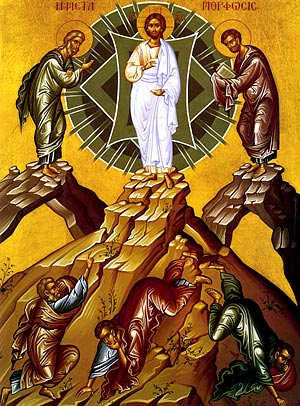
Do you believe this story? Do you believe that his clothes lit up? Not just glowing, not phosphorescent, but dazzling, like lightning. Did his body become electric? Is it possible? Of course it was impossible, which is the point! It’s an anomaly, a singularity. St. Luke reports it as a mystery. The transfiguration is reported by two other gospels, and though they agree on the core of the story, their reports have subtle differences. In order to make sense of St. Luke’s details we look in literary terms at his Gospel as a whole, with his distinctive themes. His Gospel is the most humane, with the most human interest, and one of his themes is the new humanity that Jesus is the founder of, a new generation of human beings of which Jesus is the firstborn, the people of the resurrection.
In terms of the literary structure of St. Luke, the transfiguration looks both forward and backward—it anticipates Jesus’ resurrection and is the confirmation of his baptism. When Our Lord was baptized, down there in the Jordan valley, below sea level, the lowest point in the land-mass of Asia, he heard God’s voice directly, for the first time, “You are my son, my beloved, in you I am well-pleased.” And now up here, for only the second time, on the highest point in Palestine he hears that voice again, “This is my son, my elected, listen to him.” The only two times that he hears God’s voice in the Gospel of St. Luke. So this is the confirmation of his baptism.
And it’s the anticipation of his resurrection. Fifteen chapters later, on Easter morning, there are two men standing at the empty tomb. St. Luke describes their robes as “dazzling” white, with the same word for Jesus’ dazzling clothing up on the mountain. St. Luke specifically calls them “men,” not angels as in the other gospels. They are people like us, but on the other side of death, like the white-robed martyrs in the Book of Revelations. They wear baptismal robes, the ordinary garments of the resurrected citizens of the Kingdom of God. They dazzle because they live already in the future, full of light, the future visible in Jesus on the mountain, the firstborn of the new humanity. St. Luke does not call this a transfiguration, as the other gospels do, but a change, a transformation.
St. Luke is the only one to tell us what Moses and Elijah were talking about. They were speaking of his departure. The Greek word is “exodus.” Of which Moses was the expert! Our translators missed the obvious, which even Peter did not, for all his confusion, as the booths he suggested were from the Feast of Booths, when Jews remember the Exodus and their years of wandering in the desert. Peter would have made them from the branches and foliage around them. But then the cloud overshadowed them like the cloud of Glory on Mount Sinai, and the disciples were terrified. Moses was the prophet of the beginning, and Elijah was the prophet of the end. I’m guessing that Moses spoke of how to get there, and Elijah spoke of what would be there when he got there. I’m guessing that Elijah spoke from experience of how Jesus would feel alone, even while among his people, and Moses spoke from experience of how Jesus must end alone, just him and God. Which the second half of our lesson confirms. He comes down the mountain and he walks into this tableau of a suffering son and a suffering father, and his disciples all standing around with their mouth full of teeth, looking silly and feeling worse. “We couldn’t do anything.” Our Lord can see in this tableau an image of his own impending experience. Himself the son, the son of God, seized and abused by the demonic hands of death, and his Father watching on and suffering with him, just him and God, just him alone. The dark side of the glory that he had just experienced. Of course he was upset. It was a burden for the Son of Man to be the Son of God. That’s another of St. Luke’s themes—the interplay of the two titles of Jesus: Son of God and Son of Man. Both of these titles are lit up in the Transfiguration. But in Luke’s account the emphasis is more on the Son of Man. What Jesus is for us, as he is one of us, the firstborn of our new humanity. My message for you today is that this vision on the mountain is an image of your own illumination and your own transformation. You too will be changed. Not a different face, but a different look on your face. Not to become divine, not an angel, but a human being who can fully bear God’s image, able to reflect the light of God upon your face without diminution, and to generate the light of God without distortion. You are a member of the new humanity, a new mind, a new obedience. St. Paul encourages us in our epistle, in verse 18: And all of us, with unveiled faces, seeing the glory of our Lord as though reflected in a mirror, are being transformed into the same image from one degree of glory to another, for this comes from the Lord, the Spirit. The Holy Spirit is working your transformation. We do not finish it ourselves. God finishes it in our death and resurrection. But already in this life it begins for us. The Lordship of Jesus provides the algorithm, and the Spirit is the catalyst. And you have seen examples of it happening, including persons in this congregation. Do you consider this transformation desirable? Or that it’s even possible? Do you believe that people can change? Or do they basically stay the same? Are we compelled to go through life being driven by our histories? We know that cultures change. We know that nations can be transformed. Indeed, the Bible considers it the will of God that the ethics of the Torah and the Gospel should gradually transform the nations. But what about individuals? What about you? I believe that I am being transformed. Slowly and with fits and starts. I look back with some embarrassment at my life and I shake my head at my history, and though my remorse is not a proof of real transformation it is a sign of it. There’s always repentance in transformation, and often a plea for help. Transformation requires something from the outside, a catalyst, an algorithm, a power and an influence that is external to yourself. Neither internal evolution nor spontaneous generation make for transformation. You cannot do it on your own. That’s a judgment, but it is also liberating. You must first pass through your own exodus. The God of Moses did not bring the children of Israel straight into the Promised Land. They had first to be transformed from a rabble of resistant slaves into a kingdom of priests and a holy nation, which took the desert, the diet of manna, and the fiery serpents. First they had to go through suffering, the suffering of pain, humility, and repentance.
God does not send the suffering, it’s just part of creaturely life. Nor does God get you out of your suffering—God gets you through your suffering. God goes with you through your suffering, just as God went along with Israel during those forty years in the desert. And God was transformed too, not by any change in God, but by the transformation of their capacity to know God and experience God, and to learn God’s love. You transform your image of God in order to transform yourself. You have some healing, but not complete. You have more joy, but also deeper grief. You fear people less because you fear God more, and you learn the fear of God that comes with love. You are more loving, more ethical, and therefore more humble and more vulnerable, but also spiritually more powerful. The algorithm is the Lordship of Jesus and the catalyst is the Holy Spirit. You cannot undo your history, you cannot remake your body and you cannot avoid your grief. You will contend with your history and your body and your grief until you are released in death, and transformation takes maintenance. You need the prayers and the hymns and the sacraments. Your transformation will always be something of a mystery to yourself. Yes, it is a fact, as certain as your baptism, but you will never fully comprehend it. You give up some part of it to others, to those who love you and confirm you, to God and the community. They had to tell Moses his face was shining, he didn’t know it. You get your inner light from sources outside you. But at the same time, you are already transformed in the way that you handle your history and your body and your grief, your weekly converting your tragedy into comedy. The laughter is the laughter of humility and love.
Genesis 45:3-11, 15, Psalm 37:1-12, 41-42, 1 Corinthians 15:35-38, 42-50, Luke 6:27-38 When I was a child, my mother would put my brother and me to bed, and she would talk with us and pray with us, and I learned my faith from her. I was very young when she told us about eternal life, and I was terrified. I didn’t tell her so, I kept it a secret, but I hated the whole idea of immortality. I was an overly-sensitive little boy, and the thought of my mind going on forever and ever, endlessly, kept me awake at night. I would lie there sleepless, sweating, with stomach cramps, and I remember praying, Please God, you can give eternal life to Hank, but please just let me die at the end.
Years later I was happy to learn that the Old Testament does not teach the immortality of the soul. It is nowhere in the Torah and the Prophets, despite the Israelites having lived in Egypt for 400 years, a nation obsessed with immortality. The Torah assumes that our souls are just as mortal as our bodies. Neither does the Old Testament teach that we go to heaven when we die. Heaven was no place for people! What the Israelites hoped for was to inherit the land, as it says three times in our Psalm. They were a people often exiled, wandering, and their hope was the Promised Land and life in Shalom, in peace and quiet prosperity, and to pass that along to their children’s children, who would remember them and bear their names. Being remembered was all the immortality they asked for. In their stories God remembered them, and they prayed, “Remember us, O Lord!” The first hints of resurrection are in the last of the prophets. This was how God could keep that promise of the Promised Land. Too many Israelites had lived and died in exile, and not received God’s promise, so they would be raised again someday, and gathered back to Israel, there to live a second round, but this time in Shalom. This resurrection was for inheriting the land, and not for going to heaven, nor was it for humanity in general, but for the fulfillment of God’s promises to Israel.
So the sudden resurrection of the Lord Jesus was a great surprise for all involved. No one was expecting it—that was not the plan. Just one man, and not the whole nation? And only glimpsed and not explained, his resurrected body loosened from the laws of nature and the limits of creation, and then his departure into heaven, in his physical body? How could that be? What for?
It was hard to believe for the Corinthians. The Hellenistic inhabitants of the Roman Empire were brought up believing in the immortality of the soul. They were taught by Plato that their bodies were the prisons of their souls, and their best hope was to cast off their bodies when they died to free their souls to live forever in disembodied bliss. The resurrection made no sense, either as a fact or as a metaphor, either the resurrection of Jesus alone or a future resurrection for all of us.
St. Paul quotes their two typical questions. “How are the dead raised?” It’s impossible. And, “With what kind of body do they come?” It’s inconceivable. It’s so inconceivable that it can’t be possible. St. Paul doesn’t answer the first question, and in fact the Bible never does. The Bible never explains how the Lord Jesus was resurrected or how we too shall be. It’s the second question that St. Paul answers, to establish its conceivability, and he says, You fools!
You dummies, you see the intimations of it all the time, every day you work in your garden. You take for granted that when you plant your seeds they will transform into the plants you want, and do you doubt that’s possible? Look at the seed, how dry and hard and inert it is. It doesn’t move, it doesn’t change, it doesn’t grow. You keep it in storage for years, like a stone that’s dead. And it bears no visible likeness to the green and growing thing it will become. You find that conceivable! And therefore possible! Resurrection is the same, you dopes. You know that modern biologists still cannot explain the mystery of life in seeds. How a thing that shows no signs of life, even for centuries, with just a little bit of moisture can suddenly spring to life. No other substances can do this, not even substances created in the laboratory with the same proportion of elements. With all of our marvelous science we have never been able to generate life from dead matter. But that must have happened four billion years ago, to get life started on this planet. Ever since then the molecules of certain kinds of matter have passed some code down to other molecules to make that matter come alive, but we humans have proven unable to introduce that code when it is not already there. All of life today is descended from that primeval life that was once for all generated out of dead matter, for which we may even indirectly hold God responsible, and if God can bring life to what is dead, then why not to your own dead body?
But how is that possible after many centuries of being dead, or maybe cremated? How does God find all the scattered molecules? Maybe God doesn’t, and we conceive of other possibilities. Maybe God remembers your DNA plus the bar-code of your life! DNA is mostly information, and how much information can be kept in a digital file too minute for eyes to see, and you can show a whole movie out of that. Maybe God will reconstruct you from the information that God has on you, for God remembers. All you need to be resurrected is that God remembers you!
Last week I asked you to believe that your body has the capacity for resurrection. I should have said it better. Your body does not have that capacity, because of the corrupting power of sin, until it dies first, and God resurrects it with that capacity. But even today your body is a miracle of God, a wonder. As weak and frail as we are, and hardly as agile as many animals, yet the human brain is one of the wonders of the universe, of impossible complexity and capacity, and the seat of this miracle we call the human mind, that can imagine eternity and even meditate on God. Your body is both a wonder and a sign, in which you can read that God has purposes for you, and God remembers you.
This is the last of my sermon series on epiphanies, on manifestations, on physical revelations of God, and this week’s manifestation is your body. Look at your bodies here, what do you see? Can you see past mere observance, can you see with the eyes of faith? Look at your bodies as something like seeds of what God will resurrect us into. How different will we be? If the Lord Jesus is our image, then less different than a plant is from its seed, a chicken from its egg, or a butterfly from its caterpillar. Maybe we will differ only as an elf differs from a human in The Lord of the Rings, but as in the book, not the movie, without that bad hippy hair and those ridiculous ears. Maybe our difference will be more moral than physical. Certainly at least that, which is the take-home for today: The promise of the future resurrection directs your moral lives today. Why else would you do what the Lord Jesus says to do in the gospel? “Love your enemies, do good, and lend to them, expecting nothing in return.” That’s nuts, if for this life only, but if you are planting seeds of good for God to harvest in God’s time, then you can do it. In our dying bodies what happens in the present determines the future, but you live in terms of your future resurrection, so that your future determines what you do in the present. I invite you to see your moral life today as planting seeds within the world. And already now, in God’s pleasure, a good measure of moral harvest, pressed down, shaken together, and running over will be given to you. And, in God’s time, even more. My own body is dying, and I am closer to my death than to my youth. I still courteously dislike immortality, and I hope that eternal life will differ from the immortality I fear. Recently I have learned to answer the immortality that I fear with the resurrection I believe in. How that makes eternal life any different and thus more bearable I do not know, because the resurrection is offered to us as mystery as much as fact. I have to suspend my judgment, for my judgments must die too, and for its nature and its goodness I have to trust in God and in God’s purposes for us. The thing I know for sure about eternal life is that its atmosphere is love, a love so perfect that it casts out fear, and that what God has for us when God remembers us is whatever would agree with love.
Jeremiah 17:5-10, Psalm 1, 1 Corinthians 15:12-20, Luke 6:17-26 What do we see? We see Jesus in the middle of a crowd, a seething crowd, pressing in on him. We see individuals moving in on him and cycling out again; we look closer and we see persons limping and even crawling in on him, touching him, then rising up and walking out as others take their turns. Then we see them all turn toward him, and get quiet as he lifts up his voice to address them. First he points with one hand, and then he points with the other. He could be speaking of two roads. We guess from other Bible passages that he’s speaking of the Two Ways, the Way of Blessing and the Way of Woe. “Blessed are you” if you do this, and “Woe is you” if you do that. Like in the Psalm: if you walk in the way of the righteous you will prosper. We come in close and listen, and we are surprised that Jesus is speaking of the Two Ways in contradiction, in reverse, upside down! Because, if you were poor, you might say Woe is me, but he says Blessed are you. If you were hungry, or if you were weeping, you’d say Woe is me, but he says Blessed are you. If people hate you, exclude you, revile you or defame you, then Woe is me, but he says Blessed are you. And if we prosper and are rich, we say that we are blessed, but Jesus says Woe is you. If we are satisfied and full we say that we are blessed. If we are happy and laughing, and if all speak well of us, we say, with proper Christian modesty, Well, we are blessed. Why does Jesus say the opposite, Woe is you? I do not think he’s saying that it’s better to be hungry than to be filled. He’s not saying that the poor are better than the rich. He’s not classifying people. He’s talking about the condition of being in the way of what God is doing in the world, when God reverses the ordinary way of the world and turns things upside down, which is what salvation does. So if we have carefully solidified our arrangements to keep ourselves comfortable in this corrupted world the way it is, and if our commitments require the world to stay the way it is, then we’re not going to like what God is doing. But on the other hand, if you have made a royal mess of things, and totally blown it with your life, then what Jesus offers is very good news. The Lord Jesus is not dividing us into two kinds of people. We are all both kinds. It’s a revolving door. You go through times of blessing that turn into times of woe and you get through the woe to blessing again. You go from days of weeping to days of laughing and then to weeping again. You go from hunger to being filled to hunger, from being praised to being reviled to being praised. In the words of our Heidelberg Catechism, “Rain and drought, fruitful and lean years, health and sickness, prosperity and poverty,” cycling in and out, like the people in the crowd around the Lord Jesus. Isn’t this cycle just the law of karma, the wheel of life, inexorably turning, you get what you paid for, what goes around comes around, cause and effect, growth and disintegration, flourish and die, build our golden cities and they fall again to dust. The suffering of existence, the inevitable suffering of reality. To ease the suffering we have our religions, and Buddhism offers an escape from it. The Christian answer is different—to enter the suffering and turn the cycle the other way round. I invite you to believe that God pours an energy into the world to turn the revolving door towards final hope and blessing. The Lord Jesus calls this energy the Kingdom of God, and St. Paul calls it the power of the resurrection, to reverse your karma, forgive your sins, and bless you if woe is you. The Kingdom of God has power, the power of the resurrection. This power is inexorable and yet this kingdom does not force itself, it works by love and not by arms. It is subtle, unobtrusive, often hidden, and poor, and hated and opposed, but it is irreversible and very, very patient, and because it is so sure, and yet so generous, and so unconditionally welcoming, it can afford to give its enemies full room and its opponents the freedom to get what they want. Because it is a kingdom of love, it does not insist on its own way, but it also never fails, it never fails to get what it hopes for. In our Epistle lesson St. Paul is so strong on the resurrection because he sees it as the great new energy injected by God into the world. Not immortality, the immortality of the soul that everyone believed in already, because for St. Paul that means just the same old thing forever and ever, and at the end is only dust. And resurrection not as a metaphor, but as an actual event that happened in the world, mysterious yes, inexplicable yes, but historical nonetheless, God’s sudden investment in the world, God’s new energy to push the wheel of karma back around and turn the woe to blessing. God prefers to exercise that energy only rarely in doing miracles or intervening in human events. God does not manipulate. God wants your freedom and your own power for blessing. God puts the energy into the proclamation and the testimony, the proclamation of what God did in Jesus Christ and the testimony of what we have seen in the evidence of faith, that when people believe this proclamation they live their lives in new patterns of hope and peace and reconciliation. You catch that energy in the antenna of your belief and the receiver of your faith and you transform that energy into your own words and your prayers and songs and you radiate that energy by your works of love and your witness to the powers and your service to the poor. And the energy comes also from the future back to us, in God’s Holy Spirit, sent from heaven to inspire you and strengthen you. You know that in the Bible heaven is not so much up above us as forward in the future, heaven means the once and future Kingdom of God already established by God in eternity ahead of us, shining back upon us like the dawn ahead of you, the light by which you see things differently, the same things as everyone else but in a different light and going in a different direction, and in your own small way you push that revolving door around the other way. I invite you, one more week, to welcome the news that in real time Jesus actually rose up from the dead, never to die again, and that this makes all the difference. You can welcome this Kingdom with your own life, and learn to see it and bring it out and work its implications out. You live your life in terms of it, your decisions and your bodies, you re-imagine God in terms of it, and you see the world in terms of it. In your body you feel your blessings and your woes, your wins and your losses, your fullness and your hunger, your health and your sickness, and eventually you will feel the signs of coming death, but you can also believe that your body has the capacity for resurrection, and for eternal life. What the world regards as trouble and a burden, this Kingdom raises into blessing. So then, God’s Word and Spirit are the energy, from the past and from the future. The Word of the resurrection stops the great wheel of karma. The Spirit blows on it to spin the other way around, that what you get is not what you have paid for, that what you get is not what you deserve, that your future is what determines your now, that dying leads to life and evil turns to goodness. The church can practice this. The government can’t. Welfare can’t. Even secular charities can’t. But the church can. And we look for our success in the energy of God. We don’t do it for statistics. Nor that the world speaks well of us. We do it not when we are rich but when we are poor. This is why the ministry of deacons is not an extra in the church, not just charity added on, but is central to the church and why we ordain them. They are living witness of our little actions among the hungry and the poor to illustrate the Kingdom of God and the hidden power of the resurrection.
As Jesus stood there in the middle of the seething crowd, so you can stand firm in the turmoil and vicissitudes of your own life. As the Monterey Cypress tree withstands the raging forest fires of California, and even requires the fire to open its cones and release it seeds, so you can be like that tree that is planted by the streams of water, bearing your fruit in due season, precisely in trial and trouble, fruit of blessing out of woe, rising from dying, despair to hope, and misery into love.
Jeremiah 1:4-10, Psalm 71:1-6, 1 Corinthians 13:1-13, Luke 4:21-30 What do we see in the Gospel today? We see the Lord Jesus making trouble in his hometown synagogue, and then we see the locals turning against him and even trying to kill him. Were some of them his relatives? Isn’t this story rather too extreme? Overly melodramatic? How enigmatic is it? Are we seeing it only dimly, like a distant image in an ancient mirror? Are we seeing only in part? Why did Jesus speak like a noisy gong and a clanging cymbal? Why didn’t he show them more love? Why wasn’t he more considerate of their feelings? Why did he push them so? Was he not on their side? It’s remarkable, according to St. Luke’s version, that the first opposition to Jesus came not from the scribes and Pharisees, as in St. Mark, but from his own people, and that the first people who tried to kill him were not the Romans but the very people he had come to save.
A prophet is without honor in his own country. No prophet is accepted in his own home town. I am no longer honored in the Classis of Brooklyn, though I’m the senior pastor in it, and of all the pastors in the Classis I am the only one who spent my childhood within it, and this is the Classis I wanted for years to come home to. I am a life-long member of the Reformed Church in America, I have devoted my life to it and all my scholarship, and I have been blackballed for leadership in it. I am treated as a trouble-maker because I have spoken out to welcome and affirm LGBTQ Christians. Of doing that I have no regrets, and I stand by it, but you can understand my sense of loss.
Why were the people of Nazareth so suddenly upset? I think it was only natural. Their condition under the Romans was poverty and oppression. They were like captives in their own land. And as we saw last week, Jesus had just read out from Isaiah the prophecy of bringing good news to the poor, and lifting the oppressed, and liberating those in captivity. And then he said, “The time is now, and the Messiah prophesied is me!” So the people were delighted with their hometown boy.
If he was going to do that, then it was natural to expect him to judge those who kept them poor, and punish their oppressors who taxed them so, and vanquish the occupying soldiers who treated them like slaves. Be the enemy of our enemies. But then the Lord Jesus reminded them of stories of God being as good to their enemies as to them, even to healing an enemy soldier who had defeated their own in battle, and it hit them that Jesus did not intend to be the enemy of their enemies. Of course they felt betrayed by him, and hurt, and enraged, with the extreme emotions of a crowd.
When we cry out for salvation, when we cry out for God to intervene, we naturally want God to fix our circumstances but leave us as we are, thank you very much. Save me, and save me as I am. Fight for me, that I win, and I get back what belongs to me. But the Savior has to save us mostly from ourselves. Our own worst enemy is us. So it’s good news that the Lord Jesus befriends our enemies, as that includes us! He has no enemies, only friends. Which sometimes hurts our feelings. But our feelings are what Jesus does not come to save. This is important.
It’s not that our feelings are not important. Jesus shared our feelings. This is one reason that our Savior had to be a fully human being, to feel first-hand the things we feel. Parents are right to care for their children’s feelings. Friends are careful of each other’s feelings. Lovers are all about each other’s feelings. If you love people, you care about their feelings.
It’s because you don’t want to hurt someone’s feelings that you might not say what you know to be true. Discretion is the better part of candor. And you have to ask yourself, Do they really need to hear it or is it my felt-need to say it? My mentor once explained to me that as a pastor I should tell somebody something only if that person is able to hear it. If he or she can’t hear it, then I am not obliged to say it. Was that the problem with the people of Nazareth, that they were unable to hear the good news in what Jesus said? It’s why depressed citizens often respond to politicians who will end up hurting them more instead of responsible leaders whose truth is hard to hear.
But at the same time, when we say that we don’t want to hurt other people’s feelings, it’s often as much our own feelings we’re protecting, because if you tell that truth they will think less of you, or even get angry with you, like with Jesus. I confess the many times I did not tell the truth about myself because it was my own feelings I was protecting as much as the feelings of the person I was speaking to. Is it their feelings that you do not want to hurt or in fact your own? Or both? It’s hard to distinguish when it’s your family with whom you share your feelings or any group of people that you love. So how is Jesus loving here, when love is patient and love is kind, as in First Corinthians 13?
But love has its distinctions. It’s worth remembering, that the Greek language has three words for “love” to only one for English. Three kinds of love, and they blend into each other. Two of them are all about feeling and one is not. The first kind of love is eros, intimate love, sexual attraction, the love between lovers and spouses. It’s based on feelings and is very physical. It is wonderful and powerful and it can be dangerous and to keep it safe requires great protections. The second kind of love is philia, brotherly love, sisterly love, family love, tribal love, even patriotic love. Its feeling is affection. At one end it’s family feeling, and at the other it’s the friendship of best friends. It’s based on shared genetics and language or shared experience and loyalties. It has to mean that some folks are in and some folks are out. These two kinds of love are good and natural, and they occur among animals. But they are not the kind of love that’s in First Corinthians 13. I often notice Christians saying that the church they belong is like a family. They mean well, but the New Testament never uses “family” for the church, but for the whole of humanity. That’s because the church has to be based on the third kind of love, which is agape.
This is a rarer kind of love, Godly love, Gospel love, love beyond affection, love beyond feeling, love beyond friendship because it treats its enemies as friends, love beyond family because it treats strangers the same. It is not based on feeling and your feelings can confuse your loving this way when you want to. Feelings can oppose it, and hinder recognizing it when you receive it, especially if you’re judging it by the other kinds of love. Like at Nazareth. It is often unrequited—the Rev. Dr. Martin Luther King loved his country with Gospel love and was killed for it. You live by this kind of love and it will get you into trouble. It’s unrealistic and practically impossible.
But I invite you to not rule it out because you fear it’s unrealistic, rather that you keep coming back to it and always imagine again, in both expectation and humility, how to try again to put this love into practice. Don’t ask how you can adjust the claim of love to conform to our reality, but how you change yourself to conform to the claim of love. What losses can you anticipate and accept as worth it, and what loss can you even welcome in order to gain the salvation that it offers?
This kind of love cannot depend on feeling, so it requires faith and hope. You can approach the claim of love when you live by faith instead of your own internal certainties. You can answer the challenge of love when you live in hope instead of your own realities. Love is always beyond you, so to attain it means the constant exercise of faith and hope. Faith and hope are the means to the goal that is love. You practice faith in order to love. You practice hope in order to keep on loving. And you can do this, love this way, if you do it by faith and if you accept the proof of it in your hope.
This kind of love is beyond your possession. It is in you but beyond us. That’s simply because it belongs to God. It’s not that love is God but that God is love. God defines what love is. Love is patient and kind because God is patient and kind. God does not rejoice in wrongdoing, but rejoices in the truth. God does not insist on God’s own way. God bears all things, God believes all things, God hopes all things, God endures all things, and God will never end. For now you love as in a mirror dimly, but then you will love face to face. Now you love in part, but then you will love fully, even as you have been fully loved.
Daniel James Meeter grew up in Manhattan, Bedford-Stuyvesant, Jersey, and Long Island. He was ordained to the Reformed Church ministry in 1980, and has served churches in Jersey, Michigan, and Ontario. He earned a Ph.D. from Drew University in 1989, and has published two technical books in theology as well as many articles. He is married to Rev. Melody Takken Meeter, the Director of Pastoral Care at the Lutheran Medical Center of Brooklyn. They have two married children.
The Old First Mission Statement:
Old First Reformed Church is a community of Jesus Christ in Brooklyn. We welcome persons of every ethnicity, race, and orientation to worship, serve, and love God, and to love our neighbors as ourselves. We embrace the following missions:
1. To offer God's word, prayer, the sacraments, and discipleship; 2. To offer outreach, education, fellowship, and music;
3. To offer sanctuary to anyone seeking spirituality and hope;
4. To offer hospitality to community groups and the arts; 5. To care for the gifts we have been given through our Reformed Church, including our historic sanctuary and building.