This Sunday through Tuesday I will be attending the 31st session of the Bobs Lake Gang. Our name doesn't say much for our imaginations, but hey, we're guys, and we're pastors, so who expects imagination?
In October 1992, a Canadian pastor friend of mine, Rev. Dr. Orville James, had the idea of starting a small pastors' group to meet on retreat at his cottage on Bobs Lake in Ontario. We were joined by Bob Ripley, whose star was just rising. We talked, prayed, smoked cigars, read scripture, played air guitar, repeated Monty Python scripts, did dishes, prayed some more, and failed to shower and shave.
On Monday night, we lay on the floor in the dark and listened to the Blue Jays play their first World Series. It was a tiny old AM radio, and the woodstove was on to keep us warm.
We met again in the spring, and three more pastors joined us, Drew and Andrew and Orville's brother John. Or did Andrew come the next time? Or was John there the first time? We've been going long enough to need an historian.
Since then we've added new members, three of them, and we've had vacancies and visitors along the way, but there's no question that we have forged ourselves into something; just what that something is I am not sure I want to know.
We are all Canadian pastors, mainline denominations, United and Anglican, except for me, a Dutch Calvinist from the States (though I am a dual citizen, and a subject of Elizabetha Regina and her heirs-by-law). I used to say that they wanted me in so that I could buy the single-malt Scotch at the Duty Free at the border. Then my wife and I bought the cottage next door to Orville's, and if they kicked me out I could just go up any and blast my radio like at General Noriega. And now some of the other guys are bringing the Scotch.
Fifteen years, now, or 31 sessions, without a break. We're the only group we know to have endured so long. Orville is the leader, and the rest of us have different roles to play. Andrew makes breakfast, Ripley cooks a formal dinner on Monday night (despite our lack of shaving and showering). John and I fight over the control of the coffee. We've been fighting over the coffee for years. It's what we do.
Sunday night we kick back and let loose. We report the news, and we tell the stories that pastors never dare tell anyone else but pastors. I always try to have a long joke ready. Early on I told the one about the Lutheran pastor who wakes up in hell. It remains the unbeatable standard, like Johnny Vander Meer's back-to-back no-hitters.
Monday, after breakfast, we spend all morning in scripture and prayer. We use the Anglican service for morning prayer, and whatever lessons that come up in the lectionary. We try to do that sitting outside on the deck above the lake, if it's not too cold. It's never too cold for me; I love to wrap myself in blankets like a sachem and talk about the Eternal, and then talk to the Eternal.
Soup and sandwiches for lunch, then we split up for exercise and naps and conversations, and golf or hiking or canoing on the bright, cold lake. Monday dinner is nice with napkins and wine. Monday night, the talk is quieter and calmer.
Tuesday morning, prayers and scripture again, but less intense. A quick lunch and then off home.
We have prayed each other through many difficulties. We have prayed each other through broken marriages and tough times in the ministry. Wandering children and troublesome staffs. Clergy stuff. We challenge and support each other. We probably should use more soap.
Thursday, October 25, 2007


Wednesday, October 24, 2007
Update on the Homeless Men
In the words of the Leonard Cohen song, "It's come to this, oh yes, it's come to this."
First, I thank you all for your participation in this conversation. I thank you for your comments and your interest. In particular I thank the Park Slope Civic Council for their desire to be part of a solution, and I thank Rabbi Andy Bachman and Congregation Beth Elohim for their offering to support us and assist us. ("Love bears all things, believes all things, endures all things.")
Second, now that this conversation has started, it needs to keep developing. If Park Slope was just voted the best neighborhood in NYC, then why shouldn't homeless people want to live here too? A truly diverse community needs to embrace its FULL diversity. Old First wants to be part of the continuing conversation, especially with Beth Elohim and the Civic Council.
Third, because this is a developing story, let me update you on the weekend. There are some new facts on the ground. On Sunday afternoon, the cops were called in twice by neighbors. I have to say the cops were great.
As left the church on Sunday evening, I found a steel bar the guys were keeping as a weapon. On Monday morning I learned that the men had been urinating in front of nursery school children and into their play-yard. On Monday evening a deacon confirmed to me that the men had exposed themselves in front of children while urinating.
Yesterday Frank showed me his face, very badly bruised. He told me had fallen, but I don't believe him. His face tells a different story. This morning I removed a blanket with blood stains on it.
"It's come to this, oh yes, it's come to this." (I guess I always expected it would come to this.)
I have been denying them permission to sleep on our grounds since last July, but I found it impossible to enforce. As of this morning, the Commander of Precinct 78 agreed with me that the police would enforce it.
The story isn't over. What's going to happen next, I don't know. But now that the community seems to have woken up I want it to stay involved. The men were sleeping and hanging out at Old First because Old First is public space for the community, and because, like anyone, they want a short commute, and they work on Seventh Avenue.
So please don't give them money. Give them food. Address them by name. Robert, Will, and Frank.
It's not over for us with them either at Old First. We have three deacons who will work on this with me. We'll get back to you.
Meanwhile, you might check the Brooklyn Paper for a story this weekend.
First, I thank you all for your participation in this conversation. I thank you for your comments and your interest. In particular I thank the Park Slope Civic Council for their desire to be part of a solution, and I thank Rabbi Andy Bachman and Congregation Beth Elohim for their offering to support us and assist us. ("Love bears all things, believes all things, endures all things.")
Second, now that this conversation has started, it needs to keep developing. If Park Slope was just voted the best neighborhood in NYC, then why shouldn't homeless people want to live here too? A truly diverse community needs to embrace its FULL diversity. Old First wants to be part of the continuing conversation, especially with Beth Elohim and the Civic Council.
Third, because this is a developing story, let me update you on the weekend. There are some new facts on the ground. On Sunday afternoon, the cops were called in twice by neighbors. I have to say the cops were great.
As left the church on Sunday evening, I found a steel bar the guys were keeping as a weapon. On Monday morning I learned that the men had been urinating in front of nursery school children and into their play-yard. On Monday evening a deacon confirmed to me that the men had exposed themselves in front of children while urinating.
Yesterday Frank showed me his face, very badly bruised. He told me had fallen, but I don't believe him. His face tells a different story. This morning I removed a blanket with blood stains on it.
"It's come to this, oh yes, it's come to this." (I guess I always expected it would come to this.)
I have been denying them permission to sleep on our grounds since last July, but I found it impossible to enforce. As of this morning, the Commander of Precinct 78 agreed with me that the police would enforce it.
The story isn't over. What's going to happen next, I don't know. But now that the community seems to have woken up I want it to stay involved. The men were sleeping and hanging out at Old First because Old First is public space for the community, and because, like anyone, they want a short commute, and they work on Seventh Avenue.
So please don't give them money. Give them food. Address them by name. Robert, Will, and Frank.
It's not over for us with them either at Old First. We have three deacons who will work on this with me. We'll get back to you.
Meanwhile, you might check the Brooklyn Paper for a story this weekend.
Monday, October 22, 2007
With Apologies to Frost
Nature’s last green is brown,
Her tints are going down
To blend in with the earth
From which we rise in birth.
Prospect Park is finally changing color now, though the temperature is still too warm. Most of the trees just go to brown, while a few are beginning to show off their yellows, golds, and reds.
Not the white pines on Lookout Hill, above the Nethermead, the white pines that I love. Their needles are even greener than a month ago. They have groomed themselves for winter. It is not so that they do not loose their leaves like other trees. They do.
In September we went to our cabin in Ontario, and my wife Melody said, "Look, the white pines are turning brown." And they were. Their branches were all dead brown needles. She worried for our trees, but she needn’t have. Those brown quintuplet clusters hid the tiny new growth needles behind them.
When I went back in October, the ground was thick with needles, and the white pines were bright and fresh and green. For white pines, Easter should happen in October. Oaks and maples celebrate Passover as the New Year, but conifers keep true to Rosh Hashanah.
White pines like the winter sun. And so in wintertime, when I walk from my apartment to the church, I take the long way, up and over Lookout Hill, so that I can say hello to the white pines, especially when there is snow on the ground.
I haven’t started that yet. And Sunday I was running late, so I took the Center Drive. And as I walked past the Friends Cemetery I saw what I had seen before, that most of the gravestones were in shadow from the trees, but some of the stones were brightly lit in the low rays of the autumn sun.
What’s better for gravestones — sunlight or shadow? I mean, what hastens their decay, the algae that grow in shade, or the heating and cooling of solar energy? Those stones that are brightly lit, do they mark the graves of specially righteous Quakers, whose spirits leave an energy behind to greet the sun, or of specially sinful Quakers, unhappy ones, whose souls are not at rest, and cannot abide the sweet decay of shadow and shade? Is there anyone who can come back from the dead to tell me?
Time is linear for Quakers, and for the rest of us Christians. What has been has been, there is no return, and we are praying for the future, which is a fulfillment of the past, but also therefore essentially different from the past. That's a fundamental belief of Jews and Christians and Muslims.
But trees are Taoists or Buddhists, I think. Trees believe that time is circular, and that everything will come around again. I have no desire to convert the trees to Christianity. Certainly not the white pines. They have no need of redemption.
Her tints are going down
To blend in with the earth
From which we rise in birth.
Prospect Park is finally changing color now, though the temperature is still too warm. Most of the trees just go to brown, while a few are beginning to show off their yellows, golds, and reds.
Not the white pines on Lookout Hill, above the Nethermead, the white pines that I love. Their needles are even greener than a month ago. They have groomed themselves for winter. It is not so that they do not loose their leaves like other trees. They do.
In September we went to our cabin in Ontario, and my wife Melody said, "Look, the white pines are turning brown." And they were. Their branches were all dead brown needles. She worried for our trees, but she needn’t have. Those brown quintuplet clusters hid the tiny new growth needles behind them.
When I went back in October, the ground was thick with needles, and the white pines were bright and fresh and green. For white pines, Easter should happen in October. Oaks and maples celebrate Passover as the New Year, but conifers keep true to Rosh Hashanah.
White pines like the winter sun. And so in wintertime, when I walk from my apartment to the church, I take the long way, up and over Lookout Hill, so that I can say hello to the white pines, especially when there is snow on the ground.
I haven’t started that yet. And Sunday I was running late, so I took the Center Drive. And as I walked past the Friends Cemetery I saw what I had seen before, that most of the gravestones were in shadow from the trees, but some of the stones were brightly lit in the low rays of the autumn sun.
What’s better for gravestones — sunlight or shadow? I mean, what hastens their decay, the algae that grow in shade, or the heating and cooling of solar energy? Those stones that are brightly lit, do they mark the graves of specially righteous Quakers, whose spirits leave an energy behind to greet the sun, or of specially sinful Quakers, unhappy ones, whose souls are not at rest, and cannot abide the sweet decay of shadow and shade? Is there anyone who can come back from the dead to tell me?
Time is linear for Quakers, and for the rest of us Christians. What has been has been, there is no return, and we are praying for the future, which is a fulfillment of the past, but also therefore essentially different from the past. That's a fundamental belief of Jews and Christians and Muslims.
But trees are Taoists or Buddhists, I think. Trees believe that time is circular, and that everything will come around again. I have no desire to convert the trees to Christianity. Certainly not the white pines. They have no need of redemption.
Thursday, October 18, 2007
The Homeless Men at Old First
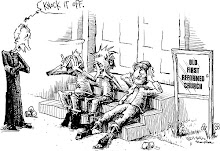
Their names are Robert Royster, Will Franklin, and Frank. They cause me a great deal of trouble, and lots of anger from our neighbors, and I do wish they would go away, but, whatever else, they remain human beings, images of God, and they need to be treated with respect.
People keep asking why don't we get rid of them. We can't. We've tried. Believe me, we have tried. They have abused our hospitality, they piss on our building, they leave food around, they leave garbage all over, they play their radio at great volumes (God forgive me, I have had to resort to theft against them to deal with that one). They are a pain in the neck. But we will not treat them as less than human beings.
We have tried to get rid of them. We've discovered the hard way that we can't do it, we can't beat them. Whenever I chase them away, they just wait an hour, two hours, and they come back. I go home at night, and they come back. No matter what we do or say, they come back.
I will confess a strong desire inside myself to just let them be. It's Jesus' church, not mine, not ours, and the New Testament is very clear about our hospitality to the poor. "The poor you will always have with you." The parable of Lazarus. Etc. You get the point. And there is no asterix pointing to a codicil that says, "the nice poor."
But at the same time I recognize we belong to a community, and the church has the responsiblity to be a good neighbor, and if the guys scare the kids, and make lewd comments at women and passersby, and if they leave food scraps around for vermin to get at, etc. etc., then, well, I know that the church has to be a good neighbor. So we decided this last July that they absolutely had to go. We tried to get rid of them. As I said, we couldn't.
We chased them away every morning. They came back every night. We threw out their stuff. They found new stuff. Only now they started getting even more hostile, to us and to other passersby. We finally found that we couldn't beat them, and the only thing was to try to control it. Yes, they beat us.
The cops can't do anything either, apparently. If you call them, you have to wait there, on the spot for about half an hour till the cops come, and all they can say is "Scram," and they give you dirty looks for taking up their time, and half an hour later the guys are back.
The cops have to catch them in the act of public urination or public consumption of liquor, which are misdemeanors, and mean nothing to anyone, or catch them inside the building, which is trespassing, and might mean a trip to Rikers Island, but Rikers is already over-crowded and they don't want to put vagrants there.
Why are they there at Old First? Easy. The money is good on Seventh Avenue. The money dries up, the guys go. Where I grew up in Bedford-Stuyvesant there are no panhandlers. Up at Ethical Culture the front porch is deeper and drier, but people don't give out money on PPW.
Old First is the only church on Seventh Avenue without a fence. That's important to us, we love it that people sit on our steps and that kids run on the top of our little wall. And that's also why they are at Old First.
Today, again, I cleaned up their garbage. Waddayagonnado. But I will not remove their sleeping bags. Some of our neighbors think I should do that. But that's a moral line I will not cross. The Torah is very clear, that you should not take from a poor man what keeps him warm at night. Leaving their filthy sleeping bags there is my little attempt to be moral in this whole thing, and honor the basic dignity the Torah assigns them.
I used to talk to them and pray with them. I used to be able to reason with them. That's no longer possible. They're drinking 24/7 lately. They are nasty to me too. How long this will go on I do not know. In the short term, it's people giving them money that keeps it going. In the long term, they are killing themselves. If they manage to get arrested, they will get cleaned up at Rikers, and we'll have them back in February!
Before Robert had descended to his current condition, and when he had sober moments, he used to pray very moving prayers for certain people in the area. for poor children, for illiterates (such as himself), for soldiers, for forgiveness of his sins. I hate what has become of him. I always knew it would be coming.
It's a grief, and we're at our wits end. We have been unable to find any solution. In a strange way, the three of them are in control. Robert, Will, and Franklin.
They have names. They have souls. They belong to our community. They tell us something about ourselves.
People keep asking why don't we get rid of them. We can't. We've tried. Believe me, we have tried. They have abused our hospitality, they piss on our building, they leave food around, they leave garbage all over, they play their radio at great volumes (God forgive me, I have had to resort to theft against them to deal with that one). They are a pain in the neck. But we will not treat them as less than human beings.
We have tried to get rid of them. We've discovered the hard way that we can't do it, we can't beat them. Whenever I chase them away, they just wait an hour, two hours, and they come back. I go home at night, and they come back. No matter what we do or say, they come back.
I will confess a strong desire inside myself to just let them be. It's Jesus' church, not mine, not ours, and the New Testament is very clear about our hospitality to the poor. "The poor you will always have with you." The parable of Lazarus. Etc. You get the point. And there is no asterix pointing to a codicil that says, "the nice poor."
But at the same time I recognize we belong to a community, and the church has the responsiblity to be a good neighbor, and if the guys scare the kids, and make lewd comments at women and passersby, and if they leave food scraps around for vermin to get at, etc. etc., then, well, I know that the church has to be a good neighbor. So we decided this last July that they absolutely had to go. We tried to get rid of them. As I said, we couldn't.
We chased them away every morning. They came back every night. We threw out their stuff. They found new stuff. Only now they started getting even more hostile, to us and to other passersby. We finally found that we couldn't beat them, and the only thing was to try to control it. Yes, they beat us.
The cops can't do anything either, apparently. If you call them, you have to wait there, on the spot for about half an hour till the cops come, and all they can say is "Scram," and they give you dirty looks for taking up their time, and half an hour later the guys are back.
The cops have to catch them in the act of public urination or public consumption of liquor, which are misdemeanors, and mean nothing to anyone, or catch them inside the building, which is trespassing, and might mean a trip to Rikers Island, but Rikers is already over-crowded and they don't want to put vagrants there.
Why are they there at Old First? Easy. The money is good on Seventh Avenue. The money dries up, the guys go. Where I grew up in Bedford-Stuyvesant there are no panhandlers. Up at Ethical Culture the front porch is deeper and drier, but people don't give out money on PPW.
Old First is the only church on Seventh Avenue without a fence. That's important to us, we love it that people sit on our steps and that kids run on the top of our little wall. And that's also why they are at Old First.
Today, again, I cleaned up their garbage. Waddayagonnado. But I will not remove their sleeping bags. Some of our neighbors think I should do that. But that's a moral line I will not cross. The Torah is very clear, that you should not take from a poor man what keeps him warm at night. Leaving their filthy sleeping bags there is my little attempt to be moral in this whole thing, and honor the basic dignity the Torah assigns them.
I used to talk to them and pray with them. I used to be able to reason with them. That's no longer possible. They're drinking 24/7 lately. They are nasty to me too. How long this will go on I do not know. In the short term, it's people giving them money that keeps it going. In the long term, they are killing themselves. If they manage to get arrested, they will get cleaned up at Rikers, and we'll have them back in February!
Before Robert had descended to his current condition, and when he had sober moments, he used to pray very moving prayers for certain people in the area. for poor children, for illiterates (such as himself), for soldiers, for forgiveness of his sins. I hate what has become of him. I always knew it would be coming.
It's a grief, and we're at our wits end. We have been unable to find any solution. In a strange way, the three of them are in control. Robert, Will, and Franklin.
They have names. They have souls. They belong to our community. They tell us something about ourselves.
Wednesday, October 10, 2007
On Widows and Apologetics
I just had a little piece published in a theology magazine, under the title above. It's about how God seems to have set things up in such a way as to make God's self more credible to orphans, widows, and the poor than to intellectuals.
And I say a word of two about our desire for intellectual respect, which can be a kind of covetousness.
To get to the full journal, called Perspectives, go here: http://www.perspectivesjournal.org/index.html
There are some other worthwhile articles as well.
To get to my little essay, go here: http://www.perspectivesjournal.org/2007/10/seeit-widows.html
And I say a word of two about our desire for intellectual respect, which can be a kind of covetousness.
To get to the full journal, called Perspectives, go here: http://www.perspectivesjournal.org/index.html
There are some other worthwhile articles as well.
To get to my little essay, go here: http://www.perspectivesjournal.org/2007/10/seeit-widows.html
Babycoat
I love Julia Durgee's cartoon style, which is why I am happy to host her on this blog.
And this last one is my favorite. Because it's so real about the self-conscious, the zelf-bewustzijn in Dutch, the self-awarness that is often sharpest in the memory of dreams. I love her take on wimsy and how she touches what is just under the surface.
And I love how her drawing is essential to her little stories, and not a mere excuse for dialogue.
I don't want to say too much about this cartoon, because I should let it speak for itself, but it expresses for me the complexity of love. There is desire in it, humility, courage, grandiosity, childlikeness, great gift and great need. This is a Romantic cartoon in the classic Don Quixotic sense of High Romance.
And this last one is my favorite. Because it's so real about the self-conscious, the zelf-bewustzijn in Dutch, the self-awarness that is often sharpest in the memory of dreams. I love her take on wimsy and how she touches what is just under the surface.
And I love how her drawing is essential to her little stories, and not a mere excuse for dialogue.
I don't want to say too much about this cartoon, because I should let it speak for itself, but it expresses for me the complexity of love. There is desire in it, humility, courage, grandiosity, childlikeness, great gift and great need. This is a Romantic cartoon in the classic Don Quixotic sense of High Romance.
Monday, October 08, 2007

Subscribe to:
Posts (Atom)