Outside my window, across the street, next to the fence of Prospect Park, is a ginko tree. It shades the bench where Melody and I sometimes sit.
Last Wednesday, it still had all its leaves, though most of them had turned. We went to Connecticut for Thanksgiving. When we got back on Friday all its leaves were down. Suddenly, like that.
And there was a beautiful carpet of yellow gold, with touches of green, around our bench. The sidewalk was covered, and the carpet was clean and fresh. In a day or two its lustre would be gone.
The ailanthus is on our side of the street, right against our building. It seems to have dropped its leaves just as suddenly. But they were scattered, and on the street. And it dropped its stems as well, the long leaf stems on which its leaflets grow, and they now litter the corner like straw.
I do not love thee, ailanthus, as I love the ginko. You have come here from China too, but you are lower class, and you have no lovely bark, and your branches break, and people call you messy.
How they can call you "Tree of Heaven" I don't know, unless it is the love of God in Heaven that loves you, and loves you no less than the ginko. But I am not God. My heart is so much smaller with less room for love.
Yet I have accepted you, finally, next to my window. At first I was consumed with wishing you were a maple or an oak, but you are what you are, and I submit to God's love of you.
But ginko, thank you for the carpet that showed us what Eden was like in its first autumn.
Wednesday, November 28, 2007
Tuesday, November 27, 2007
Sermon for November 25: Christendom and Theocracy
Christ King 2007, Jeremiah 23:1-6, Benedictus, Colossians 1:11-20, Luke 23-33-43
The Feast of Christ the King is a very late addition to the church’s calendar. In 1925, Pope Pius XI invented the Feast and required Roman Catholics to observe it. That’s how it got into the ecumenical calendar. It’s only for ecumenical reasons that we Reformed Christians observe it now.
We would say, "Why not Christ the Prophet, and why not Christ the Priest?" We prefer the title, "Christ the Lord." We would say we already have a celebration of his kingship on Ascension Day, when he took his seat on the right hand of his Father, and also, for that matter, on Good Friday, when he was enthroned upon the cross and his title was posted above his head for all to see.
The reason the pope invented this feast day was to defend the Kingship of Christ against the secularism of politicians and intellectuals. Not to mention that the Roman Catholic Church was losing power, prestige, and privilege.
Just ten years later, in 1935, Josef Stalin made his famous remark about the pope. The French Foreign Minister had suggested to Stalin that if he would encourage more Roman Catholics in Russia, then the pope would be on better terms with him. Stalin replied, "The Pope? How many divisions has he got?"
All the Christian churches use to have a lot more power in the world, including politics and economics. Now that we have so much less, does that imply that Jesus has less power too?
When I became a citizen of Canada, I had to swear allegiance to Queen Elizabeth the Second. Ironically, it’s only because she is a powerless figure-head that modern Canadians are willing to swear that. The Queen of the Netherlands actually has more influence behind the scenes, but only as long as she behaves. Is this what we have done with Jesus Christ, that we have preserved his lovely royalty but emptied it of real authority and sovereignty? Pope Benedict seems to think so.
In 1925 Pope Pius was trying to preserve the old order of Europe—historic Christendom. There are many Christians in America today who are trying to preserve America as a Christian nation. The best of their reasons is their belief that the kingship of Christ demands it.
There is no doubt that the separation of church and state has gone along with the privatization of religion and the narrowing of the kingdom of God to merely personal issues. Since religion can have no place in the public arena, you have to keep it as your own private choice. But that’s like keeping a tiger in your back yard.
Theocracy means that all of worldly power and authority derives from God. Political sovereignty derives from God, not from the people. Judaism, Christianity, and Islam are theocratic religions at their base. These three religions speak to all of life. The Laws of Moses structure a whole society. So does the Koran. The theocracy of Judaism is restricted to the land of Israel. But the theocracy of Islam is meant for all the world. Even a modern Muslim nation is expected to enforce it, whether it does that softly or strictly.
We cannot get around the theocratic element in Christianity. But how are to understand it? Should we be concerned for Christendom? Are we required to protect our Christian civilization? Is America a Christian country? Should we try to bring our Christian values into public policies and politics? Isn’t to leave it a private and individual matter to surrender the kingdom of God?
But the theocratic element in Christianity has been altered by Jesus Christ himself. The gospel version of theocracy we might better call Christocracy. There is a movement in the Bible. The Kingdom of God has been transferred into the Kingdom of Christ, the sovereignty of God is now focused in the sovereignty of Christ. And because he is the Christ who is crucified, his sovereignty is unlike any other in the world.
You can see it best revealed upon the cross. His cross is a judgement on the whole idea of kingship, but also the expression of how he does it.
Yes, his crucifixion is a travesty of justice, and in his accepting it he’s making a comment about the way that human beings do sovereignty in general. At the same time, because the cross is his throne, he’s showing us the radical difference of his kingdom. His glory is his humility. His policy is grace and reconciliation, his army is his very enemies, his weapons are the wounds of love upon his hands and feet. He does not defend his kingdom, so neither should we. He does not ask us to fight for his kingdom but simply to receive it by accepting his reconciliation.
I confess to you that I have sometimes been attracted by the arguments of those thinkers like Pope Benedict who believe it’s important for us to preserve the benefits of Christendom. I confess to you that sometimes I think I preach a slovenly form of Christianity, accommodating, easy-going, giving in too much, without standards and insufficiently rigorous. I don’t know, do you wonder this yourself? Are we selling short the sovereignty of Christ?
But then I remind myself of his sovereignty upon the cross in all its humility and lavish generosity. If you keep on bringing your enemies into your kingdom, then your kingdom needs no defense.
* * * *
Historically, kings were always judges, the supreme judges of the land. That is true of Christ, it is through judgement that Jesus exercises his kingship, not through conquest or through controlling things behind the scenes, but through judgement. And his verdicts are all set out ahead of time, his judgement is very public, it is easily available in the gospel, in what he said and what he did.
He judges all the powers and pretensions of the world. He judged the rulers of Jerusalem, both Jewish and Roman, especially by his death. He exposed the cruelty of Rome and the venality of Roman law. He exposed the corruption of the leaders of Judea and how shallow was their piety. Just by standing there before them hee exposed the fear that motivated all of them.
His judgements still continue in the world. By this very gospel he judges every nation of the world. He judges our exercise of power and our use of violence. His cross is the standard against which is measured all of our empires and achievements, and they all fall short.
But his judgement is to justify. He exposes us to reconcile us. He unmasks our pretensions in order to clothe us in his love. He condemns us with himself in order to take us with him walking in his royal garden, his paradise.
The Roman inscription posted on the cross above his head said, This is the King of the Judeans. It was a cruel joke, not to mention being anti-Semitic. The thief hanging next him did not get the joke. Unaccountably he believed it, that this loser of a Messiah would someday have a kingdom. "Jesus, remember me when you come into your kingdom."
Jesus answered that his kingdom was already there. Not completely, not yet fully, but truly there. Wherever there is reconciliation in the name of Jesus, there is the kingdom of God. We do not have to fight for it, we have only to receive it. The forgiveness of sins and of debts and of trespasses is much more important for the world and its politics than anyone seems to recognize. And that forgiveness and reconciliation is our version of Christendom and of theocracy.
A last word. The Dutch queen is not crowned, but installed, and she takes an oath of loyalty to the constitution. Dutch citizens do not swear allegiance to the Queen, but to the constitution. From 1890 till 1948 the Queen of the Netherlands was Wilhelmina, a remarkable woman of courage and intelligence who puts the modern monarchies to shame.
My grandfather loved her. Even after he immigrated in 1914. Even though he was a socialist. He might have been the only Calvinistic Socialist in New Jersey. Even after he became an America citizen he still regarded Wilhelmina as his Queen.
I believe that even as the world is changing with the positive benefits of secularization, there remains within the human heart a place for just that kind of loyalty and love, and we want to extend it to a Lord of whom the earthly kings and queens are but pale images.
So our concern is not defending the kingdom of Christ but loving its king, not its boundaries but its center, and being loyal to the power of his love, even to loving his enemies. This loyalty trumps all other loyalties, and this love generates so much other love. I want to say, "My Lord."
Copyright © 2007 by Daniel Meeter, all rights reserved.
The Feast of Christ the King is a very late addition to the church’s calendar. In 1925, Pope Pius XI invented the Feast and required Roman Catholics to observe it. That’s how it got into the ecumenical calendar. It’s only for ecumenical reasons that we Reformed Christians observe it now.
We would say, "Why not Christ the Prophet, and why not Christ the Priest?" We prefer the title, "Christ the Lord." We would say we already have a celebration of his kingship on Ascension Day, when he took his seat on the right hand of his Father, and also, for that matter, on Good Friday, when he was enthroned upon the cross and his title was posted above his head for all to see.
The reason the pope invented this feast day was to defend the Kingship of Christ against the secularism of politicians and intellectuals. Not to mention that the Roman Catholic Church was losing power, prestige, and privilege.
Just ten years later, in 1935, Josef Stalin made his famous remark about the pope. The French Foreign Minister had suggested to Stalin that if he would encourage more Roman Catholics in Russia, then the pope would be on better terms with him. Stalin replied, "The Pope? How many divisions has he got?"
All the Christian churches use to have a lot more power in the world, including politics and economics. Now that we have so much less, does that imply that Jesus has less power too?
When I became a citizen of Canada, I had to swear allegiance to Queen Elizabeth the Second. Ironically, it’s only because she is a powerless figure-head that modern Canadians are willing to swear that. The Queen of the Netherlands actually has more influence behind the scenes, but only as long as she behaves. Is this what we have done with Jesus Christ, that we have preserved his lovely royalty but emptied it of real authority and sovereignty? Pope Benedict seems to think so.
In 1925 Pope Pius was trying to preserve the old order of Europe—historic Christendom. There are many Christians in America today who are trying to preserve America as a Christian nation. The best of their reasons is their belief that the kingship of Christ demands it.
There is no doubt that the separation of church and state has gone along with the privatization of religion and the narrowing of the kingdom of God to merely personal issues. Since religion can have no place in the public arena, you have to keep it as your own private choice. But that’s like keeping a tiger in your back yard.
Theocracy means that all of worldly power and authority derives from God. Political sovereignty derives from God, not from the people. Judaism, Christianity, and Islam are theocratic religions at their base. These three religions speak to all of life. The Laws of Moses structure a whole society. So does the Koran. The theocracy of Judaism is restricted to the land of Israel. But the theocracy of Islam is meant for all the world. Even a modern Muslim nation is expected to enforce it, whether it does that softly or strictly.
We cannot get around the theocratic element in Christianity. But how are to understand it? Should we be concerned for Christendom? Are we required to protect our Christian civilization? Is America a Christian country? Should we try to bring our Christian values into public policies and politics? Isn’t to leave it a private and individual matter to surrender the kingdom of God?
But the theocratic element in Christianity has been altered by Jesus Christ himself. The gospel version of theocracy we might better call Christocracy. There is a movement in the Bible. The Kingdom of God has been transferred into the Kingdom of Christ, the sovereignty of God is now focused in the sovereignty of Christ. And because he is the Christ who is crucified, his sovereignty is unlike any other in the world.
You can see it best revealed upon the cross. His cross is a judgement on the whole idea of kingship, but also the expression of how he does it.
Yes, his crucifixion is a travesty of justice, and in his accepting it he’s making a comment about the way that human beings do sovereignty in general. At the same time, because the cross is his throne, he’s showing us the radical difference of his kingdom. His glory is his humility. His policy is grace and reconciliation, his army is his very enemies, his weapons are the wounds of love upon his hands and feet. He does not defend his kingdom, so neither should we. He does not ask us to fight for his kingdom but simply to receive it by accepting his reconciliation.
I confess to you that I have sometimes been attracted by the arguments of those thinkers like Pope Benedict who believe it’s important for us to preserve the benefits of Christendom. I confess to you that sometimes I think I preach a slovenly form of Christianity, accommodating, easy-going, giving in too much, without standards and insufficiently rigorous. I don’t know, do you wonder this yourself? Are we selling short the sovereignty of Christ?
But then I remind myself of his sovereignty upon the cross in all its humility and lavish generosity. If you keep on bringing your enemies into your kingdom, then your kingdom needs no defense.
* * * *
Historically, kings were always judges, the supreme judges of the land. That is true of Christ, it is through judgement that Jesus exercises his kingship, not through conquest or through controlling things behind the scenes, but through judgement. And his verdicts are all set out ahead of time, his judgement is very public, it is easily available in the gospel, in what he said and what he did.
He judges all the powers and pretensions of the world. He judged the rulers of Jerusalem, both Jewish and Roman, especially by his death. He exposed the cruelty of Rome and the venality of Roman law. He exposed the corruption of the leaders of Judea and how shallow was their piety. Just by standing there before them hee exposed the fear that motivated all of them.
His judgements still continue in the world. By this very gospel he judges every nation of the world. He judges our exercise of power and our use of violence. His cross is the standard against which is measured all of our empires and achievements, and they all fall short.
But his judgement is to justify. He exposes us to reconcile us. He unmasks our pretensions in order to clothe us in his love. He condemns us with himself in order to take us with him walking in his royal garden, his paradise.
The Roman inscription posted on the cross above his head said, This is the King of the Judeans. It was a cruel joke, not to mention being anti-Semitic. The thief hanging next him did not get the joke. Unaccountably he believed it, that this loser of a Messiah would someday have a kingdom. "Jesus, remember me when you come into your kingdom."
Jesus answered that his kingdom was already there. Not completely, not yet fully, but truly there. Wherever there is reconciliation in the name of Jesus, there is the kingdom of God. We do not have to fight for it, we have only to receive it. The forgiveness of sins and of debts and of trespasses is much more important for the world and its politics than anyone seems to recognize. And that forgiveness and reconciliation is our version of Christendom and of theocracy.
A last word. The Dutch queen is not crowned, but installed, and she takes an oath of loyalty to the constitution. Dutch citizens do not swear allegiance to the Queen, but to the constitution. From 1890 till 1948 the Queen of the Netherlands was Wilhelmina, a remarkable woman of courage and intelligence who puts the modern monarchies to shame.
My grandfather loved her. Even after he immigrated in 1914. Even though he was a socialist. He might have been the only Calvinistic Socialist in New Jersey. Even after he became an America citizen he still regarded Wilhelmina as his Queen.
I believe that even as the world is changing with the positive benefits of secularization, there remains within the human heart a place for just that kind of loyalty and love, and we want to extend it to a Lord of whom the earthly kings and queens are but pale images.
So our concern is not defending the kingdom of Christ but loving its king, not its boundaries but its center, and being loyal to the power of his love, even to loving his enemies. This loyalty trumps all other loyalties, and this love generates so much other love. I want to say, "My Lord."
Copyright © 2007 by Daniel Meeter, all rights reserved.
Labels:
Sermons
Wednesday, November 21, 2007
Park Slope Coalition for the Homeless
Good news. We had our first meeting last night in the study of Rabbi Bachman at Beth Elohim. Please read his account of it. "A Visit from DHS," at http://www.brooklynjews.org/weblog/
Thank you, George and Jodi of the DHS of the City of New York. Thank you, Common Ground. Thank you, Park Slope Civic Council. Thank you, Beth Elohim. Thank you, Deacons of Old First.
More to come.
Thank you, George and Jodi of the DHS of the City of New York. Thank you, Common Ground. Thank you, Park Slope Civic Council. Thank you, Beth Elohim. Thank you, Deacons of Old First.
More to come.
Labels:
Moral Marketplace
Thursday, November 15, 2007
Sermon for November 18: God Enjoys Us, And So Do We

Note #1: This picture is our best guess of our first church building, erected some time after 1660. It stood in the middle of what is now Fulton Street, in front of where Macy's is now. Most of our earliest Dutch Reformed churches were square or octagonal.
Note #2: What follows is my sermon for our Colonial Service. We participate in the city-wide celebration of Five Dutch Days, Five Boroughs. My text is from Isaiah 65:21-23. At the beginning of the sermon I give it in Dutch (from the old Statenvertaling) and at the end of the sermon in the English of the Authorized (King James) Version. But before I get there, I give the Exordium remotum.
Exordium remotum:
Geliefde gemeente, dames en heren, mensen en kinderen. The exordium remotum is when the preacher gave a preview of the sermon—he told them what he was going to tell them. Sermons were much, much longer back then, and the exordium remotum approached the length of a modern sermon.
I won't do that. I will tell you that my topic today is God Enjoys Us, So Do We. The rest of my exordium remotum is announcements and explanations.
Let me welcome any visitors here with us today. Thank you for coming. Thank you for honoring that this historical exercise has to be a real live worship service for people in the present. We thank the deacons who made koeken and koekjes for koffie kletzen after the service, to which you’re all invited.
I thank David Von Salis for being our Voorlezer. He’s not Dutch, he’s Swiss, but our very first pastor, Domine Polhemus, was not Dutch either, but German, his name was originally Polheim. Our early congregation was only half-Dutch, the rest were French and German and Danish and English and African and Indian. Most of the Africans not by choice. God have mercy.
The music of our early services was strictly psalm-singing, from the majestic Genevan psalter. Most of our English Psalms date from 1632. Our Dutch Psalm dates from 1563, the version our congregation sang in Brooklyn till 1815; they never learned the newer version of 1773, the one I learned from my own immigrant grandparents.
The Calvinists, like the Russian Orthodox, sang a capella, without accompaniment, but in Holland the city councils owned the church buildings, and they would not discard their pipe organs, so they compromised that the organist would play before and after the service but not during it, and what the organist played would be variations on the psalm tunes of the day.
And that’s what our organist, Aleeza Meir, has done today. Ms. Meir is playing our historic Roosevelt pipe organ, which was installed by grand-nephews several times removed, of Isaac Roosevelt, the ancestor of FDR. Isaac Roosevelt was a prominent elder in the New-York congregation, and one of the translators of our liturgy from Dutch to English in 1767.
The last words of the Dutch liturgy were "Gedacht de armen," meaning, "Mind the poor." We do want to keep the poor in mind. Today is also our annual blessing of the grocery bags. We will do that after the benediction. When I say, Gedacht de armen, you may come forward and join us in blessing the grocery bags. But now, let the congregation pray. Laat de gemeente bidden.
[Here followed the Prayer before Sermon from the old Liturgy.]
Predicatie:
Geliefde gemeente, mijne text is van De Profeet Isaiah, de vijf-en-zesde hoofdstuk, de verzen een-en-twintig tot en met drie-en-twintig.
En zij zullen huizen bouwen, en bewonen, en zij zullen wijngaarden planten, en derzelver vrucht eten. Zij zullen niet bouwen, dat het een ander bewone; zij zullen niet planten, dat het een ander ete, want de dagen Mijns volks zullen zijn als de dagen eens booms, op Mijn uitverkorenen zullen het werk hunner handen verslijten. Zij zullen niet tevergeefs arbeiden, noch baren ter verstoring; want zij zijn het zaad der gezegenden des Heeren, en hun nakomelingen met hen. Tot zo ver.
Dearly beloved. Some history. There were many more German Reformed immigrants to America than Dutch Reformed. The Germans went mostly to Pennsylvania, Ohio, and Missouri, and they had their own denomination, which eventually developed into the United Church of Christ. But here in New York, the German congregations joined the Dutch Reformed Church.
My father was pastor of one of these, in Bedford-Stuyvesant. What is now the New Brooklyn Reformed Church was founded as Die Deutsche Evangelische Niederlandische Reformierte Kirche, the German Evangelical Dutch Reformed Church, and the stained-glass windows are in German. Under my father it became an African-American congregation, Barbadan, Jamaican, Surinamer, Virginian, South Carolinian, Cuban, one old German lady, and us four white kids.
Every few months our family would get in the car and drive to Jersey to visit my grandparents and my cousins. My dad always took the Brooklyn Bridge. (We never took the Manhattan Bridge; I assumed it was because we were from Brooklyn, and the Manhattan Bridge was for people from Manhattan.) My dad would work his way over to the West Side Highway, and then we held our noses. It stank. That was the meat-packing district, and oh, did it stink. In the back seat of the car we would groan and make a scene.
I wonder how much the Temple in Jerusalem must have stank. The Temple’s main activity was slaughtering and cooking large animals, without refrigeration. The Temple must have felt more like an abattoir than a cathedral, except these butchers were singing psalms. The religion of Israel was extremely organic. It was flesh-and-blood, it was earthy, profoundly so.
What God promised the Children of Israel was not heaven but a piece of the earth. Not the Promised Sky but the Promised Land. The revelation from Mount Sinai is not about meditation and contemplation but property and plowing. It says alot more about cattle than about angels. It’s about houses, and vineyards, and fruit, and having children. It is a different spirituality than what’s in vogue today.
In the Old Testament, you cannot separate the spirit from the body. You can distinguish them, but you cannot separate them, just as physics cannot separate location from velocity and baseball cannot have offense without defense. In the Old Testament, spirituality is never separated from the down to earth matters of ordinary life. The soul is never separated from the body.
Other religions believe the soul to be supernatural and made of different stuff, astral stuff, immortal stuff, and that the body is even the prison of the soul, from which the soul must be set free. The Old Testament teaches that the soul belongs to the body, that it is the life of the body, the life force of the body, the energy of the body, which makes the body to be spiritual. The soul is that which makes the transitory transcendent, and the historical heavenly, and the quotidian eternal. My soul is what makes my physical spiritual, my soul is the medium for my body to be holy.
Our souls are shaped by our bodies. My soul is over six feet tall, and thin-skinned and irritable, but also sanguine and energetic. More important, our souls are conditioned by our cultures. Our souls are shaped by our histories and affected by our experience, for better or worse.
One of my early memories is the little song my grandma taught us. Klokje klinkt, vogel singt, iedereen op zijnde wijs, kind ook gij, zingt daarbij, tot des Heren lof en prijs. [Little bell rings, birdie sings, everyone in its one way, child you too sing along to the praises of the Lord.]
I loved that song, I loved it because of my grandma’s voice and my grandma’s accent, and I loved the smells and flavors of her house, and of her cooking, and all the wonderful things she made with her hands, and I used to sing that song in the back seat of the car, and that song has helped to shape and condition my present spirituality.
Your soul has the shape of your body and your soul has a sound, a voice, an accent, from your cultural conditioning. My own soul has a Dutch-American shape with African-American conditioning, plus some small Brooklyn-German influence. Your soul is not some disembodied astral stuff. It has everything to do with your body and your history, for better or worse, for richer for poorer, in sickness and in health. On the whole that’s good, it’s what God wants, Isaiah says that God rejoices in his people, so God enjoys our peculiarities and particulars.
The collective spirituality of our congregation has a specific shape and sound as well. The physicality of this building affects our common behavior, for better or worse. Our 353-year history as the first church in Brooklyn conditions our community, for richer for poorer.
That for the first third of our history we worshiped in a language that only one of us now understands, that having twice moved our location has disconnected us from the very roots we claim, that as the mother church of the borough we wanted everyone to get along so we did not take stands on the ethical issues of the day—all this history is the body that has shaped our congregation’s soul.
The outcome is that our ethical gift to the public is more sanctuary than advocacy, that our theology is more ecumenical than denominational, and that we value diversity more than identity. For better or worse. We dare to believe that God rejoices in our peculiar particulars, not counting our sins against us, but pardoning our offenses. The celebration of our heritage is not the record of our achievements, but the reckoning of what God has forgiven us, and the accounting of how God has blessed us in particular even through our weakness and shortcomings.
And so we allow ourselves to rejoice as well, to enjoy our own particular peculiarity, which is what we do today. What a very strange church we are, a wonderful collection of people almost as diverse as our first congregation. If we are humbly repentant of our sins and joyfully thankful for our blessings then we may keep this whole thing going in the fear and love of God, and, as Isaiah says, we may long enjoy the work of our hands. Our religion is not just about heaven at the end, it’s about an organic life lived now before the face of God, it’s a spirituality that engages flesh and blood, it’s eternity bearing fruit in our every-day.
We sang a version of Psalm 42 that is long forgotten in the Netherlands, the antique version of 1563, the version we sang in Brooklyn until 1815. We never learned the new version of 1773 because we were cut off from the Netherlands since 1664. In the Netherlands today they sing a version from the 1970’s.
But let me tell you something. On Tuesday afternoon, when the children were rehearsing for today, two of them, Ian and Ruby, surprised us by singing from memory that old Dutch verse, Als een hert gejacht O Here, and they knew it better than I did. What a wonder. The words of the prophet are coming true. Please listen to them again:
And they shall build houses, and inhabit them; and they shall plant vineyards, and eat the fruit of them. They shall not build, and another inhabit; they shall not plant, and another eat: for as the days of a tree are the days of my people, and mine elect shall long enjoy the work of their hands. They shall not labour in vain, nor bring forth for trouble; for they are the seed of the blessed of the LORD, and their offspring with them.
Copyright © 2007 by Daniel Meeter, all rights reserved.
Labels:
Sermons
Wednesday, November 14, 2007
Tuesday, November 13, 2007
Sermon From A Year Ago: 18,000 Sundays
Note: the following sermon was given one year ago, at our Annual Colonial Service, which is part of the city-wide Five Dutch Days, Five Boroughs, http://www.5dutchdaysnyc.org. During this service, we use the old Dutch Reformed Liturgy of 1619, but in the English translation of 1763. My text was Mark 13:1-8, the Gospel for Proper 28.
Now you know why Jesus suddenly lost his popular support. Because he predicted the destruction of the temple. That’s like predicting the destruction of the White House, or the World Trade Center.
He must have been overheard—he did say it in a public place. His disciples didn’t dare discuss it till they were in private. And two days after saying this, Jesus got arrested. Now you know why they arrested him. They took him as a terrorist, as a religious revolutionary.
The Reformed Church was revolutionary in its early years. The Calvinist preachers were at the vanguard of the political upheavals in France, Scotland, the Netherlands, Hungary, and England. In 1559, the Belgic Confession, the official digest of Dutch Reformed doctrine, was written in a Spanish prison by a preacher who was then executed as an enemy of the Emperor. The early Dutch Calvinists were iconoclasts, to be kept away from stained glass windows.
The Netherlands won its freedom from Spain, and the Reformed Church was established as the new state religion, and quickly—inevitably—the Dutch Reformed Church became the mistress of the status quo. Indeed, eventually a Calvinistic political party developed by the name of the Anti-Revolutionary Party.
Similar things happened in America. Our church was established by the Dutch colonial government. In 1776 we were not as Tory as the Episcopalians, but neither were we Revolutionists like the Presbyterians.
Our own congregation, throughout our history, has avoided the social and political issues of the day, and, some would say, the ethical issues of the day. We did not speak out against slavery. We did not march for civil rights. We are the mother church of Brooklyn. Our instincts are maternal: everybody’s welcome, let’s keep the peace, let’s not talk sex or politics.
We were established 352 years ago. In American terms that’s very old. How old should we try to get? Should we aim for 700? Should we do this Colonial Service 348 more times? Does God even desire this kind of thing? Or would Jesus predict the demolition of our limestone walls, and then ask us why we are holding on, and trying to keep one lovely stone upon another?
The temple in Jerusalem was precious to Jesus’ compatriots because it located the presence of God. No temple, no presence of God. No presence of God, no purpose for Israel, no place to do their mitzvoth, no hope, no future, no glory, no history, no memory.
But from Jesus’ point of view, while the temple symbolized the presence of God, it also restricted it. It restricted the presence of God in both access and influence. So it was time for the next chapter in God’s story, the never-ending story of God and humankind and the redemption of the world. The law of God was ready to go worldwide, the gospel was ready to go universal, it was time for the transfiguration of God’s people, the metamorphosis from a religious nation to an international religion. Jesus saw himself as the catalyst of that metamorphosis. And just as the cocoon falls away from the butterfly as it rises, so with the temple in Jerusalem.
The Christian church through history has also both symbolized and restricted the presence of God. In this congregation our forebears brought their slaves to church, but made them sit in the balcony, and would not let them drink from the communion cup till the whites had finished first.
In recent times, the last national government to be Christian by constitution was the Union of South Africa, and there apartheid was the law. Apartheid was developed by the Dutch Reformed Church as a theological justification for state-sponsored racism and a cover for ethnic paranoia and economic exploitation. That’s part of the Dutch Reformed story, when we represented and restricted the presence of God in the world. We needed to be demolished, stone by stone.
Jesus told his disciples that hard times would be coming, but they should not fear, the distress is really the birth pangs of a new order, the labor pains of a new stage in God’s design. That’s the stage that we’re in now. It’s been about 2000 years, which seems a long time to us, but speaking relatively, in planetary time, it’s only a few seconds. God may well let things develop another 2000 years, provided we haven’t destroyed the planet, of course.
This is the stage of many different stories. The previous stage was the single story, the story of Israel, one particular location, one particular language, one culture set apart for responding to the Word of God. The current stage is the stage of many stories, of one nation after another, one language after another, one culture after another responding to the Word of God. Never fully, never completely, always partially, always with cause for repentance, but giving shape and form to the gospel in the reality of culture and of life. This story is bigger than the church. This is what we call the Kingdom of God.
Recently a Muslim theologian asked me why the Christians have so many denominations. Well, partly, of course, because we fight with each other and divide from each other. That’s the repentance side of the story, but that’s not all. Why are there so many different kinds of flowers, why so many kinds of houses, so many languages and kinds of music? When you talk about the soul in Dutch, it has a different feeling than when you talk about it in English.
The many denominations are the symbols and memory of the many different stories to remember, the stories of Armenia and of Antioch, of Constantinople and Rome and Kiev and Moscow, of St. Patrick and Luther and Calvin and Stuyvesant and Polhemus and Sarah Rapalye and Anneke Jans Bogardus and the Cortelyou family, descended from French Calvinistic revolutionaries, who when they came to Long Island just wanted to have a nice little farm and worship God on the Lord’s Day. And the little congregation they belonged to told them God was present with them here.
We have a story to tell. It’s the story of 18,000 Sundays when God has spoken to us and our congregation has responded, in terms of our own particularity, in our location, in our dialect and accent and idiom. We tell this story with honesty and honor and humility. We thank God for being present with us, and being present to Brooklyn through us, in spite of how often we have restricted the very presence we represented. And the story of how God makes good out of bad. Did you hear that last week South Africa nationally legalized civil unions for gay couples?
We have a story to remember within the larger epic of God’s design. That’s why we do this historical service—it’s one small part of our distinctive mission. Listen to our Mission Statement. Old First Reformed Church is a community of Jesus Christ in Brooklyn. We welcome persons of every ethnicity, race, and orientation to worship, serve, and love God, and to love our neighbors as ourselves.
After this the Mission Statement lists five specific missions that we embrace, and the fifth one is To care for the gifts we have been given through our Reformed Church, including our historic sanctuary and building. One of those gifts is our story, and to care for it we have to know it and remember it and respect and repent of it. The people who are in it are the communion of our saints, and we love them, even at a distance, and as fallen as they were, because God loved them first, and it’s a love story, after all.
We want the congregation of the future to love us too. Who knows what building they’ll be worshiping in, maybe seven hundred Sundays from now they will be using a barn again. We want to keep this story going, the story of God among us in our place. The way to keep this story going is not to pray that God will bless what we are doing, but to pray that we do what God is blessing. Amen?
Copyright © 2007 by Daniel Meeter, all rights reserved.
Now you know why Jesus suddenly lost his popular support. Because he predicted the destruction of the temple. That’s like predicting the destruction of the White House, or the World Trade Center.
He must have been overheard—he did say it in a public place. His disciples didn’t dare discuss it till they were in private. And two days after saying this, Jesus got arrested. Now you know why they arrested him. They took him as a terrorist, as a religious revolutionary.
The Reformed Church was revolutionary in its early years. The Calvinist preachers were at the vanguard of the political upheavals in France, Scotland, the Netherlands, Hungary, and England. In 1559, the Belgic Confession, the official digest of Dutch Reformed doctrine, was written in a Spanish prison by a preacher who was then executed as an enemy of the Emperor. The early Dutch Calvinists were iconoclasts, to be kept away from stained glass windows.
The Netherlands won its freedom from Spain, and the Reformed Church was established as the new state religion, and quickly—inevitably—the Dutch Reformed Church became the mistress of the status quo. Indeed, eventually a Calvinistic political party developed by the name of the Anti-Revolutionary Party.
Similar things happened in America. Our church was established by the Dutch colonial government. In 1776 we were not as Tory as the Episcopalians, but neither were we Revolutionists like the Presbyterians.
Our own congregation, throughout our history, has avoided the social and political issues of the day, and, some would say, the ethical issues of the day. We did not speak out against slavery. We did not march for civil rights. We are the mother church of Brooklyn. Our instincts are maternal: everybody’s welcome, let’s keep the peace, let’s not talk sex or politics.
We were established 352 years ago. In American terms that’s very old. How old should we try to get? Should we aim for 700? Should we do this Colonial Service 348 more times? Does God even desire this kind of thing? Or would Jesus predict the demolition of our limestone walls, and then ask us why we are holding on, and trying to keep one lovely stone upon another?
The temple in Jerusalem was precious to Jesus’ compatriots because it located the presence of God. No temple, no presence of God. No presence of God, no purpose for Israel, no place to do their mitzvoth, no hope, no future, no glory, no history, no memory.
But from Jesus’ point of view, while the temple symbolized the presence of God, it also restricted it. It restricted the presence of God in both access and influence. So it was time for the next chapter in God’s story, the never-ending story of God and humankind and the redemption of the world. The law of God was ready to go worldwide, the gospel was ready to go universal, it was time for the transfiguration of God’s people, the metamorphosis from a religious nation to an international religion. Jesus saw himself as the catalyst of that metamorphosis. And just as the cocoon falls away from the butterfly as it rises, so with the temple in Jerusalem.
The Christian church through history has also both symbolized and restricted the presence of God. In this congregation our forebears brought their slaves to church, but made them sit in the balcony, and would not let them drink from the communion cup till the whites had finished first.
In recent times, the last national government to be Christian by constitution was the Union of South Africa, and there apartheid was the law. Apartheid was developed by the Dutch Reformed Church as a theological justification for state-sponsored racism and a cover for ethnic paranoia and economic exploitation. That’s part of the Dutch Reformed story, when we represented and restricted the presence of God in the world. We needed to be demolished, stone by stone.
Jesus told his disciples that hard times would be coming, but they should not fear, the distress is really the birth pangs of a new order, the labor pains of a new stage in God’s design. That’s the stage that we’re in now. It’s been about 2000 years, which seems a long time to us, but speaking relatively, in planetary time, it’s only a few seconds. God may well let things develop another 2000 years, provided we haven’t destroyed the planet, of course.
This is the stage of many different stories. The previous stage was the single story, the story of Israel, one particular location, one particular language, one culture set apart for responding to the Word of God. The current stage is the stage of many stories, of one nation after another, one language after another, one culture after another responding to the Word of God. Never fully, never completely, always partially, always with cause for repentance, but giving shape and form to the gospel in the reality of culture and of life. This story is bigger than the church. This is what we call the Kingdom of God.
Recently a Muslim theologian asked me why the Christians have so many denominations. Well, partly, of course, because we fight with each other and divide from each other. That’s the repentance side of the story, but that’s not all. Why are there so many different kinds of flowers, why so many kinds of houses, so many languages and kinds of music? When you talk about the soul in Dutch, it has a different feeling than when you talk about it in English.
The many denominations are the symbols and memory of the many different stories to remember, the stories of Armenia and of Antioch, of Constantinople and Rome and Kiev and Moscow, of St. Patrick and Luther and Calvin and Stuyvesant and Polhemus and Sarah Rapalye and Anneke Jans Bogardus and the Cortelyou family, descended from French Calvinistic revolutionaries, who when they came to Long Island just wanted to have a nice little farm and worship God on the Lord’s Day. And the little congregation they belonged to told them God was present with them here.
We have a story to tell. It’s the story of 18,000 Sundays when God has spoken to us and our congregation has responded, in terms of our own particularity, in our location, in our dialect and accent and idiom. We tell this story with honesty and honor and humility. We thank God for being present with us, and being present to Brooklyn through us, in spite of how often we have restricted the very presence we represented. And the story of how God makes good out of bad. Did you hear that last week South Africa nationally legalized civil unions for gay couples?
We have a story to remember within the larger epic of God’s design. That’s why we do this historical service—it’s one small part of our distinctive mission. Listen to our Mission Statement. Old First Reformed Church is a community of Jesus Christ in Brooklyn. We welcome persons of every ethnicity, race, and orientation to worship, serve, and love God, and to love our neighbors as ourselves.
After this the Mission Statement lists five specific missions that we embrace, and the fifth one is To care for the gifts we have been given through our Reformed Church, including our historic sanctuary and building. One of those gifts is our story, and to care for it we have to know it and remember it and respect and repent of it. The people who are in it are the communion of our saints, and we love them, even at a distance, and as fallen as they were, because God loved them first, and it’s a love story, after all.
We want the congregation of the future to love us too. Who knows what building they’ll be worshiping in, maybe seven hundred Sundays from now they will be using a barn again. We want to keep this story going, the story of God among us in our place. The way to keep this story going is not to pray that God will bless what we are doing, but to pray that we do what God is blessing. Amen?
Copyright © 2007 by Daniel Meeter, all rights reserved.
Labels:
Sermons
Monday, November 12, 2007
No Sermon from Yesterday
On Sunday, November 11, we had a wonderful guest preacher, Rev. Ojeda Hall Phillips, Assistant Pastor at Brown Memorial Baptist Church. She was our Consecration Sunday preacher. And she was great.
Thank you, Rev. Hall Phillips.
Labels:
Sermons
Weimaraner
As I was walking through the Park this morning on the way to work, I was thinking again about William Wegman's famous Weimaraner photos, and wondering why they trouble me. They feel vaguely exploitive, and disrepectful to the very dogs they celebrate. Sort of like what we did to natives and aborigines, when the European explorers brought them back to Europe, and dressed them up in formal clothes and showed them off, remarking how much manners they could be taught.
As I approached the bridge a dogwalker came out of the trees, accompanied by a Weimaraner! What coincidence. And an ally, I thought, who doubtless would confirm my opinions on the matter.
I said, point blank, "What do you think of Wegman's photos?"
She said, "I like them."
Drat. Oh dear.
I walked on, a little chastened in my self-righteousness.
But what is it that troubles me? There's nothing wrong with children dressing up their pets. We did it too. At the other end of the continuum is The Island of Doctor Moreau. It's a very broad continuum, and I don't dispute that Wegman is way over toward Dick, Jane, and Sally.
One of the most remarkable things about dogs is how "plastic" they are as a species. Much more than cats, for example. For some strange genetic reason, we can breed them into such distinct varieties (fr0m Chihuahuas to St. Bernards) that a visiting Martian, at first glance, would have to assume they're different species.
If we humans have done this to them generally, then what's wrong with what Wegman does?
And I know firsthand he treats them royally. I have a friend who is an assistant in that studio, and whose hands I have recognized sticking forward out of sleeves. Those dogs are loved. And they seem to enjoy their work.
I can't quite put my finger on it. And I'm not going to say it's immoral, or even wrong. But isn't there anyone else who finds it disrespectful to the very dogs that are being celebrated?
As I approached the bridge a dogwalker came out of the trees, accompanied by a Weimaraner! What coincidence. And an ally, I thought, who doubtless would confirm my opinions on the matter.
I said, point blank, "What do you think of Wegman's photos?"
She said, "I like them."
Drat. Oh dear.
I walked on, a little chastened in my self-righteousness.
But what is it that troubles me? There's nothing wrong with children dressing up their pets. We did it too. At the other end of the continuum is The Island of Doctor Moreau. It's a very broad continuum, and I don't dispute that Wegman is way over toward Dick, Jane, and Sally.
One of the most remarkable things about dogs is how "plastic" they are as a species. Much more than cats, for example. For some strange genetic reason, we can breed them into such distinct varieties (fr0m Chihuahuas to St. Bernards) that a visiting Martian, at first glance, would have to assume they're different species.
If we humans have done this to them generally, then what's wrong with what Wegman does?
And I know firsthand he treats them royally. I have a friend who is an assistant in that studio, and whose hands I have recognized sticking forward out of sleeves. Those dogs are loved. And they seem to enjoy their work.
I can't quite put my finger on it. And I'm not going to say it's immoral, or even wrong. But isn't there anyone else who finds it disrespectful to the very dogs that are being celebrated?
Labels:
Moral Marketplace
Tuesday, November 06, 2007
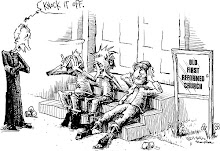
More on the Pastor and the Homeless

I should be flattered, and I am.
This was the editorial cartoon in the November 4, 2007, edition of The Brooklyn Paper.
(Do I have automatic permission to post it just because I'm in it? Does my caricature belong to me?)
If you haven't been following the story, the three men who see, speak, and hear no evil, are more or less Robert, Will, and Frank, I guess.
Read the story in the web edition of the Brooklyn Paper. The headline is, well, unflattering, but then I have to remember Luke 6:26. And the story itself is accurate enough. Only we're not "Reformed Presbyterian"!
Monday, November 05, 2007
Sermon for All Saints Sunday, 2007
Daniel 7:1-3, 15-18, Psalm 149, Ephesians 1:11-23, Luke 6:20-31
11/04/07
The Saints of Brooklyn
Jesus said, Blessed are you who are poor, for yours is the kingdom of God. He should know, because he was poor. He said, Blessed are you who are hungry now, and he knew what hunger was. He said, Blessed are you who weep now, and Jesus wept.
Not that sadness and hunger and poverty are good things in themselves, although if you want to be part of the Kingdom of God you cannot deny them or run away from them or even fear them, but because they’re not the last word. The last words are laughter and fullness — not the laughter and fulness from that come from the usual indulgences we use to soothe our hunger and our sadness, but our laughter and our fulness comes from the special riches of the Kingdom of God itself.
God says, Blessed are you when people hate you, and God should know, because so many people hate God. God says, Blessed are you when they exclude you and revile you and defame you. God should know, because of how often God is excluded and reviled and defamed. Not just by the powerful and intellectual, but, more grievously for God, at least, by so many small and poor and suffering of the earth, people who have suffered the cruelness and violence of the world and hold it against God. God knows what it is to be hated and reviled and defamed.
And we are invited to join God in this. Do you mind sharing this with God? Do you mind sharing such kind of things with Jesus? And with so many Christians who have gone on before us? We call them saints, and some of their names are very well known, but most of their names are forgotten in history, and they are remembered only by God. But to be remembered by God is a very great thing, with wonderful implications for the future resurrection.
What makes people saints is their loving their enemies despite what their enemies do to them. In this they are sharing in the love of God. God continues doing good for people by whom God is hated, God continues blessing those by whom God is cursed, and God continues to pray for those by whom the name of God is abused.
Yes, God prays to God, it happens within the Trinity, when God the Son is always making intercession to God the Father for humanity and the world. God loves the world and God loves God’s enemies and those who do not love God back. And we can join God in this godly kind of love. It’s the marker of both divinity and sanctity.
It is by our love that we judge the world. Our judgment should begin and end in love. Yes, we are to judge the world. Were you taken aback by those violent words that you read out loud in Psalm 149, and of God’s people executing judgment on the nations with our two-edged swords? Are we really to judge the world? But the character of our judgment is revealed in Jesus as the judgment of loving embrace and engagement that is both tenacious and non-violent.
Kind of like how Nelson Mandela was judging South Africa from inside his cell on Robbins Island. Kind of like how little Ruby Bridges was judging America when every morning she walked into that public school building through the gauntlet of racist threats of violence.
If someone strikes you on the cheek, as Jesus says, don’t ever hit back, but also don’t give in. Take over the initiative. Engage. But not with violence. When you offer up the other cheek, you are saying, "I don’t believe you hit me." The one who has abused you is now being judged by you, but it’s a judgment of a very tough kind of love.
he risk you take is that this time he might hit you again much harder. It takes an awful lot of courage to be both peaceful and engaged. Or if not courage, then dedication to what you believe, or if not dedication, then a desperate trust in the promises of God.
We should not be fundamentalist about what Jesus tells us here. He is not calling for heroics. Every time in our gospel lesson Jesus says the word "You" it’s in the plural form, as in Y’all, or, as we say in Brooklyn, Yous. "Blessed are yous." The dedication and the courage come in the community. We are called to be saints within community.
It’s the community together that makes a difference. People want to know how they can make a difference. The desire is admirable, but the solution is often frustrated because the assumptions are too frequently individualistic. It is more realistic, I think, to belong to a community that makes a difference.
That’s what we’re trying to do here, to gather and nourish a community that makes a difference by being a communion of saints. We are at our best as saints when we do it not alone but as a community. That’s why we say that we believe in the communion of saints. And let me remind you that most of the saints in Christian history have not been the ones that stand out alone, but those who are humbly hidden in the community of saints.
Today we are canonizing two more saints, Saint Henry and Saint Sydney. Today we are baptizing two little children. We are putting on them the mark of this community. Henry is about fifteen months old, and Sydney is about ten days old, and at five pounds, she is the tiniest saint I have ever held.
Neither of them has any idea that they are saints. But that in itself is characteristic of sanctity. It’s never themselves with which the saints are occupied, it’s the world that they love. Right now Henry still rejoices in everything he sees, and as Sydney is learning to look around and make out human faces, she pretty much loves everyone she sees. These two children have no enemies. In their innocence, they judge the world.
Blessed are they, and blessed are we to embrace them. And what a great inheritance their parents are bringing them int0, and what a great inheritance this ancient congregation can pass along to them.
Copyright © 2007 by Daniel Meeter, all rights reserved.
11/04/07
The Saints of Brooklyn
Jesus said, Blessed are you who are poor, for yours is the kingdom of God. He should know, because he was poor. He said, Blessed are you who are hungry now, and he knew what hunger was. He said, Blessed are you who weep now, and Jesus wept.
Not that sadness and hunger and poverty are good things in themselves, although if you want to be part of the Kingdom of God you cannot deny them or run away from them or even fear them, but because they’re not the last word. The last words are laughter and fullness — not the laughter and fulness from that come from the usual indulgences we use to soothe our hunger and our sadness, but our laughter and our fulness comes from the special riches of the Kingdom of God itself.
God says, Blessed are you when people hate you, and God should know, because so many people hate God. God says, Blessed are you when they exclude you and revile you and defame you. God should know, because of how often God is excluded and reviled and defamed. Not just by the powerful and intellectual, but, more grievously for God, at least, by so many small and poor and suffering of the earth, people who have suffered the cruelness and violence of the world and hold it against God. God knows what it is to be hated and reviled and defamed.
And we are invited to join God in this. Do you mind sharing this with God? Do you mind sharing such kind of things with Jesus? And with so many Christians who have gone on before us? We call them saints, and some of their names are very well known, but most of their names are forgotten in history, and they are remembered only by God. But to be remembered by God is a very great thing, with wonderful implications for the future resurrection.
What makes people saints is their loving their enemies despite what their enemies do to them. In this they are sharing in the love of God. God continues doing good for people by whom God is hated, God continues blessing those by whom God is cursed, and God continues to pray for those by whom the name of God is abused.
Yes, God prays to God, it happens within the Trinity, when God the Son is always making intercession to God the Father for humanity and the world. God loves the world and God loves God’s enemies and those who do not love God back. And we can join God in this godly kind of love. It’s the marker of both divinity and sanctity.
It is by our love that we judge the world. Our judgment should begin and end in love. Yes, we are to judge the world. Were you taken aback by those violent words that you read out loud in Psalm 149, and of God’s people executing judgment on the nations with our two-edged swords? Are we really to judge the world? But the character of our judgment is revealed in Jesus as the judgment of loving embrace and engagement that is both tenacious and non-violent.
Kind of like how Nelson Mandela was judging South Africa from inside his cell on Robbins Island. Kind of like how little Ruby Bridges was judging America when every morning she walked into that public school building through the gauntlet of racist threats of violence.
If someone strikes you on the cheek, as Jesus says, don’t ever hit back, but also don’t give in. Take over the initiative. Engage. But not with violence. When you offer up the other cheek, you are saying, "I don’t believe you hit me." The one who has abused you is now being judged by you, but it’s a judgment of a very tough kind of love.
he risk you take is that this time he might hit you again much harder. It takes an awful lot of courage to be both peaceful and engaged. Or if not courage, then dedication to what you believe, or if not dedication, then a desperate trust in the promises of God.
We should not be fundamentalist about what Jesus tells us here. He is not calling for heroics. Every time in our gospel lesson Jesus says the word "You" it’s in the plural form, as in Y’all, or, as we say in Brooklyn, Yous. "Blessed are yous." The dedication and the courage come in the community. We are called to be saints within community.
It’s the community together that makes a difference. People want to know how they can make a difference. The desire is admirable, but the solution is often frustrated because the assumptions are too frequently individualistic. It is more realistic, I think, to belong to a community that makes a difference.
That’s what we’re trying to do here, to gather and nourish a community that makes a difference by being a communion of saints. We are at our best as saints when we do it not alone but as a community. That’s why we say that we believe in the communion of saints. And let me remind you that most of the saints in Christian history have not been the ones that stand out alone, but those who are humbly hidden in the community of saints.
Today we are canonizing two more saints, Saint Henry and Saint Sydney. Today we are baptizing two little children. We are putting on them the mark of this community. Henry is about fifteen months old, and Sydney is about ten days old, and at five pounds, she is the tiniest saint I have ever held.
Neither of them has any idea that they are saints. But that in itself is characteristic of sanctity. It’s never themselves with which the saints are occupied, it’s the world that they love. Right now Henry still rejoices in everything he sees, and as Sydney is learning to look around and make out human faces, she pretty much loves everyone she sees. These two children have no enemies. In their innocence, they judge the world.
Blessed are they, and blessed are we to embrace them. And what a great inheritance their parents are bringing them int0, and what a great inheritance this ancient congregation can pass along to them.
Copyright © 2007 by Daniel Meeter, all rights reserved.
Labels:
Sermons
The Parrots of Brooklyn
I knew about the colony of feral parrots in the gothic gateway of Green-Wood Cemetery. I knew about the feral parrots at Brooklyn College; you can see their nests on the light standards. Last spring I saw the parrots at the south end of City Island.
But now I've seen the parrots in my own neighborhood, in Windsor Terrace. Twice.
Saturday, as I walked to the Kensington Post Office on McDonald Avenue, I saw three of them in the oak trees next to the Greenwood Ave pedestrian bridge over the Prospect Expressway.
Of course, first I heard them. I wan't out bird-watching, my thoughts were on something else. But their noise is unmistakable. When you hear them, you look for them.
This morning, as I waited for the B67 bus at the corner of McDonald and Terrace, a whole flock of them flew over me, flying south out of the cemetery into our neighborhood.
On Saturday I had thought we might have our own little colony in our neighborhood, but from what I saw this morning I'm guessing that the Gatehouse parrots are wide-ranging.
I love them, I think they are so cool. Sure, I know they are not native, they're invaders, but so are my people, we invaded from the Netherlands, so how can I judge them?
If you want to read about them, go to http://www.brooklynparrots.com/
But now I've seen the parrots in my own neighborhood, in Windsor Terrace. Twice.
Saturday, as I walked to the Kensington Post Office on McDonald Avenue, I saw three of them in the oak trees next to the Greenwood Ave pedestrian bridge over the Prospect Expressway.
Of course, first I heard them. I wan't out bird-watching, my thoughts were on something else. But their noise is unmistakable. When you hear them, you look for them.
This morning, as I waited for the B67 bus at the corner of McDonald and Terrace, a whole flock of them flew over me, flying south out of the cemetery into our neighborhood.
On Saturday I had thought we might have our own little colony in our neighborhood, but from what I saw this morning I'm guessing that the Gatehouse parrots are wide-ranging.
I love them, I think they are so cool. Sure, I know they are not native, they're invaders, but so are my people, we invaded from the Netherlands, so how can I judge them?
If you want to read about them, go to http://www.brooklynparrots.com/
Labels:
Sand City Almanac
Subscribe to:
Posts (Atom)