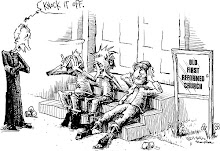
The grackles are back in the Park. They're not as popular as robins, of course, nor as tuneful. They're blackbirds, after all, from which we stand off a bit.
I remember, from my childhood, listening to the radio at the breakfast table on weekday mornings, how John Gambling and Peter Roberts used to joke about grackles. John Gambling was the host of Rambling with Gambling on WOR. (My mother never missed.) Peter Roberts was his newcaster on the half-hour, and they had this thing called the "John Gambling Research Foundation." Gambling was the straight man, and Roberts the cut-up.
Why they got such a kick out of grackles, I don't know, and just what they said about them, I can't remember. But what I think they must have noticed is that grackles (being blackbirds) are smart and audacious, and they have attitude.
Wednesday, March 12, 2008


Monday, March 10, 2008
Spiritual Formation 7: Community
Sermon for Lent 5
Ezekiel 37:1-14, Psalm 130, Romans 8:6-11, John 11:1-45
03/09/08
Heidelberg Catechism 88-90
Q88: What is involved in genuine repentance or conversion?
A: Two things: the dying-away of the old self, and the coming-to-life of the new.
Q89: What is the dying-away of the old self?
A: It is to be genuinely sorry for sin, to hate it more and more, and to run away from it.
Q90: What is the coming-to-life of the new self?
A: It is wholehearted joy in God through Christ, and a delight to do every kind of good as God wants us to.
This story marks a decisive change and innovation in the doctrine of the resurrection. As you might know, the Jews in Jesus’ day did not believe in immortality like the Greeks did or like most modern people do. They believed that when you died, you died, and your soul went down to Sheol as a shadow that would soon evaporate to nothing but a memory.
The afterlife was not big in Israel, and it’s hardly noticed in the whole Old Testament, which is remarkable against the background of Egypt from which they came, for Egypt was obsessed with the afterlife. The Hebrew Bible is all about the value of true religion for this life. It is all about the Promised Land; not heaven, but land.
But then there was a problem. The Babylonians had removed the Jews from their own land and carried them off to exile in Babylon. So much for the value of true religion in this life. How discouraged they all were.
So Ezekiel gives them a prophecy. The vision of dry bones. This was not meant to be literal, it was to suggest the renovation and return of Israel to the Promised Land.
And then in later years they started to take it literally. The Jews began to believe that all the Jews who ever lived would be brought to life again some day, and they all would have the happy life they should have had upon the Promised Land.
This was the doctrine of the resurrection that Mary and Martha were hoping for, the final resurrection at the end of time, when God would fully keep his promises to Israel, to all the Israelites who ever lived, the promised life in the promised land.
The decisive change in the doctrine of the resurrection is with Jesus saying that the resurrection is not distant but right up close. To Martha he says, it is right now, with me, where I am, he calls himself the resurrection and the life. (She’s thinking, "Jesus, I love you, but what are you talking about!") He’s saying that the new life he offers is not a reward at the end but a new kind of life for now, right now, whenever you live in obedience to my word, to my word of life.
Well, just how powerful is Jesus’ word? What he demonstrates with Lazarus is that his word is stronger than death. But how can that be? For death is the final great surrender. A dead man by definition is unable to respond to anything. Unless it’s the word of Jesus.
Here Jesus is able to get a dead man to obey his word, and just in that obedience is life, the new life. His word is powerful, and loving, and life-giving, converting death to life. And the message of the gospel is that’s also true for you, his word has power to convert your old nature into your new nature. If any of you here are interested in converting your old nature into your new nature, his word has to power to do it.
When I was eight years old, I was sitting in my father’s desk in his study upstairs in the parsonage on Herkimer Street, just a couple miles from here. I was reading one of his heavy books. I remember as if it was yesterday that my dad came in and said to me, "Danny, some day you’ll be a theologian." Did he know the effect that that would have on me? How powerful his word to me would be? What he said was way ahead of me, but I believed him, and what he said to me became more true of me gradually every day. That word was good news.
When I was about ten years old, a doctor told me that with my shoulders and my hips my body was more like a girl’s. That was bad news. When I was eleven my mother told me that I was supposed to have been a girl. Did either of them know the effect that those words would have? Especially when I compared myself to my strong and athletic older brother?
Words are very powerful, even when they’re only memories. As when a person said to you, "I know you can do it." Or when a person said "You stink." Or when a person said, "I love you."
When Jesus ascended into heaven he left his powerful words behind him, as well as a community of people who believe his words, and keep responding to them in obedience. The gospel writer recorded these words for the generations like us who will never hear Jesus directly. And yet his words have continued to be so powerful. It’s important for us to know them.
The words of Plato and Shakespeare are also powerful, but they are dead. Jesus said of himself, "I am the resurrection and the life." He means that his words are more than powerful memories. If he is the life, capital L, then he is alive. Before the face of God, somehow, and also among us, in the form of his Holy Spirit, still saying those same words.
He is at work within his words, he moves them around, applying them to us to work in us, and moving us around as well. His word converts us, putting some part of ourselves to death, and bring some new part of us to life.
His word converts us as a group, a group of people, which is why we gather every week. We gather to listen to the Bible, and not merely for information, or new ideas, or the defense of certain doctrines, but in order to have a meeting with God where God does work on us, converting us a little more each week. Our worship service is meant to be a process that converts us from just a collection of individuals into a congregation, a community, and it converts individually as well.
The dying-away of the old self and the coming-to-life of the new—I want to do it, how do I do it? Should I try this, should I try that? It’s as simple as listening. As listening to the life-giving word of God. And if you’re having trouble listening, just be still. Being still is a kind of repentance, because you are not speaking to justify yourself. And if you have trouble being still, then first just breathe. Like the bones in the vision of Ezekiel. Just breathe, and when you are slowly breathing you can start to listen.
And you can hear Jesus say this: "Lazarus, come out. Joe, come out. Jane, come out."
His word is bad news for your old self, and you can let it slowly die, though you are also allowed to weep and grieve for it, for didn’t Jesus weep? His word is good news for your new self, creating life out of your death, describing your new nature as the way that you might be. His word is always ahead of you, directing you, and every day it becomes more true of you.
Technically, though, we are unable to hear him and listen, because we’re dead. But he doesn’t let that prevent your listening. Just by speaking to you, he makes you able to hear. You are voice-activated.
He does this because he cares about your name. Remember, the resurrection is not a reward at the end, but the result of his love for us now. He does this for you because he wants community with you. He starts the community with you already. He started before you were alive, while you were still dead. He started to speak to you, and just his speaking brought you back to new life, a life you help to create when you talk back to him.
As I look at this passage, it strikes me that Jesus did this miracle not so much for Lazarus as for Mary and Martha. I mean, what did Lazarus care? The gift that he gave them was a restoration of their community, those two sisters with their brother. He restored them to community. That’s a great part of the resurrection and the life.
And that’s the last thing I want to say to you about our spiritual formation groups. I’ll that I’ve said in the last six sermons about conversion and formation holds true, but the main reason for these groups is very simple: just community. The simple community of Mary and Martha and Lazarus and Jesus, the original small group, who just like to be with each other face to face. That will be the main goal of our small groups. Because that is a great part of God’s intention for your resurrection and your life.
Copyright © 2008 by Daniel Meeter, all rights reserved.
Ezekiel 37:1-14, Psalm 130, Romans 8:6-11, John 11:1-45
03/09/08
Heidelberg Catechism 88-90
Q88: What is involved in genuine repentance or conversion?
A: Two things: the dying-away of the old self, and the coming-to-life of the new.
Q89: What is the dying-away of the old self?
A: It is to be genuinely sorry for sin, to hate it more and more, and to run away from it.
Q90: What is the coming-to-life of the new self?
A: It is wholehearted joy in God through Christ, and a delight to do every kind of good as God wants us to.
This story marks a decisive change and innovation in the doctrine of the resurrection. As you might know, the Jews in Jesus’ day did not believe in immortality like the Greeks did or like most modern people do. They believed that when you died, you died, and your soul went down to Sheol as a shadow that would soon evaporate to nothing but a memory.
The afterlife was not big in Israel, and it’s hardly noticed in the whole Old Testament, which is remarkable against the background of Egypt from which they came, for Egypt was obsessed with the afterlife. The Hebrew Bible is all about the value of true religion for this life. It is all about the Promised Land; not heaven, but land.
But then there was a problem. The Babylonians had removed the Jews from their own land and carried them off to exile in Babylon. So much for the value of true religion in this life. How discouraged they all were.
So Ezekiel gives them a prophecy. The vision of dry bones. This was not meant to be literal, it was to suggest the renovation and return of Israel to the Promised Land.
And then in later years they started to take it literally. The Jews began to believe that all the Jews who ever lived would be brought to life again some day, and they all would have the happy life they should have had upon the Promised Land.
This was the doctrine of the resurrection that Mary and Martha were hoping for, the final resurrection at the end of time, when God would fully keep his promises to Israel, to all the Israelites who ever lived, the promised life in the promised land.
The decisive change in the doctrine of the resurrection is with Jesus saying that the resurrection is not distant but right up close. To Martha he says, it is right now, with me, where I am, he calls himself the resurrection and the life. (She’s thinking, "Jesus, I love you, but what are you talking about!") He’s saying that the new life he offers is not a reward at the end but a new kind of life for now, right now, whenever you live in obedience to my word, to my word of life.
Well, just how powerful is Jesus’ word? What he demonstrates with Lazarus is that his word is stronger than death. But how can that be? For death is the final great surrender. A dead man by definition is unable to respond to anything. Unless it’s the word of Jesus.
Here Jesus is able to get a dead man to obey his word, and just in that obedience is life, the new life. His word is powerful, and loving, and life-giving, converting death to life. And the message of the gospel is that’s also true for you, his word has power to convert your old nature into your new nature. If any of you here are interested in converting your old nature into your new nature, his word has to power to do it.
When I was eight years old, I was sitting in my father’s desk in his study upstairs in the parsonage on Herkimer Street, just a couple miles from here. I was reading one of his heavy books. I remember as if it was yesterday that my dad came in and said to me, "Danny, some day you’ll be a theologian." Did he know the effect that that would have on me? How powerful his word to me would be? What he said was way ahead of me, but I believed him, and what he said to me became more true of me gradually every day. That word was good news.
When I was about ten years old, a doctor told me that with my shoulders and my hips my body was more like a girl’s. That was bad news. When I was eleven my mother told me that I was supposed to have been a girl. Did either of them know the effect that those words would have? Especially when I compared myself to my strong and athletic older brother?
Words are very powerful, even when they’re only memories. As when a person said to you, "I know you can do it." Or when a person said "You stink." Or when a person said, "I love you."
When Jesus ascended into heaven he left his powerful words behind him, as well as a community of people who believe his words, and keep responding to them in obedience. The gospel writer recorded these words for the generations like us who will never hear Jesus directly. And yet his words have continued to be so powerful. It’s important for us to know them.
The words of Plato and Shakespeare are also powerful, but they are dead. Jesus said of himself, "I am the resurrection and the life." He means that his words are more than powerful memories. If he is the life, capital L, then he is alive. Before the face of God, somehow, and also among us, in the form of his Holy Spirit, still saying those same words.
He is at work within his words, he moves them around, applying them to us to work in us, and moving us around as well. His word converts us, putting some part of ourselves to death, and bring some new part of us to life.
His word converts us as a group, a group of people, which is why we gather every week. We gather to listen to the Bible, and not merely for information, or new ideas, or the defense of certain doctrines, but in order to have a meeting with God where God does work on us, converting us a little more each week. Our worship service is meant to be a process that converts us from just a collection of individuals into a congregation, a community, and it converts individually as well.
The dying-away of the old self and the coming-to-life of the new—I want to do it, how do I do it? Should I try this, should I try that? It’s as simple as listening. As listening to the life-giving word of God. And if you’re having trouble listening, just be still. Being still is a kind of repentance, because you are not speaking to justify yourself. And if you have trouble being still, then first just breathe. Like the bones in the vision of Ezekiel. Just breathe, and when you are slowly breathing you can start to listen.
And you can hear Jesus say this: "Lazarus, come out. Joe, come out. Jane, come out."
His word is bad news for your old self, and you can let it slowly die, though you are also allowed to weep and grieve for it, for didn’t Jesus weep? His word is good news for your new self, creating life out of your death, describing your new nature as the way that you might be. His word is always ahead of you, directing you, and every day it becomes more true of you.
Technically, though, we are unable to hear him and listen, because we’re dead. But he doesn’t let that prevent your listening. Just by speaking to you, he makes you able to hear. You are voice-activated.
He does this because he cares about your name. Remember, the resurrection is not a reward at the end, but the result of his love for us now. He does this for you because he wants community with you. He starts the community with you already. He started before you were alive, while you were still dead. He started to speak to you, and just his speaking brought you back to new life, a life you help to create when you talk back to him.
As I look at this passage, it strikes me that Jesus did this miracle not so much for Lazarus as for Mary and Martha. I mean, what did Lazarus care? The gift that he gave them was a restoration of their community, those two sisters with their brother. He restored them to community. That’s a great part of the resurrection and the life.
And that’s the last thing I want to say to you about our spiritual formation groups. I’ll that I’ve said in the last six sermons about conversion and formation holds true, but the main reason for these groups is very simple: just community. The simple community of Mary and Martha and Lazarus and Jesus, the original small group, who just like to be with each other face to face. That will be the main goal of our small groups. Because that is a great part of God’s intention for your resurrection and your life.
Copyright © 2008 by Daniel Meeter, all rights reserved.
Monday, March 03, 2008
The Event for the Homeless at Old First
Common Ground » Blog Archive » HomeTeamNYC Houses 28 in One Day
Check this link to see the web page, and check the extra photos page.
Check this link to see the web page, and check the extra photos page.
Sunday, March 02, 2008
Spiritual Formation 6: Seeing and Believing
Lent 4
1 Samuel 16:1-13, Psalm 23, Ephesians 5:8-14, John 9
03/02/08
Heidelberg Catechism 88-90
Q88: What is involved in genuine repentance or conversion?
A: Two things: the dying-away of the old self, and the coming-to-life of the new.
Q89: What is the dying-away of the old self?
A: It is to be genuinely sorry for sin, to hate it more and more, and to run away from it.
Q90: What is the coming-to-life of the new self?
A: It is wholehearted joy in God through Christ, and a delight to do every kind of good as God wants us to.
Lest you think that conversion is always the same, look how different this story is from last week. With the woman at the well, Jesus was very present, you can imagine her looking him over and as she does it he looks into her eyes. But the blind man never sees Jesus till the end.
Jesus spends most of the story out of sight off stage, and the poor guy’s conversations are with everybody else and the coming-to-life of his new self is against opposition, and he ends up on the street corner having to wonder if it was worth it. Who ever said that the coming-to-life of the new self was going to be all peaches and cream? No wonder people tend to stay with the miserable old nature that they know.
Of course this story is about both sight and insight. The poor guy is seeing things for the first time, and he’s having immediately to see beneath the surfaces in ways he never had to. He’s got to stand on his own two feet now, now he’s got to look out for himself, and he’s got to start making judgments now and sizing people up. It’s one thing to see, it’s another to read what you see. He can see people now, but he’s got look inside them too!
In the story from 1 Samuel, God tells the prophet to look not on appearances but on the heart. I can just hear Samuel say, "I know that, I’m a prophet!" I love the down-to-earth and almost comic interaction between God and Samuel, like God is right there next to Samuel, standing invisibly at his shoulder.
(Well, the gift and burden of prophecy is to hear the words of God we are deaf to but that are all around us anyway, to see what we in our blindness thought was invisible but is right here anyway. The community of Jesus is meant to be prophetic, we are to see and hear what the world finds hard to believe, and to be witnesses of that.)
This story is comic in that after it tells us to look on the heart and not appearances it also tells us how handsome David was. I wonder is the Bible playin’. I can tell you that if you read the rest of First and Second Samuel, you’ll see that the Bible is critical of David, showing his underside, always suggesting the self-regard beneath his heroic generosity, but at the same time the Bible always loves him. Like how you might feel about FDR. What a stinker. How we loved him. Like how God must feel about each one of you.
Look, we have to make judgments about each other. We’re primates, after all, like chimpanzees and baboons, and unlike orangutans we are primates of a social sort, so we always have to be judging each other and explaining ourselves to each other. And do we not spend an awful lot of time explaining ourselves to each other? And don’t we expend a lot of energy calculating our behavior in advance of the judgments of each other?
But if this is natural and organic then why do we find it problem? I think it’s because among th primates our species is especially spiritual, and we live by ethics, not by ordinary nature. We are the animals that distinguish between the "is" and the "ought." We are the animals that have to see behind the surfaces, because we are so spiritual.
In our spiritual conversations, we need to listen behind the words. When we face each other in our small groups, we need to look beyond appearances into each other’s hearts. That is the speciality of religion, to put what seems apparent into parentheses, and to judge each other and the world not by what is now but by what we hope for, and what we believe will be.
That sets up a problem. To do this can be to go too quick to deeper judgement, and to not credit what the other person is telling you. We think we know better. Especially if someone is suffering, because of our religious practices we think we know better. The Pharisees were doing their religious job by judging the guy that Jesus healed, they were getting past the appearances. How could they believe him when they knew better, that the Messiah would scrupulously keep the law of the Sabbath. But what they needed to do was believe him. At face value.
So there is another dialectic here. Like I’ve said in prior weeks, spiritual formation means you have to keep in balance two things which might seem opposite. Here too. In spiritual conversation you have to listen behind the surfaces, but at the same time, you have to believe what the other person is telling you about herself, himself.
Yes, you will have your own take on what the person says, you question that person’s interpretation, you naturally use your judgement as a social primate, but you also have to believe what the person tells you. You have to say, "I believe you." In our small groups there’ll have to be a lot of this: "I believe you."
We have been conditioned by psychotherapy to think that healing happens when you finally tell the truth about yourself. Not so. Healing starts to happen when somebody else believes you, no matter how troubling or subversive or impossible. Not someone you are paying to believe you, but someone whose life is not made any easier by the truth of what you are saying. When that kind of person believes you, well, then the healing can begin. When my believing you costs me.
You might have figured out that I prefer to see myself as a conservative. Some of you are aware that at one time I was conservative on the matter of homosexuality in the church. I used to follow the debates about what caused homosexuality, whether it came from childhood sexual abuse or whether it was the fault of one the other of the parents, which, of course, is exactly that response of the disciples to the blind man when they said, "Who sinned that he is blind." Jesus has no time for this. For Jesus it’s always: How shall I to respond to you now?
I had to be converted. Not by my speaking or confessing, but by my listening and believing. In my third parish, a man in our congregation came out to me. He was the son of a Southern Baptist preacher. He told me he had always loved God. But he had hated himself because he loved other men. He kept repenting and begging God to change him and heal him. He told me that at last he came to know that God loved him as gay, and he accepted that. Would I?
When he told me this I felt convicted. Should I believe him? What about my own theological categories, that I should interpret his experience better than he himself? I felt what the blind man’s parents felt, for if I believed him I could be in trouble with my denomination. (And it is true that I lost the confidence of my closest Reformed Church colleagues at the time, except for my wife, who was ahead of me.)
I decided to believe him. I decided to believe him what he told me about himself, and that he knew his own heart, and that he knew his own experience, and so that instead of my trying to change him, maybe I had better change myself. And I am grateful to him since, especially since I have come to experience the generous love of many gay and lesbian believers.
It could be some other example. A truly spiritual conversation can further your conversion, just in your listening and believing will be another step in your spiritual formation. For isn’t it to love your neighbor as yourself? And doesn’t God listen to you and believe you? Because God loves you.
Copyright © 2008 by Daniel Meeter, all rights reserved.
1 Samuel 16:1-13, Psalm 23, Ephesians 5:8-14, John 9
03/02/08
Heidelberg Catechism 88-90
Q88: What is involved in genuine repentance or conversion?
A: Two things: the dying-away of the old self, and the coming-to-life of the new.
Q89: What is the dying-away of the old self?
A: It is to be genuinely sorry for sin, to hate it more and more, and to run away from it.
Q90: What is the coming-to-life of the new self?
A: It is wholehearted joy in God through Christ, and a delight to do every kind of good as God wants us to.
Lest you think that conversion is always the same, look how different this story is from last week. With the woman at the well, Jesus was very present, you can imagine her looking him over and as she does it he looks into her eyes. But the blind man never sees Jesus till the end.
Jesus spends most of the story out of sight off stage, and the poor guy’s conversations are with everybody else and the coming-to-life of his new self is against opposition, and he ends up on the street corner having to wonder if it was worth it. Who ever said that the coming-to-life of the new self was going to be all peaches and cream? No wonder people tend to stay with the miserable old nature that they know.
Of course this story is about both sight and insight. The poor guy is seeing things for the first time, and he’s having immediately to see beneath the surfaces in ways he never had to. He’s got to stand on his own two feet now, now he’s got to look out for himself, and he’s got to start making judgments now and sizing people up. It’s one thing to see, it’s another to read what you see. He can see people now, but he’s got look inside them too!
In the story from 1 Samuel, God tells the prophet to look not on appearances but on the heart. I can just hear Samuel say, "I know that, I’m a prophet!" I love the down-to-earth and almost comic interaction between God and Samuel, like God is right there next to Samuel, standing invisibly at his shoulder.
(Well, the gift and burden of prophecy is to hear the words of God we are deaf to but that are all around us anyway, to see what we in our blindness thought was invisible but is right here anyway. The community of Jesus is meant to be prophetic, we are to see and hear what the world finds hard to believe, and to be witnesses of that.)
This story is comic in that after it tells us to look on the heart and not appearances it also tells us how handsome David was. I wonder is the Bible playin’. I can tell you that if you read the rest of First and Second Samuel, you’ll see that the Bible is critical of David, showing his underside, always suggesting the self-regard beneath his heroic generosity, but at the same time the Bible always loves him. Like how you might feel about FDR. What a stinker. How we loved him. Like how God must feel about each one of you.
Look, we have to make judgments about each other. We’re primates, after all, like chimpanzees and baboons, and unlike orangutans we are primates of a social sort, so we always have to be judging each other and explaining ourselves to each other. And do we not spend an awful lot of time explaining ourselves to each other? And don’t we expend a lot of energy calculating our behavior in advance of the judgments of each other?
But if this is natural and organic then why do we find it problem? I think it’s because among th primates our species is especially spiritual, and we live by ethics, not by ordinary nature. We are the animals that distinguish between the "is" and the "ought." We are the animals that have to see behind the surfaces, because we are so spiritual.
In our spiritual conversations, we need to listen behind the words. When we face each other in our small groups, we need to look beyond appearances into each other’s hearts. That is the speciality of religion, to put what seems apparent into parentheses, and to judge each other and the world not by what is now but by what we hope for, and what we believe will be.
That sets up a problem. To do this can be to go too quick to deeper judgement, and to not credit what the other person is telling you. We think we know better. Especially if someone is suffering, because of our religious practices we think we know better. The Pharisees were doing their religious job by judging the guy that Jesus healed, they were getting past the appearances. How could they believe him when they knew better, that the Messiah would scrupulously keep the law of the Sabbath. But what they needed to do was believe him. At face value.
So there is another dialectic here. Like I’ve said in prior weeks, spiritual formation means you have to keep in balance two things which might seem opposite. Here too. In spiritual conversation you have to listen behind the surfaces, but at the same time, you have to believe what the other person is telling you about herself, himself.
Yes, you will have your own take on what the person says, you question that person’s interpretation, you naturally use your judgement as a social primate, but you also have to believe what the person tells you. You have to say, "I believe you." In our small groups there’ll have to be a lot of this: "I believe you."
We have been conditioned by psychotherapy to think that healing happens when you finally tell the truth about yourself. Not so. Healing starts to happen when somebody else believes you, no matter how troubling or subversive or impossible. Not someone you are paying to believe you, but someone whose life is not made any easier by the truth of what you are saying. When that kind of person believes you, well, then the healing can begin. When my believing you costs me.
You might have figured out that I prefer to see myself as a conservative. Some of you are aware that at one time I was conservative on the matter of homosexuality in the church. I used to follow the debates about what caused homosexuality, whether it came from childhood sexual abuse or whether it was the fault of one the other of the parents, which, of course, is exactly that response of the disciples to the blind man when they said, "Who sinned that he is blind." Jesus has no time for this. For Jesus it’s always: How shall I to respond to you now?
I had to be converted. Not by my speaking or confessing, but by my listening and believing. In my third parish, a man in our congregation came out to me. He was the son of a Southern Baptist preacher. He told me he had always loved God. But he had hated himself because he loved other men. He kept repenting and begging God to change him and heal him. He told me that at last he came to know that God loved him as gay, and he accepted that. Would I?
When he told me this I felt convicted. Should I believe him? What about my own theological categories, that I should interpret his experience better than he himself? I felt what the blind man’s parents felt, for if I believed him I could be in trouble with my denomination. (And it is true that I lost the confidence of my closest Reformed Church colleagues at the time, except for my wife, who was ahead of me.)
I decided to believe him. I decided to believe him what he told me about himself, and that he knew his own heart, and that he knew his own experience, and so that instead of my trying to change him, maybe I had better change myself. And I am grateful to him since, especially since I have come to experience the generous love of many gay and lesbian believers.
It could be some other example. A truly spiritual conversation can further your conversion, just in your listening and believing will be another step in your spiritual formation. For isn’t it to love your neighbor as yourself? And doesn’t God listen to you and believe you? Because God loves you.
Copyright © 2008 by Daniel Meeter, all rights reserved.
Sunday, February 24, 2008
Sermon 5 on Spiritual Formation: Conversation and Conversion
Lent 3, February 24, 2008
Exodus 17:1-7, Psalm 95, Romans 5:1-11, John 4:5-42
Heidelberg Catechism 88-90
Q88: What is involved in genuine repentance or conversion?
A: Two things: the dying-away of the old self, and the coming-to-life of the new.
Q89: What is the dying-away of the old self?
A: It is to be genuinely sorry for sin, to hate it more and more, and to run away from it.
Q90: What is the coming-to-life of the new self?
A: It is wholehearted joy in God through Christ, and a delight to do every kind of good as God wants us to.
The lection from the Gospel of John is one of the most remarkable in the Bible and it’s the subject of one of our Tiffany windows in the sanctuary, the Woman at the Well. The story is so rich I could make ten sermons out of it, and if I were an old-fashioned Calvinist I might. One of my previous sermons on this lection is posted on my blog. Today I’m taking it a different way.
We take a step back first. Way back, to the beginning of the Bible, the first verse of Genesis. "In the beginning, God created the heavens and the earth. And the earth was without form and void, and the Spirit of God brooded upon the face to the deep. And God said, Let there be light, and there was light."
The way that God created was by speaking. God spoke and it came to be. God said, "Let this be," and the world answered, "We’ll be that." The world was formed by answering God’s speech. The formation of the world was a response to God’s Word.
Genesis 1:1 is quoted by the prologue to the Gospel of John. The prologue is the famous passage we read on Christmas Eve. "In the beginning was the Word, and the Word was with God, and the Word was God."
Over the centuries the Christian tradition has tended to hear this verse in terms of philosophical theology, where the Word means an Idea, an Idea that takes Form. God created by having an Idea and then commanding the world to take the Form of that Idea, like Michelangelo with a block of marble, only God did not use hands but words.
Well, yes, but this morning I want to take it differently, as connected to the rest of the Gospel, as with our lection this morning, as meaning something like this, "In the beginning was the Talk, and the Talk was with God, and the Talk was God.
You know when it means when a boss says this to an employee: "A word!" That’s going to be a short conversation with a lot of weight, a little talk that had better make a difference.
In the beginning was the Word. In the beginning was the Talk. In the beginning was the Conversation. The prologue is suggesting something about God, something which Jesus expresses in chapters 14-17 in his long soliloquy in the Upper Room, that there’s a conversation between the Father, Son, and Spirit, a private conversation, which Jesus brings us into and which the Holy Spirit carries back out to us, and our audacious sharing in the inner conversation of the Holy Trinity is what starts to form us as a community, a spiritual community. And we Christians dare to think that as our little community of Jesus is being formed by our sharing in the Talk of God, in some small measure we even begin to know the Mind of God.
The prologue is also suggesting something about humanity, and about our place in the world. It was at the creation of the world that God first made public the Trinity’s private conversation. Creation is not commanding speech and dumb obedience, it’s life-giving conversation. As God speaks the world into being, more and more it’s able to answer, until the appearance of human kind, who are able to talk back to God, on behalf of the other creatures. Our connection to God is not just for ourselves, but for us to speak with God for the rest of the world.
The Gospel of John is the gospel of conversations. Like Matthew it has sermons, like Mark it has actions, like Luke it has metaphorical soliloquies, but distinctive to John is an emphasis on conversation. And the longest conversation with any individual is with the woman at the well.
This conversation broke the rules and crossed the proper boundaries. The Samaritans and the Jews were like the Sunnis and the Shiites or the Serbs and the Croatians, their differences were theological and political and hateful. Jesus crossed those boundaries. He crossed the boundary of kosher. Her water jug will have been unclean, and drinking from it he’ll make himself unclean.
He crossed the boundaries of sex. He will have to put his lips on her vessel. And this is at a well which is dedicated to the patriarch Jacob who met Rachel at a well and fell in love with her at first sight. The woman has to wonder is like Bill Clinton or JFK. He’s certainly not like Huckabee! His disciples show up worried that he’s like McCain.
But he never touches her. He doesn’t play with her or use her. He can see through her, but he does not disrobe her, he lets her speak for herself, he lets her lead the conversation, though his responses are not what she expects. This story is all about the conversation. And the conversation is the means of her conversion.
This is not an ordinary conversation at a well. That happened in the morning, when all the other women came to get their water. And their conversation might have been about her, and why such a woman as she was trouble for the rest of them and trouble for herself. And they would be right. We have those kinds of conversations all the time about each other. But such conversations don’t help conversion, and such kind of talk is not for spiritual formation.
This one is. By the process of what they say to each other she comes to the truth about herself. He offers her a few Biblical metaphors by which she can suddenly make sense of her life and everything she ever did. By what he says to her she can judge herself, but not that she should condemn herself—he hasn’t been sent to the world to condemn to world—he judges her not to condemn her but to justify her, not by any prior good performance, but simply by her receiving his gracious gift.
And his gift is a challenge, every word he says to her challenges her, which she might take defensively, but she answers his challenges, even as she ducks and parries, and in her answering him her new nature is coming to life, in her conversing with him she’s going through spiritual formation, just as in Genesis 1 the formation of the world was from the Talk of God.
The Word of God comes to us in several ways: in Proclamation, like Jesus’ sermons and soliloquies, in Demonstration, like Jesus’ miracles and symbolic actions, and in Conversation. A congregation that is vital has to do all three. Proclamation in the preaching and the teaching. Demonstration in the sacraments and our outreach ministries. And Conversation. The sharing of ourselves in prayer and with each other as we respond together to the Word of God.
In this conversation, Jesus shares himself. He says to her, and for the first time in the Gospel, "I am he." He opens himself. And she believes him. And note that we never get from her some long confession, we never hear some cathartic story of how she got this way and how bad she feels, etc. This conversation is not psychotherapy, and as I said, she keeps her clothes on. This conversation keeps quiet and reserved and most of it goes on inside her head.
The point of conversion is to start converting your old nature to the new one, to let your spirit start giving formation to your flesh. And so we watch her go back to her village but in a whole new way of dealing with her neighbors, and we can see the new and living water rising up within her.
There is direction here for our spiritual formation groups. And there is direction here for how summarily the Reformed church does our Lenten repentance, how concisely and condensed. We just repeat God’s word about us back to God, we just tell God that what God says about us must be right.
Yes, there are times for detailed self-examination and an inventory of your shortcomings, but your new creation is simply to believe the summary of what God says about you. When you confess that you agree, when you answer back to God, then you are already living in that new nature, and you can enjoy the delights that God offers you.
Copyright © 2008 by Daniel Meeter, all rights reserved.
Exodus 17:1-7, Psalm 95, Romans 5:1-11, John 4:5-42
Heidelberg Catechism 88-90
Q88: What is involved in genuine repentance or conversion?
A: Two things: the dying-away of the old self, and the coming-to-life of the new.
Q89: What is the dying-away of the old self?
A: It is to be genuinely sorry for sin, to hate it more and more, and to run away from it.
Q90: What is the coming-to-life of the new self?
A: It is wholehearted joy in God through Christ, and a delight to do every kind of good as God wants us to.
The lection from the Gospel of John is one of the most remarkable in the Bible and it’s the subject of one of our Tiffany windows in the sanctuary, the Woman at the Well. The story is so rich I could make ten sermons out of it, and if I were an old-fashioned Calvinist I might. One of my previous sermons on this lection is posted on my blog. Today I’m taking it a different way.
We take a step back first. Way back, to the beginning of the Bible, the first verse of Genesis. "In the beginning, God created the heavens and the earth. And the earth was without form and void, and the Spirit of God brooded upon the face to the deep. And God said, Let there be light, and there was light."
The way that God created was by speaking. God spoke and it came to be. God said, "Let this be," and the world answered, "We’ll be that." The world was formed by answering God’s speech. The formation of the world was a response to God’s Word.
Genesis 1:1 is quoted by the prologue to the Gospel of John. The prologue is the famous passage we read on Christmas Eve. "In the beginning was the Word, and the Word was with God, and the Word was God."
Over the centuries the Christian tradition has tended to hear this verse in terms of philosophical theology, where the Word means an Idea, an Idea that takes Form. God created by having an Idea and then commanding the world to take the Form of that Idea, like Michelangelo with a block of marble, only God did not use hands but words.
Well, yes, but this morning I want to take it differently, as connected to the rest of the Gospel, as with our lection this morning, as meaning something like this, "In the beginning was the Talk, and the Talk was with God, and the Talk was God.
You know when it means when a boss says this to an employee: "A word!" That’s going to be a short conversation with a lot of weight, a little talk that had better make a difference.
In the beginning was the Word. In the beginning was the Talk. In the beginning was the Conversation. The prologue is suggesting something about God, something which Jesus expresses in chapters 14-17 in his long soliloquy in the Upper Room, that there’s a conversation between the Father, Son, and Spirit, a private conversation, which Jesus brings us into and which the Holy Spirit carries back out to us, and our audacious sharing in the inner conversation of the Holy Trinity is what starts to form us as a community, a spiritual community. And we Christians dare to think that as our little community of Jesus is being formed by our sharing in the Talk of God, in some small measure we even begin to know the Mind of God.
The prologue is also suggesting something about humanity, and about our place in the world. It was at the creation of the world that God first made public the Trinity’s private conversation. Creation is not commanding speech and dumb obedience, it’s life-giving conversation. As God speaks the world into being, more and more it’s able to answer, until the appearance of human kind, who are able to talk back to God, on behalf of the other creatures. Our connection to God is not just for ourselves, but for us to speak with God for the rest of the world.
The Gospel of John is the gospel of conversations. Like Matthew it has sermons, like Mark it has actions, like Luke it has metaphorical soliloquies, but distinctive to John is an emphasis on conversation. And the longest conversation with any individual is with the woman at the well.
This conversation broke the rules and crossed the proper boundaries. The Samaritans and the Jews were like the Sunnis and the Shiites or the Serbs and the Croatians, their differences were theological and political and hateful. Jesus crossed those boundaries. He crossed the boundary of kosher. Her water jug will have been unclean, and drinking from it he’ll make himself unclean.
He crossed the boundaries of sex. He will have to put his lips on her vessel. And this is at a well which is dedicated to the patriarch Jacob who met Rachel at a well and fell in love with her at first sight. The woman has to wonder is like Bill Clinton or JFK. He’s certainly not like Huckabee! His disciples show up worried that he’s like McCain.
But he never touches her. He doesn’t play with her or use her. He can see through her, but he does not disrobe her, he lets her speak for herself, he lets her lead the conversation, though his responses are not what she expects. This story is all about the conversation. And the conversation is the means of her conversion.
This is not an ordinary conversation at a well. That happened in the morning, when all the other women came to get their water. And their conversation might have been about her, and why such a woman as she was trouble for the rest of them and trouble for herself. And they would be right. We have those kinds of conversations all the time about each other. But such conversations don’t help conversion, and such kind of talk is not for spiritual formation.
This one is. By the process of what they say to each other she comes to the truth about herself. He offers her a few Biblical metaphors by which she can suddenly make sense of her life and everything she ever did. By what he says to her she can judge herself, but not that she should condemn herself—he hasn’t been sent to the world to condemn to world—he judges her not to condemn her but to justify her, not by any prior good performance, but simply by her receiving his gracious gift.
And his gift is a challenge, every word he says to her challenges her, which she might take defensively, but she answers his challenges, even as she ducks and parries, and in her answering him her new nature is coming to life, in her conversing with him she’s going through spiritual formation, just as in Genesis 1 the formation of the world was from the Talk of God.
The Word of God comes to us in several ways: in Proclamation, like Jesus’ sermons and soliloquies, in Demonstration, like Jesus’ miracles and symbolic actions, and in Conversation. A congregation that is vital has to do all three. Proclamation in the preaching and the teaching. Demonstration in the sacraments and our outreach ministries. And Conversation. The sharing of ourselves in prayer and with each other as we respond together to the Word of God.
In this conversation, Jesus shares himself. He says to her, and for the first time in the Gospel, "I am he." He opens himself. And she believes him. And note that we never get from her some long confession, we never hear some cathartic story of how she got this way and how bad she feels, etc. This conversation is not psychotherapy, and as I said, she keeps her clothes on. This conversation keeps quiet and reserved and most of it goes on inside her head.
The point of conversion is to start converting your old nature to the new one, to let your spirit start giving formation to your flesh. And so we watch her go back to her village but in a whole new way of dealing with her neighbors, and we can see the new and living water rising up within her.
There is direction here for our spiritual formation groups. And there is direction here for how summarily the Reformed church does our Lenten repentance, how concisely and condensed. We just repeat God’s word about us back to God, we just tell God that what God says about us must be right.
Yes, there are times for detailed self-examination and an inventory of your shortcomings, but your new creation is simply to believe the summary of what God says about you. When you confess that you agree, when you answer back to God, then you are already living in that new nature, and you can enjoy the delights that God offers you.
Copyright © 2008 by Daniel Meeter, all rights reserved.
Monday, February 18, 2008
Birds and Planets
My morning prayer window looks out over Prospect Park Southwest.
Friday morning I heard my first robin of 2008, cheerfully chirping its morning song. Today I heard a lot of them as I walked through the Park, but they haven't started grazing yet.
Today as I walked down Second Street, from the Park to Eighth Ave, the stoops were all green! Brownstone and limestone with green highlights. Still in winger! From the damp? The warmth?
I've been watching a planet in the pre-dawn sky, over Ditmas Park :). I can't tell if it's Jupiter or Mercury. It's low enough to be seen between the branches of the taller trees. It's my current morning star.
Wie schoen leuchtet der Morgenstern.
Friday morning I heard my first robin of 2008, cheerfully chirping its morning song. Today I heard a lot of them as I walked through the Park, but they haven't started grazing yet.
Today as I walked down Second Street, from the Park to Eighth Ave, the stoops were all green! Brownstone and limestone with green highlights. Still in winger! From the damp? The warmth?
I've been watching a planet in the pre-dawn sky, over Ditmas Park :). I can't tell if it's Jupiter or Mercury. It's low enough to be seen between the branches of the taller trees. It's my current morning star.
Wie schoen leuchtet der Morgenstern.
Sunday, February 17, 2008
Sermon 4 on Spiritual Formation: Conversion
Lent 2
Genesis 12:1-4, Psalm 121, Romans 4:1-5, 13-17, John 3:1-17
Heidelberg Catechism 88-90
Q88: What is involved in genuine repentance or conversion?
A: Two things: the dying-away of the old self, and the coming-to-life of the new.
Q89: What is the dying-away of the old self?
A: It is to be genuinely sorry for sin, to hate it more and more, and to run away from it.
Q90: What is the coming-to-life of the new self?
A: It is wholehearted joy in God through Christ, and a delight to do every kind of good as God wants us to.
You know the reputation of the Marines and how they do basic training: they break you down. You might have individual courage and initiative, but they break you down. You might be an American citizen with civil rights and an instinct for democracy, but they break you down. After they break you down, they build you up, but different—as a Marine.
They have do this because your natural human instinct is to preserve your own life. When you see gunfire coming at you, your natural instinct is to get away from it. But a Marine has to keep going toward it. It is unnatural to be a Marine. To be a Marine you have to born again, if you know what I mean.
Did you know that in the first centuries of the early Christian church, one of the most productive mission fields was the Roman army? Look, these soldiers had been born as Germans and Gauls and Celts and Thracians and they had had to be converted into Romans, loyal to Caesar, who claimed the titles of Savior and Lord. The analogies were there, to convert again, and be loyal to the Prince of Peace, especially if you knew first hand the real truth of war.
The centrality of conversion is a distinction of Christianity, compared to other religions. Judaism has conversion, but Judaism is not an expanding faith, and if you ask to convert to Judaism, the first response of the rabbi is to discourage you.
Islam is an expanding faith, but its pattern is submission, not conversion. It has nothing in it of being "born again." Indeed, Muslims call Islam the "natural religion of mankind." To be "born again" is actually a very Jewish metaphor, and if you convert to Judaism, you are accepting a new ethnicity. You convert to a whole new life. This Jewish pattern of conversion was made expansive by the gospel, and the first response was to encourage you.
Conversion is so central to Christianity it’s also for people who are already born and raised in the faith. At least that is what Protestants say, and we get that from scripture lessons like the epistle and gospel today. We preach to both pagans and our own congregations that "you must be born again." So if somebody asks me if our church is a "born again" church, I rub my nose and scratch my head and hem and haw and then I say, "Well, yeah, kinda sorta."
However, what people mean today by "born-again" is not the original teaching of the first Protestant churches, the Lutherans and the Reformed. The current notion is that everyone has a definable and even datable conversion experience, that there is a linear break between your old self and your new self, a before and an after, that you start out unsaved, and you accept Jesus into your heart, and then you are saved.
And they mean that if you grow up as a Christian you have to do this the same as any pagan. "Once I was lost, but now I am found. Once I was a sinner, but now I am saved." For many modern Protestants the main point of Christianity is getting saved by being born again. Contrast the Greek and Russian Orthodox, for whom the whole point of Christianity is giving praise and glory to the Holy Trinity.
But the original Protestant doctrine is what you see in our Heidelberg Catechism from A.D. 1563. The old self and the new self are not so much before and after but always both and simultaneous, like a double-decker bus. Conversion is not what happens once, dramatically, but what happens daily, in very small pieces, as you choose again and again to ride the upper deck, despite the rain. And conversion doesn’t mean you weren’t less a Christian the day before. Even the holiest saints go through new conversions every day.
In 1989, after we had immigrated to Canada. I was on an two-day bicycle trip to Camp Shalom with Boyd de Waard and Pim de Koning. As we were coming back through the Six Nations Reserve, a dog came out and chased us and got real close to me. I reached down for my air pump as a club to defend myself, but we outraced the dog. Then Pim laughed and said, "You act like an American." "Why?" "Because you could have broken your air pump and you’d have to buy a new one, but if the dog had bitten you the health care would be free."
When you immigrate you have to convert. It’s a daily thing, and it’s a million small things. Converting miles to kilometers and Fahrenheit to Celsius and habits and attitudes and social norms, converting expectations and expressions. Canada is relatively easy, though the differences are far more than Americans expect. Most immigrants have to convert to whole new languages and their new life gets harder and harder to explain back home.
Immigration is the other image of conversion. We get it from our Genesis lesson. God told Abram, "Go from your country and your kindred and your father’s house to a the land that I will show you," and isn’t that like being born again.
I am a dual citizen, both Canadian and American. But the deal is that when I’m in America I am legally only an American so I have to behave like an American. When I’m in Canada I am legally only a Canadian so I have to behave like a Canadian. All Christians are dual citizens as well. Your other citizenship is the Kingdom of God. But with this the deal is different. When you’re in America you have to behave like you belong to the Kingdom of God. Well, to do that requires a constant daily conversion.
Christians have to think of themselves as double. You have two natures in you, the old one and the new. At your death, the old dies off and the new one lives on. Until then, you starve the first and feed the second. That’s conversion.
Christianity gets this kind of double-thinking from Judaism. Islam doesn’t do this; the very power of Islam comes from its unitary thinking. But Judaism always balances the opposites and the apparent contradictions. Not either-or but both-and. And now I have yet another one, and it’s about spiritual formation.
Spiritual formation is both growth and not-growth. Spiritual formation is both natural and unnatural. Spiritual formation is both coming-to-life and dying-away.
Last week I said that spiritual formation is as natural as children growing up. They can’t help it if you just give them security and good food. But the opposite is also true. Spiritual formation is like pruning and weeding and pulling up and cutting off. It has repentance in it, and remorse and pain, and discipline.
Conversion and growth are the alternating current of spiritual formation, the negative current and the positive current, and we can’t reduce it to the one or the other. It’s both.
Next week our lessons have something to tell us about how this kind of conversion can take place in a small group context. This week it’s Jesus and Nicodemus. Next week it’s Jesus and the woman at the well. This week Nicodemus drops out of the conversation, next week she stays in. And even though she’s the sinner of the two, she gets empowered at the end. Nicodemus just falls away.
But John 19 tells us that after the crucifixion it was Nicodemus who bought a hundred pounds of spices for Jesus’ body, and who lovingly wrapped his body for burial and laid it in the tomb. I guess he had been riding the bus by standing on the stairs to the upper deck, and now he was willing to be seen up on top. Imagine his joy after the Resurrection when he could tell the gospel writer the story of his secret meeting with Jesus. In Nicodemus there is hope for us. It just always takes a while.
Copyright © 2008 by Daniel Meeter, all rights reserved.
Genesis 12:1-4, Psalm 121, Romans 4:1-5, 13-17, John 3:1-17
Heidelberg Catechism 88-90
Q88: What is involved in genuine repentance or conversion?
A: Two things: the dying-away of the old self, and the coming-to-life of the new.
Q89: What is the dying-away of the old self?
A: It is to be genuinely sorry for sin, to hate it more and more, and to run away from it.
Q90: What is the coming-to-life of the new self?
A: It is wholehearted joy in God through Christ, and a delight to do every kind of good as God wants us to.
You know the reputation of the Marines and how they do basic training: they break you down. You might have individual courage and initiative, but they break you down. You might be an American citizen with civil rights and an instinct for democracy, but they break you down. After they break you down, they build you up, but different—as a Marine.
They have do this because your natural human instinct is to preserve your own life. When you see gunfire coming at you, your natural instinct is to get away from it. But a Marine has to keep going toward it. It is unnatural to be a Marine. To be a Marine you have to born again, if you know what I mean.
Did you know that in the first centuries of the early Christian church, one of the most productive mission fields was the Roman army? Look, these soldiers had been born as Germans and Gauls and Celts and Thracians and they had had to be converted into Romans, loyal to Caesar, who claimed the titles of Savior and Lord. The analogies were there, to convert again, and be loyal to the Prince of Peace, especially if you knew first hand the real truth of war.
The centrality of conversion is a distinction of Christianity, compared to other religions. Judaism has conversion, but Judaism is not an expanding faith, and if you ask to convert to Judaism, the first response of the rabbi is to discourage you.
Islam is an expanding faith, but its pattern is submission, not conversion. It has nothing in it of being "born again." Indeed, Muslims call Islam the "natural religion of mankind." To be "born again" is actually a very Jewish metaphor, and if you convert to Judaism, you are accepting a new ethnicity. You convert to a whole new life. This Jewish pattern of conversion was made expansive by the gospel, and the first response was to encourage you.
Conversion is so central to Christianity it’s also for people who are already born and raised in the faith. At least that is what Protestants say, and we get that from scripture lessons like the epistle and gospel today. We preach to both pagans and our own congregations that "you must be born again." So if somebody asks me if our church is a "born again" church, I rub my nose and scratch my head and hem and haw and then I say, "Well, yeah, kinda sorta."
However, what people mean today by "born-again" is not the original teaching of the first Protestant churches, the Lutherans and the Reformed. The current notion is that everyone has a definable and even datable conversion experience, that there is a linear break between your old self and your new self, a before and an after, that you start out unsaved, and you accept Jesus into your heart, and then you are saved.
And they mean that if you grow up as a Christian you have to do this the same as any pagan. "Once I was lost, but now I am found. Once I was a sinner, but now I am saved." For many modern Protestants the main point of Christianity is getting saved by being born again. Contrast the Greek and Russian Orthodox, for whom the whole point of Christianity is giving praise and glory to the Holy Trinity.
But the original Protestant doctrine is what you see in our Heidelberg Catechism from A.D. 1563. The old self and the new self are not so much before and after but always both and simultaneous, like a double-decker bus. Conversion is not what happens once, dramatically, but what happens daily, in very small pieces, as you choose again and again to ride the upper deck, despite the rain. And conversion doesn’t mean you weren’t less a Christian the day before. Even the holiest saints go through new conversions every day.
In 1989, after we had immigrated to Canada. I was on an two-day bicycle trip to Camp Shalom with Boyd de Waard and Pim de Koning. As we were coming back through the Six Nations Reserve, a dog came out and chased us and got real close to me. I reached down for my air pump as a club to defend myself, but we outraced the dog. Then Pim laughed and said, "You act like an American." "Why?" "Because you could have broken your air pump and you’d have to buy a new one, but if the dog had bitten you the health care would be free."
When you immigrate you have to convert. It’s a daily thing, and it’s a million small things. Converting miles to kilometers and Fahrenheit to Celsius and habits and attitudes and social norms, converting expectations and expressions. Canada is relatively easy, though the differences are far more than Americans expect. Most immigrants have to convert to whole new languages and their new life gets harder and harder to explain back home.
Immigration is the other image of conversion. We get it from our Genesis lesson. God told Abram, "Go from your country and your kindred and your father’s house to a the land that I will show you," and isn’t that like being born again.
I am a dual citizen, both Canadian and American. But the deal is that when I’m in America I am legally only an American so I have to behave like an American. When I’m in Canada I am legally only a Canadian so I have to behave like a Canadian. All Christians are dual citizens as well. Your other citizenship is the Kingdom of God. But with this the deal is different. When you’re in America you have to behave like you belong to the Kingdom of God. Well, to do that requires a constant daily conversion.
Christians have to think of themselves as double. You have two natures in you, the old one and the new. At your death, the old dies off and the new one lives on. Until then, you starve the first and feed the second. That’s conversion.
Christianity gets this kind of double-thinking from Judaism. Islam doesn’t do this; the very power of Islam comes from its unitary thinking. But Judaism always balances the opposites and the apparent contradictions. Not either-or but both-and. And now I have yet another one, and it’s about spiritual formation.
Spiritual formation is both growth and not-growth. Spiritual formation is both natural and unnatural. Spiritual formation is both coming-to-life and dying-away.
Last week I said that spiritual formation is as natural as children growing up. They can’t help it if you just give them security and good food. But the opposite is also true. Spiritual formation is like pruning and weeding and pulling up and cutting off. It has repentance in it, and remorse and pain, and discipline.
Conversion and growth are the alternating current of spiritual formation, the negative current and the positive current, and we can’t reduce it to the one or the other. It’s both.
Next week our lessons have something to tell us about how this kind of conversion can take place in a small group context. This week it’s Jesus and Nicodemus. Next week it’s Jesus and the woman at the well. This week Nicodemus drops out of the conversation, next week she stays in. And even though she’s the sinner of the two, she gets empowered at the end. Nicodemus just falls away.
But John 19 tells us that after the crucifixion it was Nicodemus who bought a hundred pounds of spices for Jesus’ body, and who lovingly wrapped his body for burial and laid it in the tomb. I guess he had been riding the bus by standing on the stairs to the upper deck, and now he was willing to be seen up on top. Imagine his joy after the Resurrection when he could tell the gospel writer the story of his secret meeting with Jesus. In Nicodemus there is hope for us. It just always takes a while.
Copyright © 2008 by Daniel Meeter, all rights reserved.
Monday, February 11, 2008
Sermon 3 On Spiritual Formation: Clothing and Community

Lent 1, February 10, 2008
Genesis 2:15-17; 3:1-7, Psalm 32, Romans 5:12-19, Matthew 4:1-11
Let me remind you what we’re doing in this series of sermons. The Consistory has put a priority on the development in our congregation of "holistic small groups." We are calling these Spiritual Formation Groups. And I am going to our scripture lessons each week and listening to what they might tell us about Spiritual Formation Groups. This week I can hear two messages in the lessons. First from Genesis, and second from the gospel.
Let me remind you what we’re doing in this series of sermons. The Consistory has put a priority on the development in our congregation of "holistic small groups." We are calling these Spiritual Formation Groups. And I am going to our scripture lessons each week and listening to what they might tell us about Spiritual Formation Groups. This week I can hear two messages in the lessons. First from Genesis, and second from the gospel.
In 1967 a book called The Naked Ape was published by Desmond Morris. The author tried to explain human beings in strictly zoological terms as animals among other animals, as apes among other apes, without any reference to such factors as ethics or aesthetics or spirituality. Many people were delighted and many were offended.
The title of the book was brilliant for marketing, but hokey as science. All apes are naked. A title more scientifically accurate would have been, "The Ape that Feels Naked," but that would give credence to the very ethical and spiritual factors that the author was ruling out.
The fact that we are the apes who feel our nakedness tells us that narrow zoological categories do not suffice for human behavior. We do things that other animals don’t do. When animals feel vulnerable, they hide or they run or they attack. They don’t put clothes on.
Adam and Eve felt naked. Their nakedness was shame to them. They felt shame because of their guilt. We are the animals that feel shame and guilt. We are the animals that have something to feel shameful and guilty about. We are the animals that feel naked when we are naked.
The Christian hope is not a return to primal nakedness. Our vision for the future is not that we will reach a pristine state of nudity. It’s rather that we will be clothed, clothed in our right minds, dressed in righteousness, decked out in gladness, robed in light, walking in beauty. Our Christian hope is not a return to nature, but an advance to a new nature. And that advancement means formation.
And so our Spiritual Formation Groups are not about exposure. You will keep your clothes on. Your nakedness is reserved for only one relationship, with your spouse who loves you intimately, quite literally warts and all. Well, your doctor, too, the specialist trained to heal you. And I won’t condemn you if this summer you go skinny-dipping with your friends, but I won’t join you.
Our Spiritual Formation Groups are not for confessing your sins. Neither are they for therapy or for treating our dysfunctions. You won’t be rehearsing all that stuff from your childhood about your siblings and your parents. (If you need to, I can refer you to a therapist.) Our business will be our present fellowship, engaging each other in the clothes that we are wearing now.
We’re going to do this because you need to do this, for spiritual formation. Your spirit needs to get close to other spirits, and stay close for a while. Not too close. Not so much intimacy as fellowship. Our spirits will dance square dances, not slow dances. There are some aspects of spiritual formation that you can only do on your own, or with a spiritual director, or in silence, but other kinds you have to do in fellowship with other spirits.
What your group will talk about is not yourselves so much as the Word of God in your lives. You will help each other hear the Word of God. You will support each other as you reflect on the Word of God, reflecting forward into your future, and reflecting backward into your past. Yes, there will be sharing, that’s so much of the pleasure and encouragement, but what you share is your response to the Word of God in the real life terms of your own life.
We believe that God talks to us. We believe that God is alive and active and interested in us and that God talks to us. We believe that God has specific and dependable ways of talking to us. We believe that God talks to us through scripture. By means of the Bible.
The Bible is the greatest treasure of the Christian faith and one of its chief frustrations. People tell me that they try to read the Bible and they just can’t make sense of it. Well, of course not, it’s a daunting combination of Paradise Lost and Beowulf and the Canterbury Tales and Hammurabi’s Code.
Protestants make a big deal about everybody being able to read the Bible. But then one group says it means this and another group says that, and anyone can make it say anything. When Jesus was tempted by Satan, his answer to the first temptation was this, "Man does not live by bread alone, but by every word that comes from the mouth of God." And so Satan says, "Hey, no problem, for my next temptation I will just quote scripture!"
It’s a Protestant problem. Roman Catholics don’t have the same problem. Catholicism says that the Roman Church’s official interpretation of the Bible has the same authority as the Bible itself. To be fair, it’s a Protestant myth that the Roman Catholic Church was against laypeople reading the Bible. What it was against was the private interpretation of the Bible. It wanted to avoid the Protestant problem of who knows what the Bible means.
The solution to this Protestant problem is not Roman Catholic but catholic in the larger sense, and in understanding the Holy Catholic Church not as a hierarchy but as a community. And that means that we read the Bible in community, in the communion of saints. We read the Bible within the community of people across the centuries and the continents, who lived in the time of St. Augustine and St. Jerome and Luther and Calvin and who live today in Guatemala and South Africa. We read the Bible within the community of our own fellowship. Among the other spirits who are in close contact to yours. We read the Bible in spiritual community. We listen for the Word of God in a spirit of love.
In Jesus’ ministry, he almost always talked to groups. He gave his word to people in groups. I can think of only two cases of Jesus conversing one-on-one: with the woman at the well and with Nicodemus, both of which we’ll read this month. We all have need for times like that. But most of our listening to the Word of God is best done in community.
That’s how I learned to hear God’s Word. In the small group of our family dinner table growing up. Every night, after dessert, we read the Bible at the table. Sometimes a special children’s bible, sometimes the real thing, and then we might talk about it. Over the years, that builds up.
Spiritual formation is a lot like physical formation. With the right conditions it happens quite naturally, almost automatically. The child has a genetic code inside, and if you offer the child a safe, secure, and happy home, and you feed the child the food it needs, the child grows up, she can’t help it, the child’s formation takes its course.
So too with your spiritual formation. It’s not so much that you have to work on it. God offers it to you. God feeds you with God’s word within the fellowship of your small group. No sudden revelations, but it does build up.
I guess the original holistic small group is the Christian vision of God. The Holy Trinity. I suppose that what the Father, Son, and Holy Spirit share in their timeless eternality is their fellowship and their Word. And that God also offers us.
Copyright © 2008 by Daniel Meeter, all rights reserved.
Monday, February 04, 2008
Our New Homeless Ministry at Old First
God is good.
All the time.
In just a few months, God has taken Old First from a place of frustation to a place of joy and satisfaction.
Thanks to the notorious Three Homeless Men of Old First,
thanks to Only the Blog Knows Brooklyn,
thanks to Rabbi Andy Bachman,
thanks to the Department of Homeless Services, NYC,
thanks to Common Ground,
thanks to the interest of our own congregation,
thanks to the new Park Slope Coalition for the Homeless,
and thanks to God,
"Our shelter from the stormy blast
and our eternal home,"
we were able to rejoice two weeks ago (January 22) in being able to help begin to solve the homeless problem one person at a time. We were able to host, at Old First, the "Home Team" event, which, among other things, found homes for 28 people.
See the Common Ground link, and check out the "more photos" link. I love it that this was going on in our sanctuary. Makes the place kind of holy, don't you think?
That's our own Pat Caldwell, one of the volunteers, who was able to give real help, long lasting help, to someone she's been giving quarters to for years.
We hope to do more of these.
God is good,
all the time.
All the time.
In just a few months, God has taken Old First from a place of frustation to a place of joy and satisfaction.
Thanks to the notorious Three Homeless Men of Old First,
thanks to Only the Blog Knows Brooklyn,
thanks to Rabbi Andy Bachman,
thanks to the Department of Homeless Services, NYC,
thanks to Common Ground,
thanks to the interest of our own congregation,
thanks to the new Park Slope Coalition for the Homeless,
and thanks to God,
"Our shelter from the stormy blast
and our eternal home,"
we were able to rejoice two weeks ago (January 22) in being able to help begin to solve the homeless problem one person at a time. We were able to host, at Old First, the "Home Team" event, which, among other things, found homes for 28 people.
See the Common Ground link, and check out the "more photos" link. I love it that this was going on in our sanctuary. Makes the place kind of holy, don't you think?
That's our own Pat Caldwell, one of the volunteers, who was able to give real help, long lasting help, to someone she's been giving quarters to for years.
We hope to do more of these.
God is good,
all the time.
Monday, January 28, 2008
Study Week
Today I begin a study week. I am very grateful to my congregation, which sees fit to give me a nice amount of time each year for study and reading and writing.
This week my two best buddies are coming down from Canada to join me. We three will take rooms at the St. Hilda's House, a convent and retreat center of the (very high and spiky) Episcopal Sisters of the Holy Spirit up in Morningside Heights.
We have been given library privileges at Union Theological Seminary.
In case you want to know, my companions will be Rev. Dr. Orville James, of Wellington Square United Church, Burlington, Ontario, and Rev. Robert Ripley, of Metropolitan United Church, London, Ontario. Not bad company, what.
Orville will bring a bunch of books. Rip will bring his materials to move ahead on his doctorate from Fuller.
I will bring my books for the course I'm teaching on Reformed Church History and Missions.
I will also bring the very lovely cigar I was given as a Christmas present by my favorite druid, one Jack Gavin, of Park Slope.
This week my two best buddies are coming down from Canada to join me. We three will take rooms at the St. Hilda's House, a convent and retreat center of the (very high and spiky) Episcopal Sisters of the Holy Spirit up in Morningside Heights.
We have been given library privileges at Union Theological Seminary.
In case you want to know, my companions will be Rev. Dr. Orville James, of Wellington Square United Church, Burlington, Ontario, and Rev. Robert Ripley, of Metropolitan United Church, London, Ontario. Not bad company, what.
Orville will bring a bunch of books. Rip will bring his materials to move ahead on his doctorate from Fuller.
I will bring my books for the course I'm teaching on Reformed Church History and Missions.
I will also bring the very lovely cigar I was given as a Christmas present by my favorite druid, one Jack Gavin, of Park Slope.
Sunday, January 27, 2008
Sermon # 2 on Spiritual Formation: No Affinity
Epiphany 3, January 27, 2008
Isaiah 9:1-4, Psalm 27, 1 Corinthians 1:10-18, Matthew 4:12-23
This is the second sermon in a series on Spiritual Formation Groups. Let me review the purpose of this series, for those of you who were not here last week.
As you know, the governing body of our church is called the “consistory”, and the consistory has been working a long-term program called NCD, for Natural Church Development. NCD offers tools to improve our collective spiritual health as a congregation. We took a diagnostic test last June, which revealed that we are weakest in “holistic small groups.” Not just groups, not just small groups, but holistic small groups.
So the consistory made this our priority, and we established a Church Health Team to work on it. One of the Church Health Team’s decisions is to sharpen the focus to “Spiritual Formation Groups.” Spiritual Formation Groups. So in this series of sermons, I am asking our weekly scripture lessons what they might have to say about Spiritual Formation Groups, and then I’m telling you what they tell me.
Maybe you’ve heard this story (and it may be apocryphal) about what happened once in the Special Olympics. They were running the 100-yard dash, and the runner out in front suddenly noticed that one of the other runners had fallen down, so he turned around and helped him get back up and they crossed the finished line together, sharing last place.
Can I say that Christianity is the Special Olympics among religions? When you compare the religion we practice to other religions it can seem like that. In other religions, there is a greater emphasis on the spiritual advancement of particular individuals. When do you hear Christians really talk about enlightenment? We tend not to get that close to God, we tend to be pedestrian in our spirituality.
Even compared to Psalm 27, which says, “Your face, Lord, do I seek.” I know it’s a metaphor, even for Psalm 27, but for who among us is it driving metaphor? How many among us got up this Sunday morning with the driving thought, I want to go today and seek God’s face?
I don’t think in other religions they even have committees. I know Buddhism doesn’t have committees. Christianity is less about individual spiritual advancement and more about your neighbor. It’s about the group. It’s not that you don’t want the face of God, it’s not that you don’t want to advance in spirituality, but for most of us it’s more about belonging to a community.
But that is also the wonderful thing about Christianity. It’s the formation of new and even apparently unnatural communities. What I mean by “unnatural” communities is not that they’re unhealthy or artificial, but that but that they’re not the ordinary anthropological groups in which we find ourselves.
Contrast us to Judaism. The positive power of Judaism is in how it sanctifies those very basic anthropological groups we call the family, the tribe, and the nation. Judaism assumes ethnicity.
Islam, in principle, is the opposite, its vision is for humanity as a single whole, a universal unity. And so its strategy is to superimpose a single authority and discipline above the various ethnicities and tribes and nations which both submit and also maintain themselves.
Hinduism gives spiritual meaning to social class, it gives religious virtue to the separation of people into upper and lower castes and theological justification for prejudice and poverty. Now what this acceptance of organic human groupings seems to allow for is that within it, individuals can concentrate on their own private spiritual advancement. While we Christians are so busy on committees.
Christianity, according to its founder, is meant be the religion of love, love of God and love of neighbor. That you can’t love God unless you love your neighbor as yourself, and that means crossing the lines of caste and class and color and family and tribe and nation, to establish new communities hitherto unthinkable, side by side and face to face.
Oh yes, the post-Biblical systems of Christianity have well developed strategies for affirming such groups as family, tribe, and nation. And yes, Christianity has certainly found ways to keep intact the stratification of social class and the preservation of prejudice and poverty. You’ve heard that 11 AM on Sunday morning is called the most segregated hour of the week. But this is how Christianity also keeps on crucifying its founder.
What Jesus taught and modeled and what St. Paul practiced in the expansion of the church was calling people out of their natural groupings into new communities based on no affinity at all but their common commitment to Jesus the Messiah. Jews and Greeks, slaves and free, male and female, Roman soldiers and Jewish patriots, meeting each other face to face, eating from each other’s hands and drinking from a common cup. That’s tough. That feels unnatural. Birds of a feather flock together.
That’s why Jesus compared it to fishing, which for fish, is, well, if not unnatural, certainly not healthy. When Jesus saw Peter and Andrew fishing, they were removing the fish from their native environment (and I might add, without the consent of the fished). He told them he’d make them do the same for people (though generally with a different attitude towards their consent).
So even today, when we gather into the community of Jesus, we are consenting, that what counts here is not our normal native paradigms of family and color and class, but we are all of us just a mess of fish.
Of course the church tends to fall back into affinity groups, and we’ll invent new divisions if we have to. As in Corinth: “I’m in Paul’s group, I follow Apollos, I go with Peter.” The guy who says, “I follow Jesus,” pretends to be above it all but is really the most resistant to community of any sort.
It’s natural for us to associate with people with similar backgrounds and experience because we feel cozy and at home with them, they understand us. Singles with singles, parents with other parents, gay folks with gay folks, and me with those very few other people who like both opera and baseball.
We call these natural groups and interest groups affinity groups, and look, it’s okay to have affinity groups. But those kind of groups are not what are most challenging for Spiritual Formation. If you think about it, Spiritual Formation should feel as cozy and natural as walking on water.
Jesus says, “Follow me,” to James and John, and he doesn’t tell them where. Spiritual Formation means territory new and unfamiliar, and seeing our own experience in a whole new light. It’s not about your background and where you’ve come from but where you are going.
So now here’s my special message today for Spiritual Formation Groups: Let’s expect that they shall have no more affinity than who can meet on Tuesday and who can meet on Thursday, etc. In principle, at random, with no identity but a common approach to Jesus. Some of you might be flounders and some of you porgies and some of you bluefish, but now you’ll all be lying side by side on the ice. Let me challenge us to try it. What a challenge that will be for me. Do I have to be in a Spiritual Formation Group myself?
The Old First congregation is a coalition. Our backgrounds are diverse: Methodist, Lutheran, Catholic, etc. We are black and white, rich and poor, straight and gay, young and old, conservative and liberal. So St. Paul challenges us like he challenged the Old First Church in Corinth, to be of the same mind and the same purpose.
Don’t get him wrong. He doesn’t mean the mind at rest but the mind in motion. It’s not about agreement but purpose. It’s about moving together and seeking the face of God. Side by side and face to face.
Will you seek the face of God with me? I will seek the face of God with you, and I will see God’s face reflected on your own, whatever color and share you face may be.
Can you and I step together into this same light? I was sitting in my own private darkness and you were sitting in your own, and when we step together into this it might shine on different things in you than what gets seen in me, but I’m willing to walk into this light with you. I’m willing to judge myself by the same criteria by which you judge yourself. We don’t know where this is going to take us, but isn’t that the point? Doesn’t that always happen when what you are doing is for love?
Copyright © 2008 by Daniel Meeter, all rights reserved.
Isaiah 9:1-4, Psalm 27, 1 Corinthians 1:10-18, Matthew 4:12-23
This is the second sermon in a series on Spiritual Formation Groups. Let me review the purpose of this series, for those of you who were not here last week.
As you know, the governing body of our church is called the “consistory”, and the consistory has been working a long-term program called NCD, for Natural Church Development. NCD offers tools to improve our collective spiritual health as a congregation. We took a diagnostic test last June, which revealed that we are weakest in “holistic small groups.” Not just groups, not just small groups, but holistic small groups.
So the consistory made this our priority, and we established a Church Health Team to work on it. One of the Church Health Team’s decisions is to sharpen the focus to “Spiritual Formation Groups.” Spiritual Formation Groups. So in this series of sermons, I am asking our weekly scripture lessons what they might have to say about Spiritual Formation Groups, and then I’m telling you what they tell me.
Maybe you’ve heard this story (and it may be apocryphal) about what happened once in the Special Olympics. They were running the 100-yard dash, and the runner out in front suddenly noticed that one of the other runners had fallen down, so he turned around and helped him get back up and they crossed the finished line together, sharing last place.
Can I say that Christianity is the Special Olympics among religions? When you compare the religion we practice to other religions it can seem like that. In other religions, there is a greater emphasis on the spiritual advancement of particular individuals. When do you hear Christians really talk about enlightenment? We tend not to get that close to God, we tend to be pedestrian in our spirituality.
Even compared to Psalm 27, which says, “Your face, Lord, do I seek.” I know it’s a metaphor, even for Psalm 27, but for who among us is it driving metaphor? How many among us got up this Sunday morning with the driving thought, I want to go today and seek God’s face?
I don’t think in other religions they even have committees. I know Buddhism doesn’t have committees. Christianity is less about individual spiritual advancement and more about your neighbor. It’s about the group. It’s not that you don’t want the face of God, it’s not that you don’t want to advance in spirituality, but for most of us it’s more about belonging to a community.
But that is also the wonderful thing about Christianity. It’s the formation of new and even apparently unnatural communities. What I mean by “unnatural” communities is not that they’re unhealthy or artificial, but that but that they’re not the ordinary anthropological groups in which we find ourselves.
Contrast us to Judaism. The positive power of Judaism is in how it sanctifies those very basic anthropological groups we call the family, the tribe, and the nation. Judaism assumes ethnicity.
Islam, in principle, is the opposite, its vision is for humanity as a single whole, a universal unity. And so its strategy is to superimpose a single authority and discipline above the various ethnicities and tribes and nations which both submit and also maintain themselves.
Hinduism gives spiritual meaning to social class, it gives religious virtue to the separation of people into upper and lower castes and theological justification for prejudice and poverty. Now what this acceptance of organic human groupings seems to allow for is that within it, individuals can concentrate on their own private spiritual advancement. While we Christians are so busy on committees.
Christianity, according to its founder, is meant be the religion of love, love of God and love of neighbor. That you can’t love God unless you love your neighbor as yourself, and that means crossing the lines of caste and class and color and family and tribe and nation, to establish new communities hitherto unthinkable, side by side and face to face.
Oh yes, the post-Biblical systems of Christianity have well developed strategies for affirming such groups as family, tribe, and nation. And yes, Christianity has certainly found ways to keep intact the stratification of social class and the preservation of prejudice and poverty. You’ve heard that 11 AM on Sunday morning is called the most segregated hour of the week. But this is how Christianity also keeps on crucifying its founder.
What Jesus taught and modeled and what St. Paul practiced in the expansion of the church was calling people out of their natural groupings into new communities based on no affinity at all but their common commitment to Jesus the Messiah. Jews and Greeks, slaves and free, male and female, Roman soldiers and Jewish patriots, meeting each other face to face, eating from each other’s hands and drinking from a common cup. That’s tough. That feels unnatural. Birds of a feather flock together.
That’s why Jesus compared it to fishing, which for fish, is, well, if not unnatural, certainly not healthy. When Jesus saw Peter and Andrew fishing, they were removing the fish from their native environment (and I might add, without the consent of the fished). He told them he’d make them do the same for people (though generally with a different attitude towards their consent).
So even today, when we gather into the community of Jesus, we are consenting, that what counts here is not our normal native paradigms of family and color and class, but we are all of us just a mess of fish.
Of course the church tends to fall back into affinity groups, and we’ll invent new divisions if we have to. As in Corinth: “I’m in Paul’s group, I follow Apollos, I go with Peter.” The guy who says, “I follow Jesus,” pretends to be above it all but is really the most resistant to community of any sort.
It’s natural for us to associate with people with similar backgrounds and experience because we feel cozy and at home with them, they understand us. Singles with singles, parents with other parents, gay folks with gay folks, and me with those very few other people who like both opera and baseball.
We call these natural groups and interest groups affinity groups, and look, it’s okay to have affinity groups. But those kind of groups are not what are most challenging for Spiritual Formation. If you think about it, Spiritual Formation should feel as cozy and natural as walking on water.
Jesus says, “Follow me,” to James and John, and he doesn’t tell them where. Spiritual Formation means territory new and unfamiliar, and seeing our own experience in a whole new light. It’s not about your background and where you’ve come from but where you are going.
So now here’s my special message today for Spiritual Formation Groups: Let’s expect that they shall have no more affinity than who can meet on Tuesday and who can meet on Thursday, etc. In principle, at random, with no identity but a common approach to Jesus. Some of you might be flounders and some of you porgies and some of you bluefish, but now you’ll all be lying side by side on the ice. Let me challenge us to try it. What a challenge that will be for me. Do I have to be in a Spiritual Formation Group myself?
The Old First congregation is a coalition. Our backgrounds are diverse: Methodist, Lutheran, Catholic, etc. We are black and white, rich and poor, straight and gay, young and old, conservative and liberal. So St. Paul challenges us like he challenged the Old First Church in Corinth, to be of the same mind and the same purpose.
Don’t get him wrong. He doesn’t mean the mind at rest but the mind in motion. It’s not about agreement but purpose. It’s about moving together and seeking the face of God. Side by side and face to face.
Will you seek the face of God with me? I will seek the face of God with you, and I will see God’s face reflected on your own, whatever color and share you face may be.
Can you and I step together into this same light? I was sitting in my own private darkness and you were sitting in your own, and when we step together into this it might shine on different things in you than what gets seen in me, but I’m willing to walk into this light with you. I’m willing to judge myself by the same criteria by which you judge yourself. We don’t know where this is going to take us, but isn’t that the point? Doesn’t that always happen when what you are doing is for love?
Copyright © 2008 by Daniel Meeter, all rights reserved.
Sermon # 1 On Spiritual Formation: Small Groups
January 20, 2008, Ephiphany 2
Isaiah 49:1-7, Psalm 40, 1 Corinthians 1:1-9, John 1:29-42, 01/20/08
Spiritual Formation 1: Small Groups
Some sermons are public proclamations, but this sermon is what I call pastoral speech. It’s for this particular congregation right now. I need to guide you into something outward and then into something inward. Going out and coming in. Like breathing. First, the outward.
We have two big days ahead of us. Three big things in just two days. Martin Luther King, the Home Team homeless fair, and the Jim Wallis book event. Boom, boom, boom. I’m still looking for a few more volunteers for each of them. You have the chance for doing real service in the name of God. If you can’t volunteer, then please come anyway and participate.
These three events are excellent expressions of our outreach, and they bear witness to what we believe the Kingdom of God is like. These events express our Mission Statement, specifically Missions number Three and Four. Our Third Mission is sanctuary for anyone seeking spirituality and hope. Our Fourth Mission is hospitality to community groups and the arts.
A church is called to be God’s servant in the world, to be a light to the nations. You heard those words in the reading from Isaiah. "You are my servant, Israel, in whom I will be glorified."
Well, how does that apply to us? We’re not Israel, we’re the church. But look at the Isaiah reading, and see that the servant is double: first, the whole nation of Israel, and second, the Messiah. The Messiah is needed because Israel had failed in its mission. Israel laments that it labored in vain, and spent itself in nothingness and vanity. The Messiah is the servant who restores Israel to its mission to be a light to the nations, that God’s salvation might reach the ends of the earth.
The Messiah, the servant who would do all that, was introduced by John the Baptist. And we, the church, are in the Messiah’s fellowship, according to First Corinthians. That means we share his servanthood, and we let Isaiah speak to us. We repeat the words of Psalm 40, "Here I am, in the scroll of the book it is written of me. I delight to do your will, O my God." I hope that you can say this too, and that tomorrow and Tuesday you can delight to do God’s will.
Tuesday evening we’re partnering with the Community Bookstore and hosting Jim Wallis, with his new book, The Great Awakening. We’re the second stop in the national tour. Jim Wallis proposes a positive relationship of faith and politics for a secular nation, appropriate to the separation of church and state. He’s talking about the Kingdom of God in real live terms. I need two more volunteers to be ushers and helpers. If you could show up at 6:30, that would be nice.
Tuesday morning we’re partnering with city’s Department of Homeless Services and the Common Ground agency for the "Home Team" event. It’s like a farmer’s market of services for the homeless. We’ll have breakfast and medicine and health care and house-keys and room-keys. Our goal is twenty-five homeless people walking out of our sanctuary with keys to housing in their hands, and it’s a wonderful thing. This is what the Kingdom of God is like.
It can be scary for the homeless folks, so we need volunteers to act as their buddies and their guides. We still need some volunteers. Plan to say two hours. If you could show up at 7:00, that would be great, but you can come later, and we need a couple to help clean up from noon to 1:00 pm.
Tomorrow we’re partnering with Spoke the Hub to host all kinds of peacemaking activities in honor of Rev. Dr. Martin Luther King, Jr. This building will be full of groups and classes doing all sorts of things. I’ll be leading a group in the morning and so will Jenny Burrill. Then, in the afternoon, in the sanctuary, we’ll have six different chapels for six religions, for silent prayer, all of us praying quietly for peace. We’re still looking for some volunteers to help serve the meal at 6 pm and to do dishes afterwards. I also need some volunteers to come and pray.
Don’t think of yourselves as volunteers. Think of yourselves as servants. It’s paradoxical how that might help. For this is what the servants hear God telling them: "I will send you as a light to the nations, that my salvation may reach to the ends of the earth." Only we’re bringing the nations into our building, so you don’t have to go to very far.
Now let me address the inward, and our souls, our congregation, breathing in.
The consistory has been working a program we call NCD, for Natural Church Development. NCD offers us tools to improve our congregation’s health, and the healthier we are, the better we grow. We got started with a diagnostic test last June. The test revealed that one of our weaknesses is the area of holistic small groups. Not just any groups, not just any small groups, but holistic small groups.
So our consistory has made this our priority this coming year. You’ll be hearing more about it. A committee called the Church Health Team bas been working on it. One of the Church Health Team’s decisions has been to focus the terminology on Spiritual Formation Groups. Spiritual Formation Groups. And the next seven sermons, I will ask our scripture lessons about Spiritual Formation Groups, and we’ll listen to what our scripture lessons tell us.
Today it’s rather obvious. According to John’s Gospel, after Jesus’ baptism, the first thing he does is gather a small group. Four guys. They spend the evening at his house with him, and drink their tea, and talk. Jesus is beginning to work on their spiritual formation.
This is basic to Christianity, especially when you compare it to its sister religions. In Judaism the basic group is the family. Not a group of individuals. In Islam the basic group is the whole public, the whole population. But if you look at both the Gospels and the Acts of the Apostles, it’s almost always small groups of voluntary individuals. As Jesus said, "Where two or three are gathered in my name, there am I in the midst of them."
This small group emphasis is not just pragmatic. It’s the inevitable implication of the Incarnation of God for us in Jesus Christ. Because in Jesus God comes very close, very close indeed, even uncomfortably close. Religions prefer to keep God at some distance, up in heaven, which lets us keep our space. But if God really gets so close, that means personal interaction, and that means transformation.
When those first two disciples started to follow Jesus, he turned around and said, "What are you looking for?" Well, that’s rather direct. They back off a bit. They don’t reveal what they are looking for, that they’re looking for the Messiah, they parry with a question of their own. "Rabbi, where are you staying." Calling him Rabbi means they're holding back their cards.
There is reason to be hesitant. Look what happened to Simon. When they brought him close to Jesus, Jesus gave him a new name. I’ll bet that shook him up a bit, altering his identity. "What’s wrong with what my mother called me?" That’s not what Simon bargained for.
You see, if you get this close, you get more than you bargained for, and there are costs and benefits. When you get involved in spiritual formation, that also means transformation. Transformation can be scary.
On Tuesday morning, you might get close to a homeless person as they get some help. Janet Phillips volunteered for this last time, and she told us she found it a little scary, but she wants very much to do it again. Tomorrow, you might get close to a Hindu or a Buddhist as they pray. If you find it a little uncomfortable you’ll also find it transformational. You’ll be doing this as God’s servant. The servant is called to do God’s will. And the servant can expect God’s faithfulness and God’s love. You will discover the depths of God’s faithfulness and love only when you test them and require them.
I can promise you all of this. And I invite you to this all, in the Spiritual Formation Groups in the months ahead, and in the outreach activities in the next two days. You will recover the truth of the old morning prayer, that the service of God is perfect freedom.
Copyright © 2008 by Daniel Meeter, all rights reserved.
Isaiah 49:1-7, Psalm 40, 1 Corinthians 1:1-9, John 1:29-42, 01/20/08
Spiritual Formation 1: Small Groups
Some sermons are public proclamations, but this sermon is what I call pastoral speech. It’s for this particular congregation right now. I need to guide you into something outward and then into something inward. Going out and coming in. Like breathing. First, the outward.
We have two big days ahead of us. Three big things in just two days. Martin Luther King, the Home Team homeless fair, and the Jim Wallis book event. Boom, boom, boom. I’m still looking for a few more volunteers for each of them. You have the chance for doing real service in the name of God. If you can’t volunteer, then please come anyway and participate.
These three events are excellent expressions of our outreach, and they bear witness to what we believe the Kingdom of God is like. These events express our Mission Statement, specifically Missions number Three and Four. Our Third Mission is sanctuary for anyone seeking spirituality and hope. Our Fourth Mission is hospitality to community groups and the arts.
A church is called to be God’s servant in the world, to be a light to the nations. You heard those words in the reading from Isaiah. "You are my servant, Israel, in whom I will be glorified."
Well, how does that apply to us? We’re not Israel, we’re the church. But look at the Isaiah reading, and see that the servant is double: first, the whole nation of Israel, and second, the Messiah. The Messiah is needed because Israel had failed in its mission. Israel laments that it labored in vain, and spent itself in nothingness and vanity. The Messiah is the servant who restores Israel to its mission to be a light to the nations, that God’s salvation might reach the ends of the earth.
The Messiah, the servant who would do all that, was introduced by John the Baptist. And we, the church, are in the Messiah’s fellowship, according to First Corinthians. That means we share his servanthood, and we let Isaiah speak to us. We repeat the words of Psalm 40, "Here I am, in the scroll of the book it is written of me. I delight to do your will, O my God." I hope that you can say this too, and that tomorrow and Tuesday you can delight to do God’s will.
Tuesday evening we’re partnering with the Community Bookstore and hosting Jim Wallis, with his new book, The Great Awakening. We’re the second stop in the national tour. Jim Wallis proposes a positive relationship of faith and politics for a secular nation, appropriate to the separation of church and state. He’s talking about the Kingdom of God in real live terms. I need two more volunteers to be ushers and helpers. If you could show up at 6:30, that would be nice.
Tuesday morning we’re partnering with city’s Department of Homeless Services and the Common Ground agency for the "Home Team" event. It’s like a farmer’s market of services for the homeless. We’ll have breakfast and medicine and health care and house-keys and room-keys. Our goal is twenty-five homeless people walking out of our sanctuary with keys to housing in their hands, and it’s a wonderful thing. This is what the Kingdom of God is like.
It can be scary for the homeless folks, so we need volunteers to act as their buddies and their guides. We still need some volunteers. Plan to say two hours. If you could show up at 7:00, that would be great, but you can come later, and we need a couple to help clean up from noon to 1:00 pm.
Tomorrow we’re partnering with Spoke the Hub to host all kinds of peacemaking activities in honor of Rev. Dr. Martin Luther King, Jr. This building will be full of groups and classes doing all sorts of things. I’ll be leading a group in the morning and so will Jenny Burrill. Then, in the afternoon, in the sanctuary, we’ll have six different chapels for six religions, for silent prayer, all of us praying quietly for peace. We’re still looking for some volunteers to help serve the meal at 6 pm and to do dishes afterwards. I also need some volunteers to come and pray.
Don’t think of yourselves as volunteers. Think of yourselves as servants. It’s paradoxical how that might help. For this is what the servants hear God telling them: "I will send you as a light to the nations, that my salvation may reach to the ends of the earth." Only we’re bringing the nations into our building, so you don’t have to go to very far.
Now let me address the inward, and our souls, our congregation, breathing in.
The consistory has been working a program we call NCD, for Natural Church Development. NCD offers us tools to improve our congregation’s health, and the healthier we are, the better we grow. We got started with a diagnostic test last June. The test revealed that one of our weaknesses is the area of holistic small groups. Not just any groups, not just any small groups, but holistic small groups.
So our consistory has made this our priority this coming year. You’ll be hearing more about it. A committee called the Church Health Team bas been working on it. One of the Church Health Team’s decisions has been to focus the terminology on Spiritual Formation Groups. Spiritual Formation Groups. And the next seven sermons, I will ask our scripture lessons about Spiritual Formation Groups, and we’ll listen to what our scripture lessons tell us.
Today it’s rather obvious. According to John’s Gospel, after Jesus’ baptism, the first thing he does is gather a small group. Four guys. They spend the evening at his house with him, and drink their tea, and talk. Jesus is beginning to work on their spiritual formation.
This is basic to Christianity, especially when you compare it to its sister religions. In Judaism the basic group is the family. Not a group of individuals. In Islam the basic group is the whole public, the whole population. But if you look at both the Gospels and the Acts of the Apostles, it’s almost always small groups of voluntary individuals. As Jesus said, "Where two or three are gathered in my name, there am I in the midst of them."
This small group emphasis is not just pragmatic. It’s the inevitable implication of the Incarnation of God for us in Jesus Christ. Because in Jesus God comes very close, very close indeed, even uncomfortably close. Religions prefer to keep God at some distance, up in heaven, which lets us keep our space. But if God really gets so close, that means personal interaction, and that means transformation.
When those first two disciples started to follow Jesus, he turned around and said, "What are you looking for?" Well, that’s rather direct. They back off a bit. They don’t reveal what they are looking for, that they’re looking for the Messiah, they parry with a question of their own. "Rabbi, where are you staying." Calling him Rabbi means they're holding back their cards.
There is reason to be hesitant. Look what happened to Simon. When they brought him close to Jesus, Jesus gave him a new name. I’ll bet that shook him up a bit, altering his identity. "What’s wrong with what my mother called me?" That’s not what Simon bargained for.
You see, if you get this close, you get more than you bargained for, and there are costs and benefits. When you get involved in spiritual formation, that also means transformation. Transformation can be scary.
On Tuesday morning, you might get close to a homeless person as they get some help. Janet Phillips volunteered for this last time, and she told us she found it a little scary, but she wants very much to do it again. Tomorrow, you might get close to a Hindu or a Buddhist as they pray. If you find it a little uncomfortable you’ll also find it transformational. You’ll be doing this as God’s servant. The servant is called to do God’s will. And the servant can expect God’s faithfulness and God’s love. You will discover the depths of God’s faithfulness and love only when you test them and require them.
I can promise you all of this. And I invite you to this all, in the Spiritual Formation Groups in the months ahead, and in the outreach activities in the next two days. You will recover the truth of the old morning prayer, that the service of God is perfect freedom.
Copyright © 2008 by Daniel Meeter, all rights reserved.
Saturday, January 12, 2008


The Seed is the Word photos


The Seed is the Word is our summer arts / Bible program. These are some photos.
Tuesday, January 08, 2008
UCC and UMC
Watching the New Hampshire debate on Sunday night, I thought, how true to type they are.
Hillary Clinton stands for actions, not words.
Barack Obama stands for the power of words.
It's fitting that Hillary is a Methodist (UMC), and that Obama is Reformed (UCC).
The Methodists are the great pragmatists of Protestantism, the quintessential pragmatic traditionalists. The Reformed are all about the Word, sometimes even obstinately so.
Hillary Clinton stands for actions, not words.
Barack Obama stands for the power of words.
It's fitting that Hillary is a Methodist (UMC), and that Obama is Reformed (UCC).
The Methodists are the great pragmatists of Protestantism, the quintessential pragmatic traditionalists. The Reformed are all about the Word, sometimes even obstinately so.
Friday, January 04, 2008
Jim Wallis at Old First
Jim Wallis is the author of the book God's Politics: Why the Right Gets It Wrong and the Left Doesn't Get It, and most recently of The Great Awakening: Reviving Faith and Politics in a Post-Religious Right America.
Thanks to Wallis' organization Sojourners, and Park Slope's own Community Bookstore, Wallis will be reading from The Great Awakening at Old First on Tuesday, January 22, at 7:30 PM.
Click here for more information about the event, and for the opportunity to RSVP. It's important to RSVP as a large crowd is expected. There will be a permanent link in the sidebar of this blog for RSVPs as well.
Thanks to Wallis' organization Sojourners, and Park Slope's own Community Bookstore, Wallis will be reading from The Great Awakening at Old First on Tuesday, January 22, at 7:30 PM.
Click here for more information about the event, and for the opportunity to RSVP. It's important to RSVP as a large crowd is expected. There will be a permanent link in the sidebar of this blog for RSVPs as well.
Sunday, December 16, 2007
Christmas Pageant
We just finished our Christmas pageant. O magnum mysterium. Not just animals, but children!
Jessica Stockton, aka Booknerd, and one of our Sunday School teachers, sent us this reflection by Rick Moody:
"Why is it that the worse the Christmas service, the closer we get to the idea of Christmas? Children's services, with children running aimlessly in the aisles in lamb costumes or dressed as wise men, neglecting or refusing to say their lines, why so much closer to the idea of Christmas?
What is this thing about Christmas, the paradoxical tendency of Christmas, that the more heartbreaking it is the closer it seems to get to the point? Why is failure and awkwardness so human and so natural at Christmas?...
Why is it that desperation is closer to God?...
At the same time, what about the Mean Estate stuff, what about Mary lying in bad circumstances? Why is it that the no-room-at-the-inn part is inevitably moving, even when you are skeptical about the whole thing?...
And why an ideology of the neglected and left out and miserable and disinherited and lonely and poor and ill and exiled, anyway?...
And why is it, meanwhile, that singing is the thing that enables me to understand this, why is it that singing makes the Christmas holiday what it is, what it can be, what it ought to be?"
- Rick Moody, Christmas 2006
Jessica Stockton, aka Booknerd, and one of our Sunday School teachers, sent us this reflection by Rick Moody:
"Why is it that the worse the Christmas service, the closer we get to the idea of Christmas? Children's services, with children running aimlessly in the aisles in lamb costumes or dressed as wise men, neglecting or refusing to say their lines, why so much closer to the idea of Christmas?
What is this thing about Christmas, the paradoxical tendency of Christmas, that the more heartbreaking it is the closer it seems to get to the point? Why is failure and awkwardness so human and so natural at Christmas?...
Why is it that desperation is closer to God?...
At the same time, what about the Mean Estate stuff, what about Mary lying in bad circumstances? Why is it that the no-room-at-the-inn part is inevitably moving, even when you are skeptical about the whole thing?...
And why an ideology of the neglected and left out and miserable and disinherited and lonely and poor and ill and exiled, anyway?...
And why is it, meanwhile, that singing is the thing that enables me to understand this, why is it that singing makes the Christmas holiday what it is, what it can be, what it ought to be?"
- Rick Moody, Christmas 2006
Saturday, December 15, 2007
Please Not Pettitte

Oh no, not Andy Pettitte. I have always loved Andy Pettitte as much as I hated Roger Clemens. (The great things about sports is you get to love and hate with the purity of the Psalms!) And not just because Andy Pettitte taught Sunday School.
I'm sorry, Theresa, in my posting earlier this week, that I compared our Sunday School team-teaching to you being Pettitte and me Posada.
(I'll still take Posada. Theresa, you can be Dontrelle. But please come to Queens, Dontrelle, take the 7-train, not the D-train.)
I always figured that Clemens was on Rocket Juice. But to learn that Andy Pettitte is supposed to have taken "human-growth-hormone" is just too hard to bear.
I always figured that Pettitte's friendship with Clemens had to be chalked up to Grace, like Jesus loving sinners. There goes that sentiment.
When my kids were small, we all were fans of Lenny Dykstra. When Nick was six and Anni was four they would call out "Lenny Dykstra" when they saw him up at bat. We loved his energy and style of play, but also that he was one of ours, not just a Dutchman, but a Frisian!
And then he bulked up and tried to be a long-ball hitter. God made him a lead-off man, and now he wanted to hit home runs. No, Lenny, no. And how did he get such big muscles over the winter?
Well, as Frank DeFord always says, sports is the entertainment business, and sports stars are entertainers. What we do is amplify entertainers.
This past week we had some children singing in our sanctuary, and they miked them and amplified them with enough electronic equipment for a Stones Tour. Children's voices on steroids. It seems to be what people want.
It can't be good for the souls of those children, and it was very bad for Lenny Dykstra's body. I don't know if Pettitte still teaches Sunday School, but Sunday Schools have to offer children a whole different set of expectations, and give them back their own small voices, and quiet sounds, and their bodies as temples.
I'm sorry, Theresa, in my posting earlier this week, that I compared our Sunday School team-teaching to you being Pettitte and me Posada.
(I'll still take Posada. Theresa, you can be Dontrelle. But please come to Queens, Dontrelle, take the 7-train, not the D-train.)
I always figured that Clemens was on Rocket Juice. But to learn that Andy Pettitte is supposed to have taken "human-growth-hormone" is just too hard to bear.
I always figured that Pettitte's friendship with Clemens had to be chalked up to Grace, like Jesus loving sinners. There goes that sentiment.
When my kids were small, we all were fans of Lenny Dykstra. When Nick was six and Anni was four they would call out "Lenny Dykstra" when they saw him up at bat. We loved his energy and style of play, but also that he was one of ours, not just a Dutchman, but a Frisian!
And then he bulked up and tried to be a long-ball hitter. God made him a lead-off man, and now he wanted to hit home runs. No, Lenny, no. And how did he get such big muscles over the winter?
Well, as Frank DeFord always says, sports is the entertainment business, and sports stars are entertainers. What we do is amplify entertainers.
This past week we had some children singing in our sanctuary, and they miked them and amplified them with enough electronic equipment for a Stones Tour. Children's voices on steroids. It seems to be what people want.
It can't be good for the souls of those children, and it was very bad for Lenny Dykstra's body. I don't know if Pettitte still teaches Sunday School, but Sunday Schools have to offer children a whole different set of expectations, and give them back their own small voices, and quiet sounds, and their bodies as temples.
Sermon for Advent 3, December 16: God In Me

Isaiah 35:1-10, Magnificat, James 5:7-10, Matthew 11:2-11
This is the third sermon in my series on the inner experience of God. This series is not going how I expected it. I had expected to focus this week on Mary. We just read responsively her famous song, the Magnificat, her ecstasy upon her pregnancy. She’s had a unique experience of God.
The character of Mary belongs to the Gospel of Luke, which we read every third year. The Gospel of Matthew takes the nativity from Joseph’s point of view. Matthew is more traditionally masculine. If Luke is Puccini, Matthew is Verdi. If Luke is Mozart, Matthew is Beethoven. Luke is Leonardo da Vinci, and Matthew Michelangelo. If Luke is ecstasy, Matthew is agony.
We will stay with the male viewpoint, with the agony of John the Baptist, and throught that find the ecstasy.
John the Baptist had expected great things from the Messiah, which things did not happen. He expected a revolution, he announced a regime change, which is why he was in Guantanamo.
But the leader he had pointed to was not leading it. The teaching and the miracles were nice, but not the Messiah’s job. We need a leader, not a teacher. We need a king, not a preacher. We need a commander, not a healer. So Jesus, no hard feelings, should we be expecting someone else?
The disappointment of John the Baptist is like the disappointment of that parishioner whose questions led to this series of sermons: How come I don’t feel like I have God in my heart, like other people do? Yes, where’s the benefit? If we can’t feel God, then why not stay with what we can feel—material things, food and drink, sex, exercise, yoga, or ordinary social relationships?
What can I expect in the experience of God? Should I feel Jesus inside me? Is the feeling discernibly distinct from my ordinary feelings? John the Baptist thought the Messiah would bring a discernible change in day-to-day events, that the power and glory would be undeniable.
Well, Jesus can explain himself. He has to be careful, because if says directly, Yes, I am the Messiah, then King Herod will arrest him too, because King Herod has the same expectations as John the Baptist, though opposite desires. Jesus does not regard it as the time and place to declare himself so directly. He has to reserve his royalty for the throne that is the cross.
But in the mean time, to any one with eyes to see, he is able to explain himself. The blind see, the deaf hear, the lame walk, the dumb speak.
Please note how Jesus is not a typical revolutionary. How little he changes things. In a real sense his miracles are not even supernatural. It’s nature he’s restoring as nature should be. He makes the lame to walk, not fly. His power as Messiah is not to do the radical and supernatural in the world, but to restore the ordinary world to how the Creator intended it, and to reveal within it where its Creator intends to take it. The only difference between the world he points to and the world we’re used to is the removal of the power and corruption of human sin.
Religious people so often look for the supernatural, the radically different, the miracle which is inexplicable. It appeals to the ancient love of magic and the modern love of getting high and the lure of special knowledge for the special class. It’s often as innocent as desiring a sacred pill to get us through a life which otherwise is nasty, brutish, and short.
Now it’s true that in special cases, for the sake of a special mission, God comes to people in special ways. During World War II, the German Resistance theologian Dietrich Bonhoeffer was in a Nazi jail, and he reported in his letters home that occasionally Christ had come to be with him in his cell. When his friends wrote back to ask how they could get similar experiences of God, he answered in some exasperation that they had the normal encouragements of family and church and music, and all he had was this special experience of God, to compensate.
I have told you about my single direct experience of God, at 857 President Street. It was when I was at my lowest, and discouraged in my ministry, feeling my failures and my weaknesses. One day while I was in prayer, repeating a Psalm, I suddenly felt the presence of Jesus next to me. And it was not Jesus in my heart, but Jesus, somehow in the Word of scripture, next to me. And then suddenly he left, and has not come again. But I knew at once that is was for my mission, and since then I do not doubt my ministry.
Should I look for this kind of thing? No. Thou shalt not covet. It was a gift, not a possession. Too bad many Christians chase such feelings, and when the thrill is gone, they lose their faith.
The world that God offers us is the ordinary world. It is not a supernatural world, but this world, fully moral and spiritual. God gives us eyes to see the birds, not the future. God gives us ears to hear our neighbors, not the angels. The difference in the world God offers us is a moral difference, the removal of sin and guilt and corruption.
Thet moral difference is greater and more inclusive than we expect, the moral difference has a profound affect on many, many things, from family life to the economy to the soil to the weather to our physical well-being. The prophecy of Isaiah is of the world of nature coming to flower and full fruition. We are so used to a world that is corrupted that we cannot even imagine a fully moral world in all its consequence. And we might not even welcome it, considering the changes in ourselves to make us fit to live in it.
What we like is this world as it is, only in our favor. We like this world to be nice to us and we can stay the way we are. We like the presence of God to be the continuation of our current expectations. We like the experience of God to satisfy our current appetites, even as corrupted.
Look, our experience of God will not be what we demand, and yet it will be very natural. It will be real, but not as we expected it, and it will even judge our expectations. If we stand by our demands we may will miss it. If we are compelled by our felt needs we may miss his gifts, and our agendas leave no room for his agenda. But if we get past our stumbling blocks, if we get past our offense at him, if we give in, we are set free.
You get the healing of your own nature, the fulfillment of your creation. You will feel the presence of God in feeling yourself, for once, as God intended you to be. Your experience of the Spirit is your experience of yourself as God intends you will become.
What’s coming to birth in you is you. The Virgin Mary is unique in giving birth to God. What's in you is you, what the Holy Spirit conceives in you is the new birth of yourself. Your ecstasy is the feeling of that new self in you, moral and spiritual, and that is from God’s presence in you.
That is not the typical modern kind of self-discovery, of searching for your own authentic self. You cannot perform, you have to receive it. It has to be directed from the outside, it is conceived in you by the Spirit of God and its genetic code is the Word of God. And that takes openness, prayer, and study.
There is no substitute here for the Word of God. Yes, the scriptures, and the hearing of the scriptures in the community, in this local community, and the great community of Christians across the ages. There is no magic to the Bible, it isn’t quick, it takes time and patience, and studied openness.
But when we read the Bible, in patience and humility, and in community, it gives us the world back. It gives us back the natural joy of the world that we’re supposed to have. Not the world as we have made it, but the world as God intends it. We can already sense it and rejoice in it, and we can rejoice in ourselves as part of the world.
So when others forgive us, we can learn not to be ashamed of that forgiveness but to enjoy it. We learn to rejoice, not in what we achieve, but in what we are forgiven of. We rejoice not in what we have, but in what we are being given. I can tell you that that the enjoyment of your own forgiveness is the doorway to the joy and wonder in the world that God is giving you.
Copyright © 2007 by Daniel Meeter, all rights reserved.
Thursday, December 13, 2007
Teaching Junior Highs
I notice that Rabbi Andy Bachman also teaches Junior High kids in his shul. And then every week he writes about it in his blog.
I love it. I teach Junior High too. Actually I team-teach it with Theresa Levin, and lately she's become the leader in the team. She's Pettite, I'm Posada.
I am a little jealous that Andy gets to do it on a weekday afternoon. That's the right time. You just can't do it right on Sunday mornings before church.
As I read his blogs (Andy is a wonderful blogger) I am reminded that teaching Junior High can be one greatest pleasures of the ministry. Stimulating, satisfying, challenging, engaging. What a privilege. Makes one a much better theologian. Every theologian should teach Junior High.
How come our society doesn't regard Junior High teachers with greater esteem than Harvard professors?
I look forward to that Junior High class every week, as short as the sessions always are.
I love it. I teach Junior High too. Actually I team-teach it with Theresa Levin, and lately she's become the leader in the team. She's Pettite, I'm Posada.
I am a little jealous that Andy gets to do it on a weekday afternoon. That's the right time. You just can't do it right on Sunday mornings before church.
As I read his blogs (Andy is a wonderful blogger) I am reminded that teaching Junior High can be one greatest pleasures of the ministry. Stimulating, satisfying, challenging, engaging. What a privilege. Makes one a much better theologian. Every theologian should teach Junior High.
How come our society doesn't regard Junior High teachers with greater esteem than Harvard professors?
I look forward to that Junior High class every week, as short as the sessions always are.
Subscribe to:
Posts (Atom)